📚 Reading retention lab
Regression rate calculator
Estimate how quickly a reading or study skill is slipping after a pause, then size a realistic review plan from the observed score drop.
Use comparable assessments whenever possible: same rubric, similar text difficulty, and the same scoring scale.
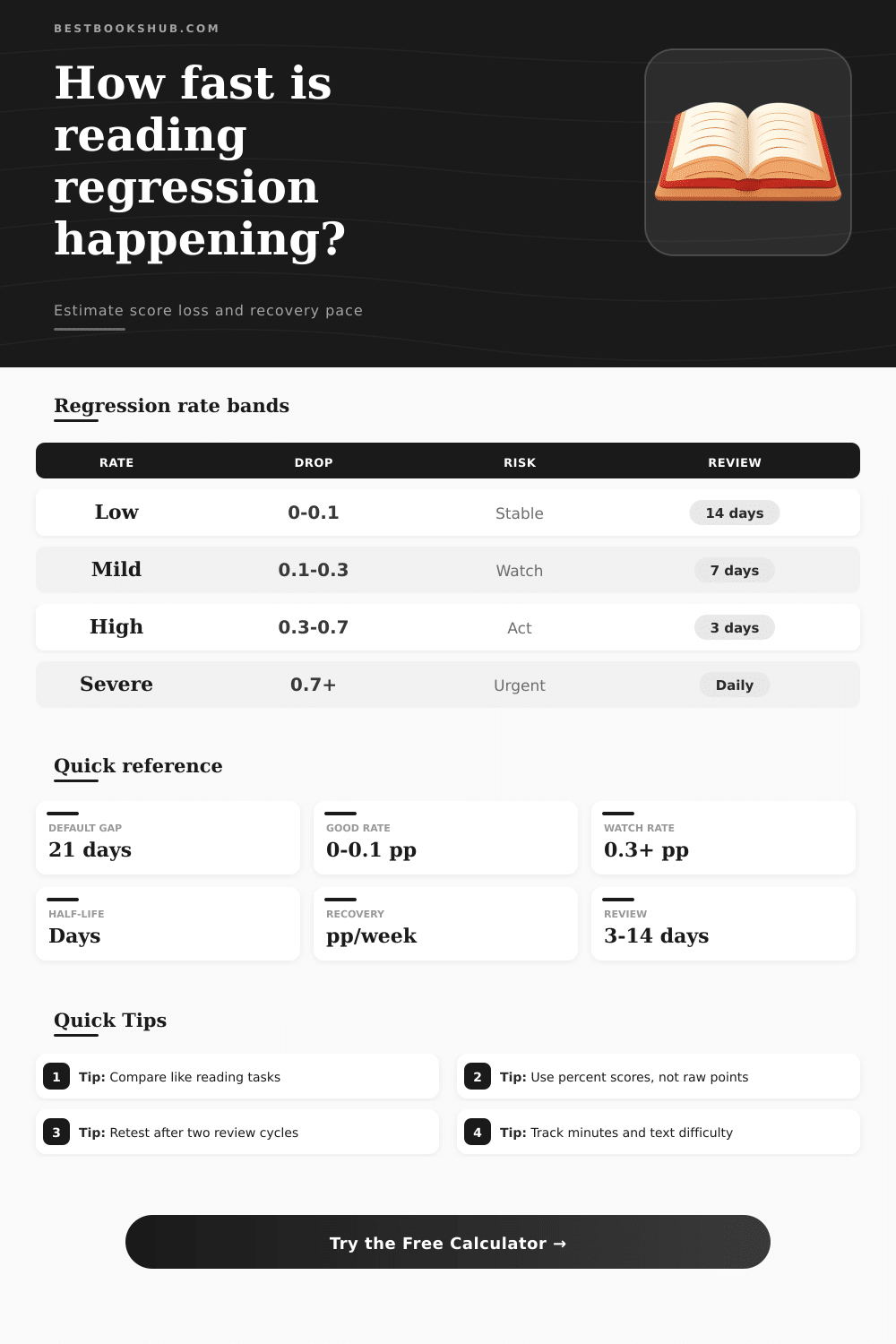
| Regression band | Points per day | Typical reading signal | Suggested review cadence |
|---|---|---|---|
| Stable retention | 0 to 0.10 | Score is holding; mistakes are mostly random. | Review every 10 to 14 days. |
| Light regression | 0.10 to 0.30 | Minor recall gaps, slower summary, or weaker detail memory. | Review weekly with quick retrieval checks. |
| Active regression | 0.30 to 0.70 | Comprehension, vocabulary, or fluency drops are visible. | Review every 2 to 3 days with short passages. |
| Sharp regression | 0.70 and above | Recent score is far below baseline or confidence is low. | Use daily recovery blocks and retest weekly. |
| Context | Best score type | Common gap pattern | Best recovery signal |
|---|---|---|---|
| Academic reading | Comprehension percent | Lost detail recall after a course pause. | Stronger explanation of claims and evidence. |
| Language learning | Vocabulary retention | Fast loss without spaced repetition. | More words recalled without prompts. |
| Children's fluency | Words per minute | Summer or holiday reading slowdown. | Better accuracy with familiar grade-level text. |
| Book club preparation | Summary rubric | Plot and character details fade first. | Cleaner chapter recap and quote placement. |
| Research reading | Annotation accuracy | Method and citation memory weakens. | Faster source mapping and note retrieval. |
| Scenario | Baseline to current | Gap length | Approximate rate |
|---|---|---|---|
| Short exam pause | 90% to 86% | 14 days | 0.29 points per day |
| Summer reading gap | 84% to 70% | 56 days | 0.25 points per day |
| Harder text switch | 88% to 76% | 21 days | 0.57 raw points per day |
| No review month | 92% to 72% | 30 days | 0.67 points per day |
| Steady light review | 85% to 82% | 28 days | 0.11 points per day |
DISCLOSURE: This post may contain affiliate links, meaning when you click the links and make a purchase, I receive a commission. As an Amazon Associate I earn from qualifying purchases.
After an extended break from study, you may find yourself forgetting much of what you read. You can recognize the words and even read them, yet they makes no sense to you. That’s not because you’re unlucky; it’s because something measurable has decayed as a result of disuse.
Perhaps you believe that brain is like a bank: once information enters, it remains there indefinitely. Not so. Memory functions similarly to a garden. Plants need tending or else they will wither. And the rate at which they will wither depend upon several factors. This also lets you know how quickly it will degrade.
How Your Memory Changes and How to Fix It
Most people estimate how much studying they should of do to catch up. They might plan for two weeks of review when they actualy need five, or vice versa. Then they study a week and say “I still have four more days!” The calculator takes the guesswork out of your recovery plan. It measures the loss of raw performance against reality.
All study gap aren’t created equal. Missing a week during finals is different then missing six months without touching a book. The tool factors in how far away from your baseline test you are.
How does this work? More than you think. Take the difficulty adjustment factor. Your test was easy at the outset. Now your reading material is difficult, you’ll score worse. Does that mean it’s regression? Not exactly. It means you’re now dealing with something harder. That isn’t necessarily a sign of regression; instead, it’s a mismatch between ability and expectation. Flag this disparity in the tool.
That’s how you distinguish genuine lost skill from struggling with more challenging material. That’s how you know what to do next: slower texts if it’s the former, or more reps if it’s the latter.
This decay will stop with retrieval practice; but when? Spaced repetition during review has been shown in research to improve long term retention. The reference table link regression bands to suggested review schedule. Reviewing once or twice a month should suffice if you’re losing only a little bit of knowledge each day.
If you notice a sharp decline, however, weekly reviews won’t cut it. Engage yourself every day. Engage yourself every day. When there’s a harsh band, it’s time for a reset. You’re re-building foundations, not simply brushing up.
In real life, those percentages depend on context. If you’re forgetting words while learning a new language, that’s a different situation from if you’ve forgotten how to read as a student. Spaced repetition helps protect vocabulary. Comprehension can erode if you stop engaging with narratives or arguments. By allowing you to choose what to assess, the tool fits such situations and bases the recovery estimate based off how that particular skill degrades with time.
A high regression rate isn’t cause for panic: this is data. It’s not destiny. Often when you see a big number it means your starting baseline was higher than normal or the test environment was more moddern. Treat the estimated recovery days as a goal. If the app says you need 20 days to recover your score, do one focus read a day for ten minutes then build on that. Consistency trumps intensity.
Remember, you’re trying to fight back against memory’s natural decline. You don’t want to go back in time. You want to know how fast it fades so you can create a regimen of care. Maintenance is part of knowledge. When you quantify what’s lost, your anxiety becomes a plan. Those words might sound odd at first, but with practice they’ll be familiar all over again. All you have to do is know how thirsty the garden is before you dig.