📝 Clause clarity scan
Relative Pronoun Counter
Paste prose, essays, book notes, or classroom passages to count who, whom, whose, which, that, where, and when while checking clause density and antecedent distance.
Load a preset to test narrative, review, academic, catalog, dialogue, instruction, and clause-heavy samples with realistic relative pronoun patterns.
DISCLOSURE: This post may contain affiliate links, meaning when you click the links and make a purchase, I receive a commission. As an Amazon Associate I earn from qualifying purchases.
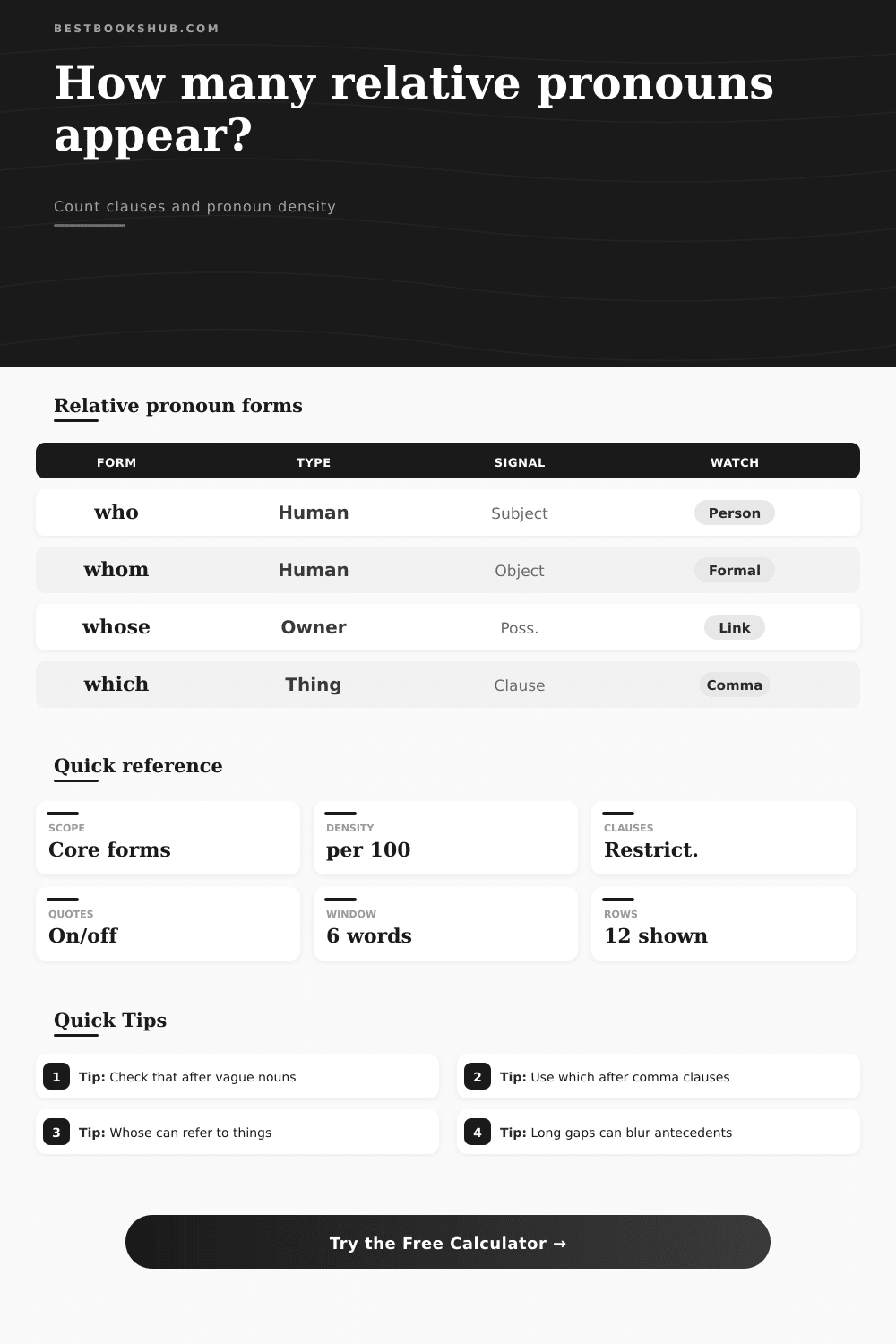
The calculator matches visible relative forms, estimates whether each connector begins a restrictive or nonrestrictive clause, and flags long antecedent gaps for review.
| # | Form | Clause type | Antecedent gap | Density | Context |
|---|---|---|---|---|---|
| Run the calculator to list relative clause contexts. | |||||
| Family | Forms counted | Selected hits | Typical antecedent | Editing watch |
|---|---|---|---|---|
| Relative form families appear after scanning. | ||||
| Pattern | Common forms | Signal | Example use | Review point |
|---|---|---|---|---|
| Restrictive relative | that, who, which | No comma before connector | Identifies the noun being discussed | Usually essential to meaning |
| Nonrestrictive relative | which, who, whose | Comma before connector | Adds extra information | Check comma pair and sentence flow |
| Possessive relative | whose | Ownership link | Connects person, group, or thing to a noun | Make the owner easy to find |
| Relative adverb | where, when | Place or time link | Attaches a clause to location or time | Use expanded scope to include it |
| That-clause ambiguity | that | Can be relative or content clause | Depends on the words around it | Review after verbs like said or thought |
| Band | Relative signals per 100 words | Likely texture | Useful for | Editing move |
|---|---|---|---|---|
| Sparse | 0 to 2.9 | Short independent sentences | Plain summaries and action scenes | Add links only when relation is unclear |
| Moderate | 3.0 to 5.9 | Balanced clause support | Most essays, reviews, and narrative prose | Check antecedent gaps, not every clause |
| Dense | 6.0 to 9.9 | Layered explanation | Academic and analytical paragraphs | Break stacked clauses into cleaner sentences |
| Heavy | 10.0 plus | Clause-heavy syntax | Technical notes or close analysis | Revise repeated that and distant references |
This calculator is a transparent grammar scanner. It estimates clause type from punctuation and nearby words, so final editorial judgment still matters for ambiguous that clauses.
Begin with a basic sentence: “The man entered the room.” Simple and to-the-point.
Add some context: “The man, who was wearing a red coat, entered the room.” Voila! A relative clause is a single small grammatical maneuver that alters the pulse of the sentences. You’re not merely telling facts; you’re knitting together relationships among ideas.
How to Fix Your Relative Clauses
Here’s where most authors go off-track. They string together so many clauses that the subject get lost in a mess of that, which, and who?
Once you’ve pasted in your text, the calculator crunches the numbers. From there, it protects you from guessing whether your sentence structure has spun out of control.
The glue holding together complex sentences are relative pronouns. By linking descriptions straight onto the noun they enable you to fit more info into fewer words. But like all glues, too much makes it gunk.
The key here is knowing what it is you’re measuring. You are not just measuring word count but tracking the distance between the pronoun and its antecedent. Is there a wide enough gap for the reader to stumble? Do they lose track of who or what it is you’re referring to? In that case, checking clause density is more important then word count.
Nonrestrictive and restrictive clauses is different. Even seasoned editors stumble over this one.
A nonrestrictive clause contains commas around who or which to provide additional information. A restrictive clause contain who or that without the commas to identify something in particular. Without the commas, it’s impossible to eliminate the clause from the sentence without destroying it.
Restrictive and nonrestrictive clauses are ambiguous if mixed. For example: “The red car.” Does that mean you own just one car? No comma implies it. With the comma: “The car, which is red,” suggests you own multiple cars, but this one is the red one. The reference table on page explains this nicely. It shows how punctuation shows intent.
Why on earth would you want to do this by hand? Because we has to write that way (it’s a common habit among writers). They think what they’re writing is clear when all along they’re burying the main idea beneath a pile of subordinate clauses.
Too many relative pronouns make for heavy prose. Each new clause forces your brain to stop and draw a new relationship. You do not want that to happen, especially with technical or academic writing. That genre has to be densely explanatory, but clarity reigns supreme. You want to inform, not confuse.
Scan for certain types of connections. Isolating them will allow you to see where you are relying too heavily on one kind of connection. (Using too many that or which clauses in a row makes for a repetitive, choppy piece of writing.) Vary your structure and keep the reader engaged.
Check for long gaps between nouns and their antecedents: when a noun is more than six words away from its previous mention, the link are weak. That’s a lot of scrolling for the reader to do in their mind to get back to the anchor. It’s a small thing, but it matters when it comes to readability.
Compare catalog copy to a novel page. Catalog copy is meant to be scannable and efficient. Novels include relative clauses that add mood and depth of characters. If you look at the options in the calculator, they’re showing you what normal density would be for different types of writing. That’s a benchmark.
Don’t think: I want no relative pronouns. Think: How much do I need (or want) for my purposes? If too little, the writing will feel blunt and staccato. If too much, it’ll sound like a legal contract.
Grammar, at its heart, is all about controlling attention. You’re leading the reader’s eye across your ideas. Relative pronouns are like turns in the road. Too many turns within a limited space, and the driver goes dizzy. Can’t make out the signs? Then they’re lost.
That’s where the counter comes in. It draws out a map of where the road becomes winding and where the landmarks become too far apart from each other.
So now you’ve got a choice: should I just make it simpler? Should I insert a comma? Should I start a fresh sentence?
Following good writing isn’t about mindless rule-following. It’s about knowing when to tighten things up for clarity and when to bend them for effect.
The man in the red coat came into the room. We know who he is. What’s he doing here? Where’s he going? And what’s he wearing?