🔍 Editorial repeat scanner
Repeated word detector
Paste a draft to catch adjacent double words, near repeats inside a chosen word window, repeated phrases, case and punctuation echoes, severity flags, and rewrite queue items.
Load a realistic editing sample, then change the window, phrase length, and normalization settings to see how the detector behaves.
DISCLOSURE: This post may contain affiliate links, meaning when you click the links and make a purchase, I receive a commission. As an Amazon Associate I earn from qualifying purchases.
This is not a frequency counter. It looks for local editing problems: immediate repeats, repeated words close together, recurring phrases, and repeated sentence-level echoes.
The strongest repeat signal will appear here after a scan.
The four cards below mirror the detector pipeline: token preparation, adjacent scan, near-window scan, and phrase echo scan.
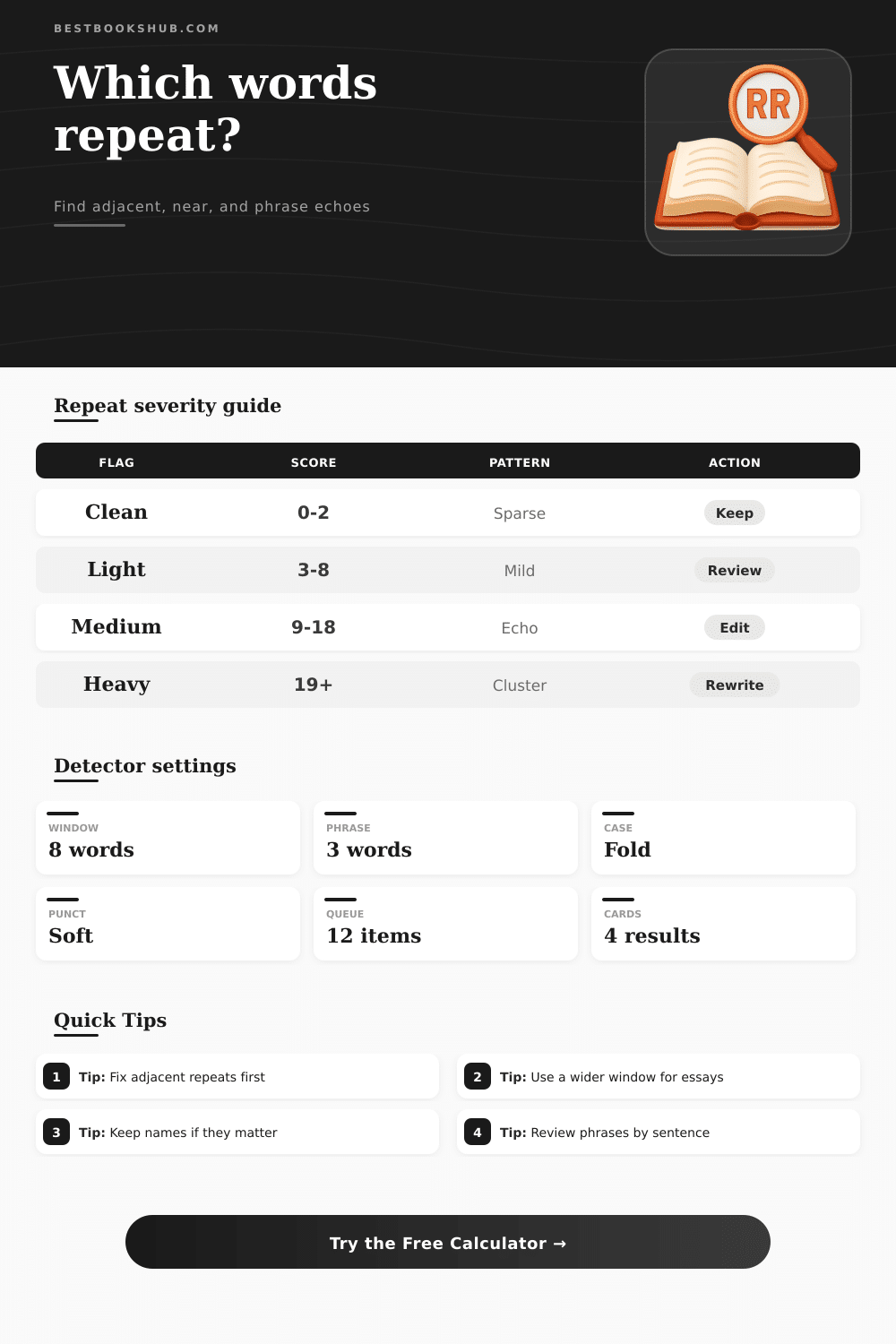
Use this grid to interpret which kind of repeat matters most before editing. Adjacent repeats are usually errors, while phrase echoes depend on intent and proximity.
These tables update after every scan. Context snippets are shortened so you can quickly find the sentence that needs attention.
| # | Word | Type | Gap | Position | Context |
|---|---|---|---|---|---|
| No adjacent repeat scan yet. | |||||
| # | Word | Gap | Sentence | Severity | Context |
|---|---|---|---|---|---|
| No near-repeat scan yet. | |||||
| # | Repeated phrase | Hits | First gap | Flag | Best action |
|---|---|---|---|---|---|
| No phrase-repeat scan yet. | |||||
| Rank | Queue item | Why it matters | Suggested edit | Score |
|---|---|---|---|---|
| No rewrite queue yet. | ||||
These reference tables explain the default scoring rules, normalization choices, and window sizes used by the detector.
| Severity band | Score range | Typical pattern | Editing action |
|---|---|---|---|
| Clean | 0-2 | No meaningful local repeat pattern | Keep scanning after larger edits |
| Light | 3-8 | One or two soft echoes | Review only if the passage feels flat |
| Medium | 9-18 | Several close echoes or phrase repeats | Rewrite the repeated sentence cluster |
| Heavy | 19+ | Adjacent errors, dense local echoes, or repeated phrase loops | Fix queue items before line editing |
| Window size | Best for | Repeat sensitivity | When to use |
|---|---|---|---|
| 2-4 words | Proofreading | Very local | Find typo-like doubles and stutters |
| 5-8 words | General prose | Balanced | Catch common sentence-level echoes |
| 9-16 words | Essays and reviews | Broad | Find topic-word overuse inside sentences |
| 17-40 words | Long paragraphs | Very broad | Audit repeated framing and transitions |
| Normalization mode | What it changes | Strength | Tradeoff |
|---|---|---|---|
| Fold case | Book and book match | Reliable for editing | May merge names with common words |
| Soft punctuation | Trims edge marks and normalizes quotes | Good default | Keeps some word shape |
| Strip all marks | Removes punctuation from tokens | Most aggressive | Can merge styled compounds |
| Keep token marks | Preserves punctuation inside tokens | Most literal | Can miss editorial echoes |
Repeated words show up in writing more than peoples tend to realize. Repeated words often show up without the writer’s knowledge. A writer may finish writing a paragraph that utilize repeated words without realizing the sentence structure and the ideas in the paragraph is correct, but the paragraph has a slow rhythm because of the repeated words.
Repeated words can show up in much types of writing. For example, a writer writing a novel might use repeated words to describe the same setting in the story. A writer writing dialog for a movie might use repeated words to create natural speech.
Find and Fix Repeated Words
A writer writing an essay might use repeated words to show a point that is being made in the essay multiple time. While repetition of words is not always a mistake in writing, repetition of words without purpose can become a problem for the writer. You must decide which types of repetition in your writing you consider to be useful and which types of repetition are mistake.
For example, if you place the same noun twice in a row, you have created an immediate double word. An immediate double word should almost always be fixed. If a word appear again a few sentences later, that is a near repeat.
A near repeat might be acceptable depending on the subject matter of the sentence that contain the repeated word. If a phrase of three or four words appear more than once, that is a phrase echo. A phrase echo can be used to create a certain mood in the writing or it can be a mistake.
The context in which the writing was performed can help to determine if a repeated word are a problem or not. For example, if the three-word phrase is used in a short scene in a movie, its use twice in that scene will likely be a problem. However, if the same phrase appear in an essay several paragraphs later, its use is likely not a problem for the reader.
The setting in which the writing was performed and the length of the sentences can impact how readers may notice repeated words. Thus, there is no one rule that can be applied to all types of writing. The calculator will find repeated words after you enter your text into the calculator.
The calculator can separate immediate double words from near repeats. Additionally, the calculator will find recurring phrases in your text that appear a minimum number of times. The calculator will also provide severity bands for your writing that highlight which type of word repetition you should fix first.
A heavy flag will show if you have many instance of repeated words in your text. A light flag will show that your text is mostly clean from repeated words. Within the tool, there are different settings that determine the type of editing choices you would like to make to your writing.
For example, the window size determine how far apart two instances of a word have to be for them to be considered a near repeat. A narrow window size will help you spot accidental stutters in your writing. A wider window size will help you spot words that are being overuse in a paragraph.
The case and punctuation settings allow you to decide whether proper names should be considered separate words from the text. Finally, the stopword filter will help you to ignore function words in your writing so that only content words is counted. These different editing settings are important for different types of writing.
For example, dialogue will require a smaller window size to account for the repetitions of words that are common in dialogue. However, academic writing may require a larger window size so that the same terms are used throughout the writing. Thus, the tool does not make editing decisions for the writer, but the tool can help the writer to recognize repeated words so that the writer can make editing decisions for the writing.
There are several ways to use the results of the calculator. For example, you should scan your writing for instances of adjacent repeats. All adjacent repeats should be fixed.
Additionally, you can review the list of near repeats. You should fix each of these near repeats by changing one of the repeated words to a synonym. Finally, the list of phrase echoes can be reviewed to determine whether each of these phrases is used to provide a certain mood to the writing or whether they are simply used to fill the space created by a thought that cannot otherwise be expressed in the writing.
Following these steps will create a rewrite queue that can help to edit your writing according to the recommendation of the calculator. The reference table located on the page provides default settings for the calculator. You can change these default settings to accommodate the specifics of your writing.
For example, if you change the size of the window or the length of the phrases that are to be reviewed, the calculator will recognize these changes and will find different phrases to be repeated. Thus, the tool can be customized for your specific writing project. The more that you use the calculator to find repeated words in your writing, the better that you will be able to recognize repeated words.
Eventually, you will be able to hear a repeated word in your writing before the calculator will find that repeated word. Thus, the calculator will become a training aid for your ear so that you can recognize mistakes in your writing that you would otherwise miss during your first reading of your text. Using the calculator will catch mistake in your writing that you make, and you will become skilled at catching those mistakes during your future reading of your writing.