📚 Book memory planner
Reread time calculator
Estimate a second pass through a familiar book with first-read speed, reread speed multiplier, skim depth, annotation density, favorite chapters, session limits, and memory-refresh goals.
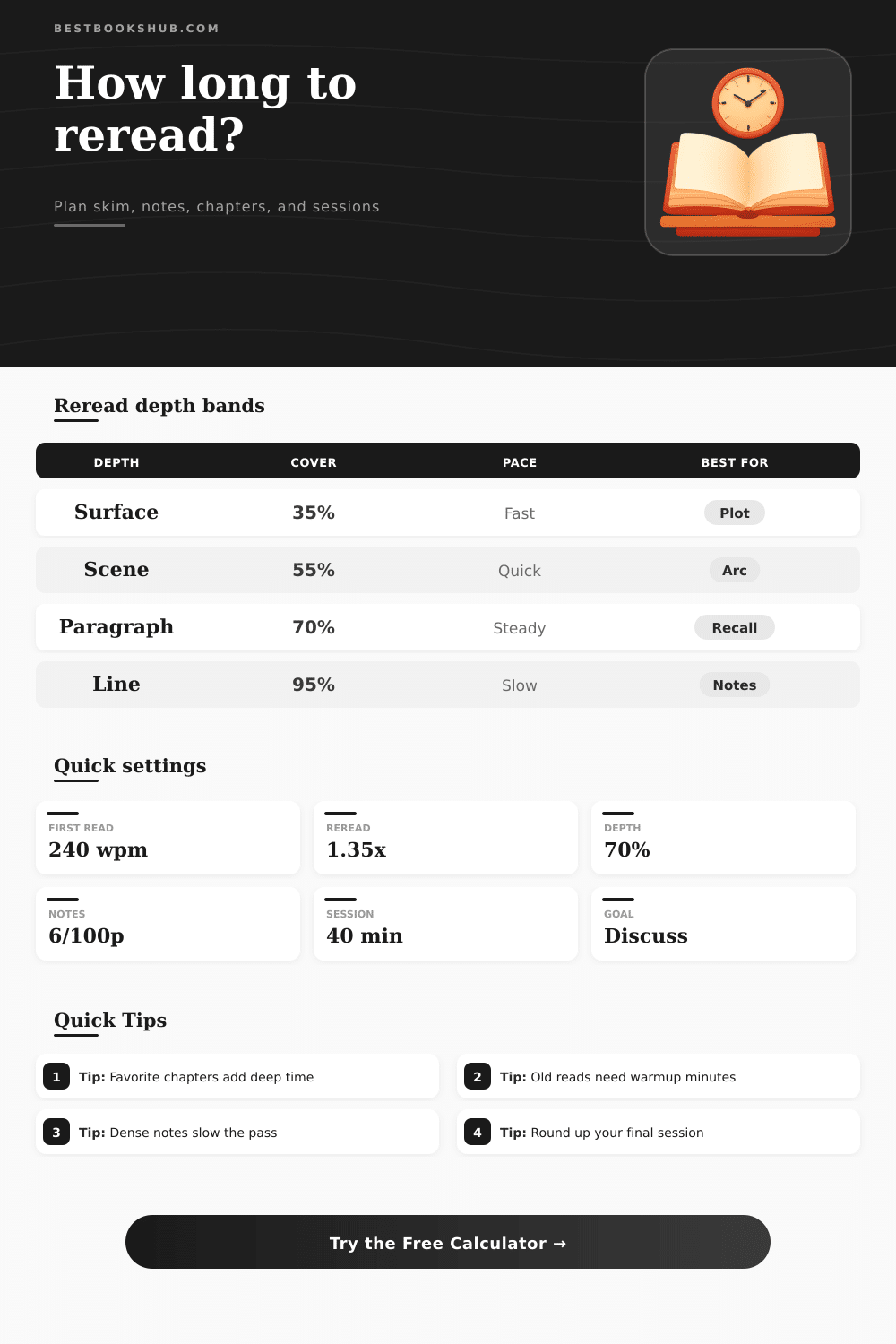
| Depth mode | Coverage | Speed effect | Use when |
|---|---|---|---|
| Surface plot sweep | 35% of pages | About 1.45x faster | You only need plot landmarks and ending context. |
| Scene and chapter sweep | 55% of pages | About 1.22x faster | You want major scenes, character moves, and chapter flow. |
| Paragraph-level refresh | 70% of pages | Near normal reread pace | You want dependable recall without line-level attention. |
| Near-full reread | 88% of pages | About 0.90x speed | You skip small stretches but still reread most scenes. |
| Line-by-line reread | 100% of pages | About 0.72x speed | You are studying style, quotes, structure, or argument. |
| Notes per 100 pages | Planning label | Time adjustment | Typical reread behavior |
|---|---|---|---|
| 0 to 2 | Clean pass | Minimal drag | Mostly uninterrupted reading, with rare flags. |
| 3 to 8 | Light margins | Small drag | Short reactions, a few underlined scenes, simple bookmarks. |
| 9 to 16 | Study margins | Moderate drag | Theme notes, quote capture, chapter summaries, cross-references. |
| 17 to 30 | Heavy margins | High drag | Frequent stopping, comparing passages, extracting key language. |
| 31 or more | Research pass | Very high drag | Note-first reread where the book becomes a working document. |
| Goal | Time multiplier | Recall target | Best output |
|---|---|---|---|
| Gist tune-up | 0.86x | 70% | Series recap, plot orientation, fast continuation. |
| Plot and character refresh | 1.00x | 78% | Reliable scene memory and character motivation. |
| Book club discussion | 1.14x | 84% | Examples, turning points, and opinion-ready notes. |
| Quote and theme retrieval | 1.26x | 88% | Marked passages, theme threads, line-level evidence. |
| Teach or write from reread | 1.40x | 92% | Structured notes, citations, scene map, argument memory. |
| Session length | Best fit | Warmup advice | Risk to watch |
|---|---|---|---|
| 15 to 25 minutes | Poetry, short chapters, commute reads | Use 2 to 4 minutes | Too many restarts can erode flow. |
| 30 to 45 minutes | Most fiction and discussion rereads | Use 3 to 6 minutes | Chapter endings may spill over. |
| 50 to 75 minutes | Dense nonfiction or academic chapters | Use 5 to 8 minutes | Annotation fatigue can slow the last third. |
| 90 minutes or more | Focused weekend reread blocks | Use 6 to 10 minutes | Plan a break for notes and memory checks. |
A selective reread can still take real time if a few favorite chapters get slow, close attention. Keep them in the plan instead of assuming every selected page is skimmed.
DISCLOSURE: This post may contain affiliate links, meaning when you click the links and make a purchase, I receive a commission. As an Amazon Associate I earn from qualifying purchases.
A series recap can be quick, but a book club or teaching pass needs slower pages, annotation drag, and a larger buffer for recalling names, themes, and evidence.
Here’s the rereader’s conundrum: You pick up a book published three years ago, and you don’t know where the hell it went. You recall broad strokes of the story, maybe a single great sentence, or shape of ending, but that middle part are foggy. Why does this occur? Memory decays, and it is most destructive when we try to recover things about in-between stuff.
So you must understand your own goal: Are you seeking thematic richness, or do you want more plot markers? That question will change how much time you need to spend on the book.
Why Rereading Takes Different Amounts of Time
Time Rereading People tend to underestimate how long it takes to reread stuff, thinking familiarity = fast. Sure, familiarity makes a lot of thing go faster, at least up to a point. Whether or not you remember what’s coming next, some passages is just packed with words, slowing you down. You’ll move quickly through familiar dialogue. You may breeze through a comfort read at 1.5x normal speed. You might find yourself moving slowly at that same pace with an annotated academic book on the second read, or even slower then the first.
The calculator frees you from having to do conversion coefficients and other guesswork yourself: you simply input your reading preferences for speed and book length, and let the calculator do the math. It also forces you to identify where the fiction occur; those pesky chapters you’re not going to skip, the heavy notes, etc., the friction points that gobble up your time.
How deeply do you want to revisit? A surface sweep (about thirty-five percent of the text) will remind you who did what but not necessarily why, which is fine if you’re catching up in anticipation of a sequel. If you are prepping for a book club discussion, you might need paragraph-level refresh covering about seventy percent of the pages. However, you’re going to pay big-time for that last thirty-five percent. You can’t skim over character motivation because it require your full attention instead of mere recognition.
The chart on the page illustrate how breadth versus recall accuracy corresponds to speed: more coverage, less speed. If you highlighted every third sentence during your first read, then annotations is yet another silent time thief. Highlighting isn’t really rereading the book. It’s rereading yourself thinking about the book. Every highlight take a stop-and-think moment to understand the passage and your prior thought, and more highlights = more drag. To account for this, the tool calculates how many minutes it will take overall based on the number of notes per hundred pages. This is a small detail that makes a big difference when you are planning your week ahead.
You might imagine breezing through a highlighted classic in an hour, but it’s mentally heavy work to integrate your old thoughts against fresh eyes. It depends what you’re doing. Writing or teaching from the text require almost your full attention; a quick check of series continuity is easy peasy. But if you’re teaching, then you want structure memory and quote retrieval, pushing that pace towards a slow crawl through each line.
There’s also a time factor on memory warmup: If you start a session cold, plan to spend five minutes reorienting yourself to the narrative world. This friction is included in the calculator’s session estimate; ignore it at your own peril. You’ll always need a few minutes to remind yourself where you left off.
It changes everything when your favorite chapter(s) is involved, since each of us has scenes we’ll read over again just because we love them so much. Even if you skim through most of the book, they requires careful reading, and the tool recognizes this, treating them as the slower pages they are (since emotional investment slows processing speed). Prose deserves our lingering attention when it matters to us, and rereading is inherently selective: that’s not a bug, it’s a feature. Knowing ahead of time where to plan for the slow dives avoids the frustration of a slipping estimated finish date.
But really, reading again is a conversation between you and yourself. You decide which bits you want to remember and which you are okay letting fade away. It is up to you. The numbers shows the cost so you can decide whether you want to pay. If you’re on the hunt for a theme, or even just following a plot point, knowing the price before going in means it won’t feel like a chore as you go along. It’ll be fun to remember what you read. It’s you getting back in the story. It is on your terms.