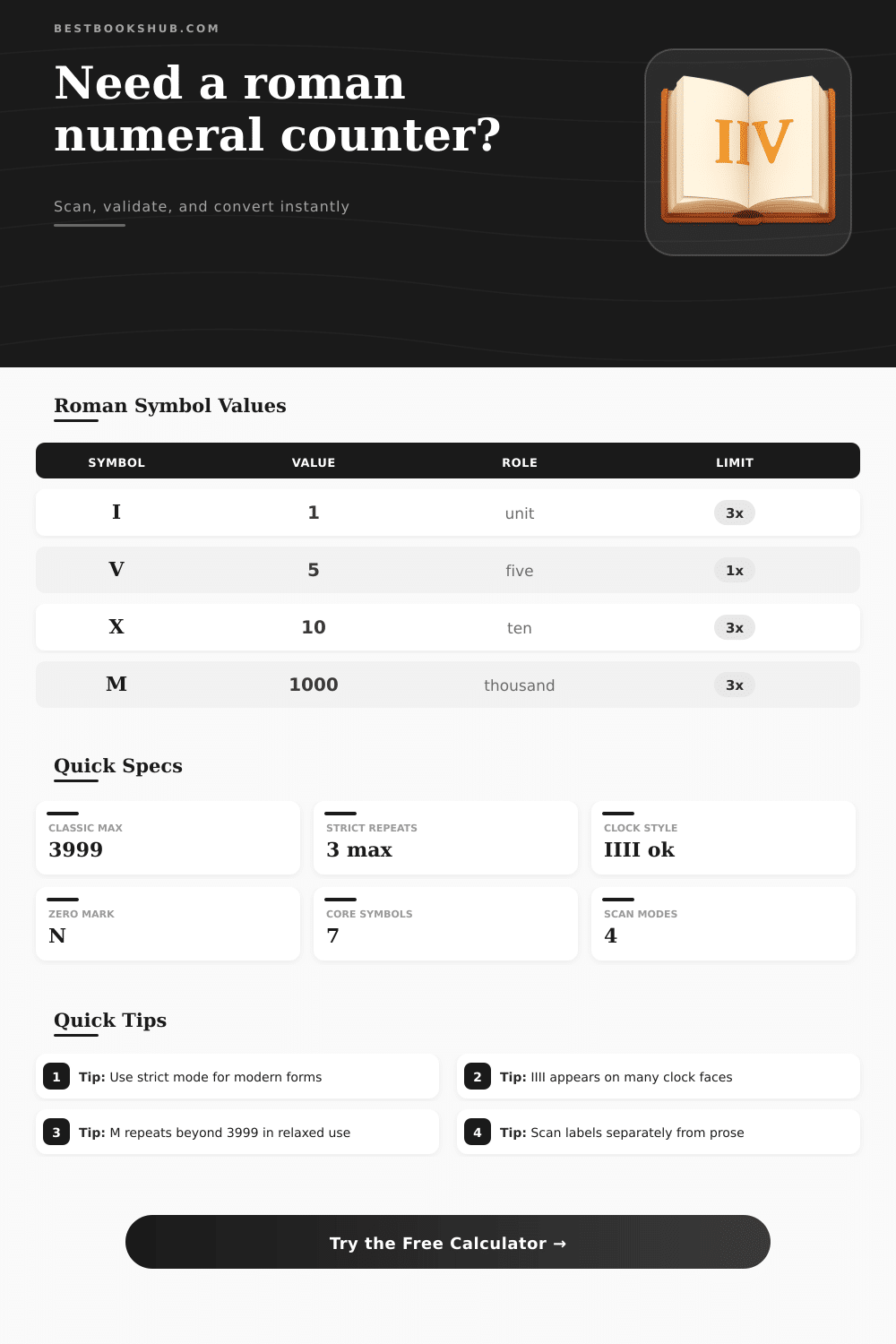
Roman Numeral Counter and Checker
Scan pasted text, validate Roman numerals, convert Arabic numbers, and count every I, V, X, L, C, D, and M with a transparent breakdown.
Standalone tokens are easiest to audit. Use the scan scope control for labels like Chapter IV or Part III.
Full Breakdown
| Symbol | Arabic Value | Repeat Rule | Can Subtract From |
|---|---|---|---|
| I | 1 | Up to III in strict notation | V and X |
| V | 5 | Not repeated in strict notation | Not used subtractively |
| X | 10 | Up to XXX in strict notation | L and C |
| L | 50 | Not repeated in strict notation | Not used subtractively |
| C | 100 | Up to CCC in strict notation | D and M |
| D | 500 | Not repeated in strict notation | Not used subtractively |
| M | 1000 | Up to MMM under 3999 cap | Not used subtractively |
| Standard | Accepts | Rejects | Best For |
|---|---|---|---|
| Strict modern subtractive | IV, IX, XL, XC, CD, CM | IIII, IC, VX, repeated V | Book chapters, dates, catalog labels |
| Clock-face friendly | Strict forms plus IIII | IC, VX, repeated L or D | Clock faces and decorative dials |
| Additive manuscript style | VIIII, LXXXX, DCCCC | Wrong symbol order jumps | Older inscriptions and manuscripts |
| Permissive symbol counter | Any I V X L C D M cluster | Only non-Roman characters | Fast counting before cleanup |
| Arabic | Strict Roman | Additive Variant | Typical Use |
|---|---|---|---|
| 4 | IV | IIII | Chapters or clock numerals |
| 9 | IX | VIIII | Chapter IX, page front matter |
| 40 | XL | XXXX | Volume or event numbering |
| 90 | XC | LXXXX | Catalog and appendix ranges |
| 400 | CD | CCCC | Inscription checks |
| 900 | CM | DCCCC | Copyright dates |
| 2026 | MMXXVI | MMXXVI | Modern year notation |
| Scope | Finds | May Skip | Use When |
|---|---|---|---|
| Standalone Roman tokens | IV, IX, MCMXCIX | ChapterIV without space | Clean manuscripts and pasted lists |
| Book labels and tokens | Chapter IV, Part III | Embedded catalog codes | Book outlines and front matter |
| Line starts and headings | I. Introduction | Inline references later in text | Outlines, contents pages, headings |
| Every Roman-looking cluster | Clusters inside mixed labels | Nothing Roman-looking | Messy OCR or first-pass cleanup |
DISCLOSURE: This post may contain affiliate links, meaning when you click the links and make a purchase, I receive a commission. As an Amazon Associate I earn from qualifying purchases.
The reason Roman numerals seem to stand the test of time: They appears on royal regiments, movie credits, and clock faces. But as a writer, they can be confusing. Sure, we all intuitively grasp that IX = 9 and IV=4 but applying them is another story.
Different sources has different rules for combining Roman numerals. That’s why you need a dedicated counter. By entering in your text, it will validate according to contemporary or historical standards making sure your chapter number look good. It does all this work for you while you decide if your document follows a style.
Why Roman Numerals Are Confusing
The thing that normaly causes confusion is what we call the subtractive principle. In strict moddern notation, if you want to show a smaller amount subtracted from a larger amount, you put the smaller amount first, for example: This means using IV for four or XC for ninety. But there is a limit to this. You can’t just subtract any number from any other. For example, IC isn’t ninety nine; it’s XCIX. This is because you cannot simply subtract any number from any other. Because otherwise how would your calculator know which was which?
That’s why it offers you a choice of validation standards. On selecting strict mode, it will flag up numerals that don’t strictly follow the rules, such as repeated five-values or just a single V (XV). It does this because these are typical human errors, people attempting to impose their own logic on the system without actualy being aware of the true rules.
And why would that matter? Well, imagine submitting a manuscript to an academic journal or publisher only to find out they don’t accept manuscripts with inconsistent use of numerals.
But there’s even more to consider here: historical perspective. In ancient Rome, there was no fixed way to write numbers so we see many different versions depending on the period. For example, at times they would write VIIII where we’d expect IV (additive notation). That’s fine, it’s simply a variant form. The app provides for this with an optional additive manuscript style setting. Why? Well, if you’re trying to recreate the look of classic texts or copy them down yourself, this comes into play. Otherwise you’ll be needlessly correcting things that were actualy historically correct but flagged by a stern check-and-correct program.
There’s also a quirk in clocks that has been part of clocks for ages: many clock use IIII instead of IV. For the most part this is about aesthetics, as it balances out the other end of the clock face with the number VIII. There is a special clock-face friendly mode on the calculator which will allow for this departure from normal rules without throwing up an error. It’s one of those moments where looks meet purpose. Is IIII an error or is it considered decoration? That makes all the difference in the world when you’re tackling a project based off clocks (or maybe old-school graphics).
Eventually, classical Roman numerals runs out of steam at 3999 (represented as MMMCMXCIX). To represent higher values, you need to either put a bar above the symbols or put them in parentheses to show thousands. However, the software can be set to allow for longer ranges and this is where you’d change that setting (e.g. If your catalog number runs beyond 3999 or if you’re working with dates past 3999). This applies if your catalog number runs beyond 9999 or if you’re working with dates past 3999. In other words, it will keep your system from saying no to perfectly legitimate information just because it doesn’t conform to the standard form.
You should of used this tool earlier. Roman numerals are in the end a language inside another language, one subject to its own set of conventions which change depending on the situation. If you’re writing your thesis, creating a clock face, wondering how the heck Super Bowl LVIII got to be like that, knowing the rules will help you avoid errors. And the calculator lays out exactly what symbols is used where, and how many tokens they consume; now you have the proof required for an educated choice. Instead of feeling vaguely right (or wrong), you’ll know for sure. You’ll produce something neat and regular and in tune with past traditions as well as current standards.