📚 Lexical diversity lab
Root Type-Token Ratio Calculator
Measure vocabulary diversity with Root TTR: unique word types divided by the square root of total word tokens, with transparent token rules and benchmark context.
Choose a realistic writing sample to see how Root TTR changes with genre, compression, repetition, and token filtering rules.
DISCLOSURE: This post may contain affiliate links, meaning when you click the links and make a purchase, I receive a commission. As an Amazon Associate I earn from qualifying purchases.
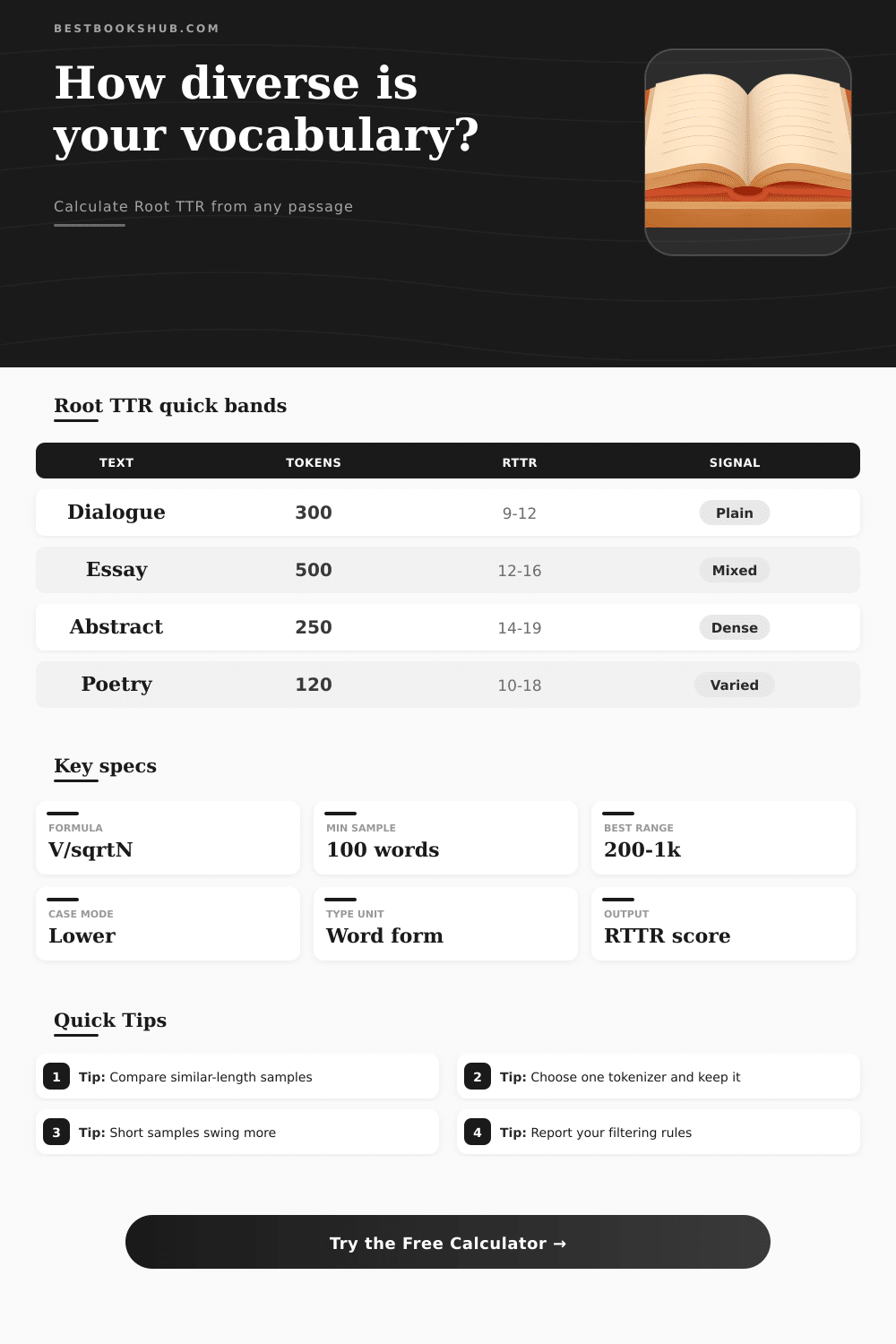
Root TTR formula: unique types ÷ square root of total tokens. Use the same settings when comparing passages.
| Root TTR band | Approximate signal | Where it often appears | What to check next |
|---|---|---|---|
| Under 8 | Highly repeated vocabulary | Very short notes, drills, repeated dialogue, controlled readers | Check whether a tiny token count is depressing the score. |
| 8 to 12 | Plain or tightly focused wording | Dialogue scenes, summaries, early readers, instructional prose | Look for repeated names, pronouns, and common verbs. |
| 12 to 16 | Moderate lexical variety | General essays, book reviews, narrative chapters, blog prose | Compare against a similar-length sample before judging style. |
| 16 to 20 | Dense or varied vocabulary | Academic abstracts, critical reviews, lyrical passages | Confirm that rare words are not numbers, citations, or names. |
| 20+ | Very high type concentration | Short technical abstracts, poetry fragments, terminology lists | Review tokenization because short samples can spike sharply. |
| Metric | Formula or method | Length sensitivity | Good use case |
|---|---|---|---|
| Plain TTR | Types ÷ tokens | Strongly drops as samples grow | Quick comparison of equal-length passages. |
| Root TTR | Types ÷ √tokens | Less harsh than plain TTR, still length-aware | Fast readability-adjacent diversity checks. |
| Corrected TTR | Types ÷ √(2 × tokens) | Similar direction, slightly lower scale | Reports that need a normalized variant. |
| Herdan's C | log(types) ÷ log(tokens) | Designed for broader sample comparison | Longer corpus summaries and research notes. |
| MATTR | Average moving-window TTR | Depends on chosen window size | Comparing uneven texts with local diversity. |
| Setting | What it changes | Root TTR effect | Best for |
|---|---|---|---|
| Lowercase normalization | Treats Book and book as the same type | Usually lowers type count slightly | Most prose comparisons. |
| Preserve case | Counts capitalization variants separately | Can raise type count in headings and notes | Editing capitalization consistency. |
| Join hyphenated words | Keeps well-worn as one token | May increase rare compound types | Literary prose and style studies. |
| Remove stopwords | Drops common function words | Often raises apparent lexical density | Content-word vocabulary checks. |
| Mask numbers | Turns all numeric forms into NUM | Prevents dates from inflating types | Technical, historical, or data-heavy text. |
| Sample type | Recommended tokens | Typical Root TTR pattern | Comparison caution |
|---|---|---|---|
| Picture book page | 80 to 250 | Can look low because repetition is intentional | Compare pages from the same reading level. |
| Dialogue scene | 300 to 800 | Pronouns and speech tags often pull RTTR down | Separate narration if you want style-specific results. |
| Academic abstract | 150 to 350 | Terminology creates a high unique-type share | Watch citation fragments and abbreviations. |
| Book review | 400 to 1,200 | Moderate to high if summary and critique mix | Named entities can inflate the type count. |
| Technical manual | 500 to 1,500 | Repeated commands can lower diversity | Mask numbers when model names or versions repeat. |
With the Root TTR calculator you can apply word variety to drafts, reviews, excerpts and abstracts. Document the formula used. Compare benchmarks. Adjust token rules.
When you first look at some text to guess how much variety its words have, your judgment usually isn’t helped by plain instinct. A kid’s picture book might sound simple enough but still surprise you with thoughtful choice of word. An academic abstract might seem dense but actualy recycle just five specialist term. That’s where the root type-token ratio comes in. It capture the tension between freshness and repetition. It is number of unique word forms divided by square root of the total words processed. The math is ancient, but insight is useful.
What Is Root TTR and How to Use It
It also softens the drop-off you see in ordinary type-token ratio. Once a piece of writing are lengthy enough for repetition, plain TTR crumples: all those words will have been used before. But Root TTR recognize that a longer sample will by its nature be more repetitive; it allow you to compare a 650-word essay with a 180-word poem without the length screaming out. It lets style do that job instead. And that’s important: whether you’re judging someone else’s words, or your own.
Before you can calculate anything, though, you have to make some decisions about tokens. Do you count each instance of “the” separately? Are “The” and “the” the same type or not? Is a word like “well-worn” one idea or two? How do you handle numbers? Throw them away? Convert them to placeholders? Leave them alone? Each of these decisions will affect what score says to you.
Lowercase all your text so proper nouns don’t artificially inflate variety. Strip out common function words to highlight content vocabulary, but you will lose the naturally rhythm of each piece. These are decisions that need interpretation, and the score can be no more honest then the set of rules you announce along with it.
It’s not talent that’s shaping those numbers; it’s genre. In general, the more dialogue we have, the worse it will be. Dialogue often relies too much on contractions and pronouns and uses too many verbal tag. The tighter our written style, the better we’re likely to do because each word will earn its keep, whether in poetry or plain prose. Using more academic jargon might help an academic piece get a higher score. However, if we remove citations and all those repeated methodological verbs, it may sound narrow.
The calculator crunches digits and you get to decide if they align with what you aim to achieve from your readers. Don’t fall into the trap of thinking that one score means one thing, whether high or low. It could be just that this particular bit of text is doing its job. Repetition happens in picture books for good reason. Technical instructions are written to keep you from getting lost by repeating key word. Extremely short passages can lead to a high score where the denominator (the square root) is tiny, and adding one new word can send the number shooting way up.
Users of any site learn to match apples with apples: same genre, similar length, similar filtering parameters. Beyond the formula, however, is context, tone and cultural resonance. Just because a children’s story has a low score for lexical diversity doesn’t mean it won’t dazzle with imagery and sound. And a corporate report with great variety can feel colder and more distant than another which repeats some reassuring phrase. Your ear will not be replaced by the metric; it simply shows one of its many dimension.
But the root type-token ratio shines as a mirror. Run the same passage through it with varying token rules, and observe the change in the reflection. Tweak a paragraph. Recalibrate. Ask if what you did moved the needle in the right direction. Good writing isn’t something this tool dictates; it won’t allow you to fool yourself into thinking you use many different words. And that clarity is more valuable than any individual number you’ll recieve on-screen.