📊 Rubric Score Calculator
Enter your rubric criteria, weights, and scores to instantly compute weighted totals, letter grades, and percentage scores.
| # | Criterion Name | Weight (%) | Max Points | Score Earned | Remove |
|---|
| Percentage | Letter Grade | GPA Equivalent | Performance Level |
|---|---|---|---|
| 97–100% | A+ | 4.0 | Exceptional |
| 93–96% | A | 4.0 | Excellent |
| 90–92% | A– | 3.7 | Excellent |
| 87–89% | B+ | 3.3 | Above Average |
| 83–86% | B | 3.0 | Above Average |
| 80–82% | B– | 2.7 | Above Average |
| 77–79% | C+ | 2.3 | Average |
| 73–76% | C | 2.0 | Average |
| 70–72% | C– | 1.7 | Average |
| 67–69% | D+ | 1.3 | Below Average |
| 60–66% | D | 1.0 | Below Average |
| Below 60% | F | 0.0 | Failing |
| 4-Point Score | Percentage | 10-Point Equiv. | Letter Grade |
|---|---|---|---|
| 4.0 | 100% | 10 | A |
| 3.5 | 87.5% | 8.75 | B+ |
| 3.0 | 75% | 7.5 | C |
| 2.5 | 62.5% | 6.25 | D |
| 2.0 | 50% | 5.0 | F |
| 1.5 | 37.5% | 3.75 | F |
| 1.0 | 25% | 2.5 | F |
| Assignment Type | Typical Criteria | Criteria Count | Typical Max Points |
|---|---|---|---|
| Essay | Thesis, Evidence, Analysis, Mechanics | 4 | 20–100 |
| Presentation | Content, Delivery, Visuals, Time | 4 | 40 |
| Science Project | Hypothesis, Methods, Data, Conclusion | 4–6 | 40–60 |
| Group Work | Collaboration, Contribution, Quality | 3–5 | 30–50 |
| Creative Writing | Creativity, Voice, Structure, Grammar | 4 | 20–40 |
| Lab Report | Procedure, Data, Analysis, Safety | 4–6 | 30–60 |
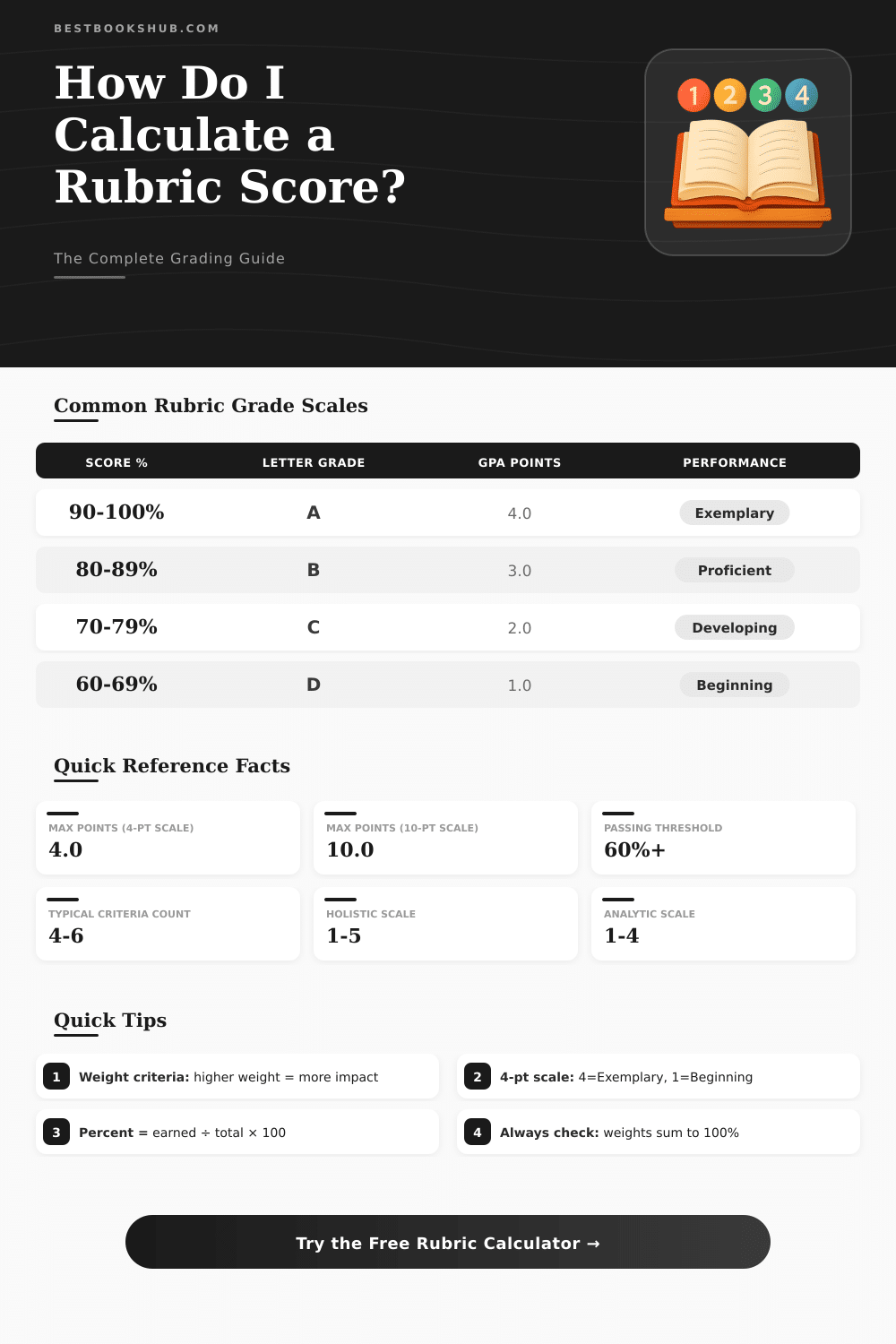
In a weighted rubric, each criterion has a different importance (weight %). For example, "Content" may count for 40% while "Grammar" counts for 10%. Always verify your weights sum to exactly 100% before grading.
To find a criterion’s percentage: divide the earned score by the max points, then multiply by 100. The weighted contribution = criterion percentage × weight %. Sum all weighted contributions for the final score.
A rubric is a teaching tool used to estimate the learning of students. It bases on eval criteria and levels to communicate clear expectations Moreover, it acts as a helpful strategy for advisers. In education, a rubric is a guide used to measure the quality of student answers.
DISCLOSURE: This post may contain affiliate links, meaning when you click the links and make a purchase, I receive a commission. As an Amazon Associate I earn from qualifying purchases.
Such a rubric helps to fairly grade works, as short answers, essays or reports.
What a Rubric Is and How It Helps
Usually designed as a grid, grading rubrics include criteria, levels of impact, points and descriptions, that become unique tools for every task. A rubric is useful for students and teachers equally, because its goal is transparancy in the grading. Students use it while they work, so they know what is expected and what each part values.
The levels of impact can be general, using labels as “Very Bad” to “Excellent“, or changed for a particular situation, for instance “Harmful” to “Very Efficient”. One common mode is to limit the categories to four: Unacceptable, Unsatisfactory, Satisfactory and Good/Excellent. Rubrics help teachers estimate student work more objectively and steadily.
There are various types of rubrics. A holistic rubric allows the grader to give only one score, usually on a scale of 1 to 4 or 1 to 6, based on general judgment of the work. Because holistic categories do not give descriptive feedback, research suggests that they are less steadily used.
They work for rush the grading of small tasks, that require only general answers. Analytical categories share the task in several criteria and describe different levels for each. Pupils receive separate points for every criterion, that are later combined in a total amount.
The raw score is counted as the sum of all criteria grades. A numeric value is given to every level, and the grader chooses the level that the work reached. From a mathematical viewpoint, the points in a rubric can be represented as weighted amounts.
Even so, simple mathematical ways to convert rubric points are often not efficient for individual tasks.
Some setups use values as 100, 70 and 50 when the rubric is more than 3. For instance, 70 or 75 represent the minimum for mastery, while higher points go beyond that. That makes it easy for students to pass, but creates a challenge for winning an A or B. Another good method is to create sample products together as a class, using the rubric as a guide.
Students can even grade each other using rubrics, writing numbers instead of names and reviewing the points later. Rubrics give a more standard and objective way to estimate impact, because they share the rating in discrete parts andlevels.