💬 Dialogue attribution audit
Said-bookism counter
Paste a scene or chapter excerpt to count dialogue attribution alternatives to said and asked, then compare intensity categories per 1,000 dialogue words.
Use these tables as interpretation aids for scene-level samples. Whole novels usually need lower density than a single heated exchange.
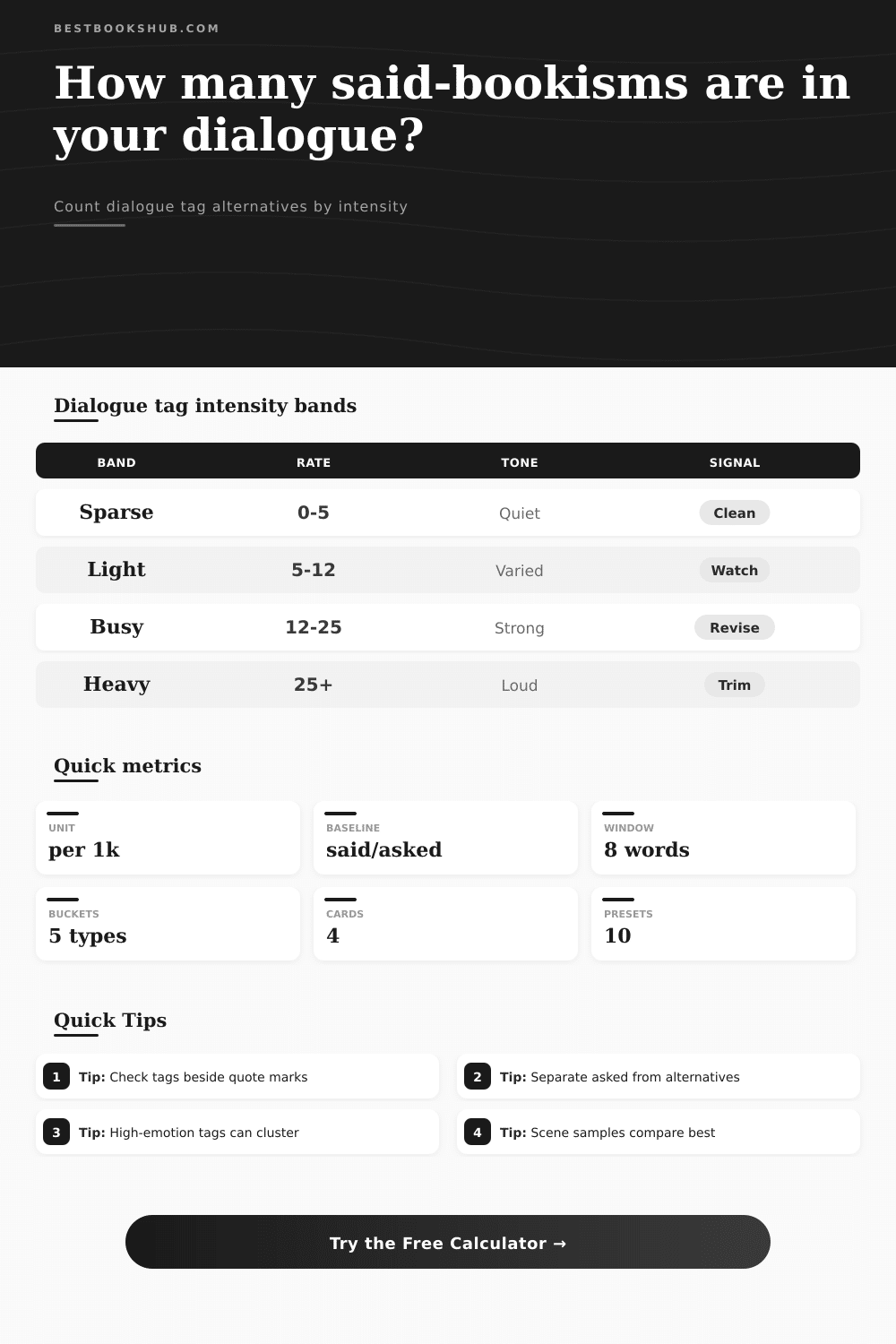
| Rate band | Per 1,000 dialogue words | Typical signal | Revision focus |
|---|---|---|---|
| Sparse | 0 to 5 | Mostly said/asked or action beats | Check clarity only |
| Light | 5 to 12 | Some variation in delivery | Watch repeated favorites |
| Busy | 12 to 25 | Attribution verbs shape tone | Trim clusters around one exchange |
| Heavy | 25 plus | Tags may compete with speech | Review loud, emotional, and action-like tags |
| Category | Examples counted | Intensity | Context clue |
|---|---|---|---|
| Baseline | said, asked | Plain | Separated when baseline control is active |
| Neutral alternate | replied, answered, added, noted | Low | Often functional but more visible than said |
| Soft delivery | whispered, murmured, breathed | Medium | Often tied to secrecy, quiet, or closeness |
| Loud delivery | shouted, yelled, barked, roared | High | Often marks volume or conflict |
| Emotional delivery | snapped, pleaded, demanded, confessed | High | Often tells attitude directly |
| Action-like tag | smiled, shrugged, laughed, frowned | Flagged | May work better as an action beat |
| Sample type | Useful excerpt length | Best scope | What to compare |
|---|---|---|---|
| Single scene | 800 to 2,500 words | Quote context | Tag clusters inside one exchange |
| Chapter pass | 3,000 to 6,000 words | Dialogue lines | Scene-to-scene rhythm changes |
| Revision sample | 1,000 to 4,000 words | Whole excerpt | Repeated favorite verbs |
| Script-like text | 2 to 10 pages | Dialogue lines | Action-like tags near speech |
| High-frequency word | Why it stands out | Nearby check | Possible action |
|---|---|---|---|
| snapped | Strong attitude cue | Look for repeated conflict beats | Keep only the sharpest moments |
| whispered | Strong volume cue | Check whether setting already implies quiet | Replace repeats with stage context |
| laughed | Action and delivery blur | Check if the quoted words can be laughed | Split into action beat when needed |
| replied | Common neutral alternate | Check back-and-forth exchanges | Use only where response logic matters |
DISCLOSURE: This post may contain affiliate links, meaning when you click the links and make a purchase, I receive a commission. As an Amazon Associate I earn from qualifying purchases.
What’s the giveaway? How do you know when someone is writing a weak dialogue scene? It’s in their attributions.
Synonyms for said is used as a matter of course, to give some flavor to a sentence. But these synonyms typicaly add more noise than anything else. You may encounter words like hissed, whispered, or gasped. We call them said-bookisms.
How to Write Better Dialogue
Now sometimes it isn’t the word that are wrong. Sometimes it’s how many times you repeat it. Every time you use a tag for a line of dialogue, it becomes something the reader no longer hears. Instead, they read script directions.
This is what the calculator on the page fixes. You type your stuff in there and then it counts just how much credit you’re giving. No guessing required.
This section covers clean dialogue. As a starting point: Most editors suggest that said and asked is invisible to the reader. Asked? The same. Said and asked let the content of the speech stand out. Replace said with murmured or replied, and it’s no longer about the content, it’s about the way someone said something.
That’s what the tool does. It puts the baseline tags (said, asked) on one side, then provides options on the other. So you can see how much you rely on those tags for description. And it calculates that as a percentage: How many times do they appear in every one-thousand dialog words?
Why is this important? A single scene may use stronger tags than an entire chapter. The raw number doesn’t mean anything unless you account for the length.
For example, maybe youve got a whole page of snaps. That sounds like a lot. But maybe there are two thousand words of dialogue on that page. That is not bad at all. Now, maybe there’s just two-hundred words of dialogue on that page. This is a problem.
In addition, they’ve found that it’s not just about what words is used but the intensity of the tag. Some alternate tags are stronger then others. Whispered indicates volume. That’s a redundancy if context already implies secrecy. Shouted indicates some form of conflict. If you use shouted for everything that turns into a shouting match, the real fight in the story are lessened.
They break down the tags into bands. They range from low-energy, neutral tags (e.g., noted, added), through mid-level (e.g., asked, remarked), up to high intensity ones (e.g., demanded, barked). And the tool flags those tags that read like actions rather than speech (e.g., laughed, smiled). Such tags tend to muddy the distinction between acting and talking.
You see people use smiled as a dialogue tag all the time. Smiling isn’t a way to deliver a line. It’s an action, and using it as a dialogue tag weaken the writing. Often separating it out into a beat will improve the scene.
There’s also a bit more with context windows. Here, you can set how far before and after a quote the tool looks to find the attribution verb. Tight and it grabs the old-fashioned He said thing. Wider, and it’ll pick up some of those less strict examples where there is a gap between the attribution and the quotation itself. That gives you a broader view of your rhythmic story-telling.
There are certain go-to words individual writers has. Maybe you’ve got muttered or snapped on almost every other page, and you don’t even notice it. Notice it now? Half of the problem is solved.
The second half means believing that the dialogue will speak for itself. If someone’s angry, let them come off as angry when they talk. Let their words convey it; no tag necessary.
A quick reference table is available on the page. If it’s sparse, that means you’re writing clean dialogue. It uses subtext or action. If it’s heavy, you’re explaining too much. That can slow the pace. Also, it’s telling the reader what to feel.
You don’t want to get rid of options altogether. Use them carefully when they add emphasis. Save the occasional whisper or demand for high-impact scenes so that those few words packs more punch. Otherwise let said carry the load. It is an oldie but a goodie.
Why does it work? Because it doesn’t get in the way. Good dialogue sounds like real speech. Not like you’re being given directions. Auditing your tags lets the reader hear the character. Not you, the author.