📖 Poetry scansion tool
Scansion syllable calculator
Paste poem lines to estimate syllables, mark likely unstressed and stressed beats, group feet, check meter fit, and review elision or feminine-ending adjustments.
| Line | Text | Syllables | Stress marks | Feet | Meter note |
|---|---|---|---|---|---|
| Add poem lines to calculate scansion. | |||||
| Meter | Pattern | Expected syllables | Usual line feel |
|---|---|---|---|
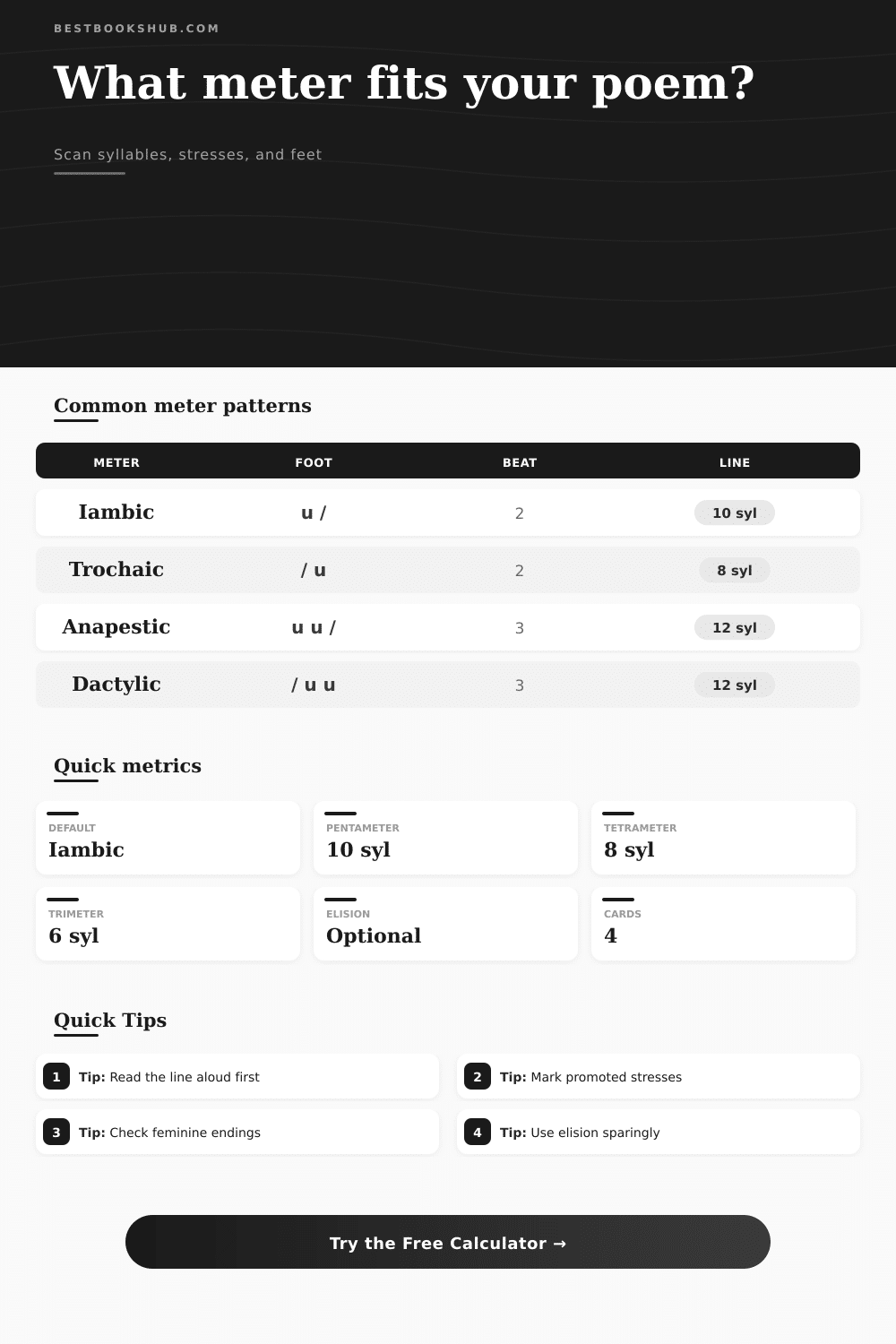
| Iambic pentameter | u / u / u / u / u / | 10 | Balanced blank verse or sonnet line |
| Iambic tetrameter | u / u / u / u / | 8 | Shorter rising line with steady motion |
| Trochaic tetrameter | / u / u / u / u | 8 | Strong initial beat and falling cadence |
| Anapestic tetrameter | u u / u u / u u / u u / | 12 | Rolling comic, narrative, or song measure |
| Dactylic tetrameter | / u u / u u / u u / u u | 12 | Forward-driving classical-style cadence |
| Common meter | 8 / 6 / 8 / 6 | Alternating | Ballad and hymn stanza movement |
| Adjustment | Example | Effect | When to use |
|---|---|---|---|
| Marked elision | o'er, ne'er, heav'n | Often reduces one beat | When the poet prints an apostrophe |
| Synaloepha | the evening | May blend adjacent vowels | When two words flow into one sound |
| Final -ed | blessed, loved | Can be one or two syllables | When archaic or solemn diction appears |
| Feminine ending | ending unstressed extra | Adds one trailing syllable | When the line otherwise fits the meter |
| Promotion | opening noun or verb | Raises a weak beat | When emphasis overrides strict alternation |
| Foot length | Best for | Example mark | Calculator behavior |
|---|---|---|---|
| 2 syllables | Iambs and trochees | u / | u / | Breaks line into paired beats |
| 3 syllables | Anapests and dactyls | u u / | u u / | Breaks line into triplet beats |
| Target foot | Preset meter checking | Uses selected meter | Chooses 2 or 3 from the target |
| No breaks | Free verse review | continuous marks | Shows one ungrouped stress string |
DISCLOSURE: This post may contain affiliate links, meaning when you click the links and make a purchase, I receive a commission. As an Amazon Associate I earn from qualifying purchases.
The only way to really hear how a poem sounds is to read it out loud. You can look at it all day long until eyes start crossing over on themselves, but music is not in what you see. The music lives in air between your teeth.
Scanning is the map you draw so that you don’t forget that music. It turns the line’s vague feeling into real marks, marks that shows you where to breathe and where to place the stress. Poets, most of them, learn to scan instinctively, tapping their fingers and marking the margin with carets and slashes. Yet sometimes, especially when editing your own work, or puzzling through why one line doesn’t seem quite right, seeing how the line break down visually will help. It reveals verse’s hidden structure.
How to Scan Your Poem
Here’s where the hard work comes into play… Counting out syllables and guessing at pattern of stressed/unstressed syllables. (That would be the ‘meter’.) It’s not that you get a grade from this. There’s no pass/fail. There’s always an element of oddness that’s on purpose in poetry. A perfectly regular pattern can become monotonous, like hearing a ticking clock or metronome running away behind every line. Typically what we’re going for is a solid rhythm with some variation so that ear doesn’t get lost. That’s the baseline the calculator provides. You then have a standard to judge when you stray from it.
The first true choice comes when selecting a meter preset. In English literature, many poems use iambic pentameter, which is designed to reflect the rise and fall of spoken language. It’s like walking. Some begin with a powerful beat, such as trochaic meter, which resembles a chant or drum. Others move forward with momentum, rolling anapests forward, or marching with a heavy, driving step, the dactyls. Understanding what kind of foot you are reading changes the experience of that line. You may think a line is iambic, but if it actualy scans as trochaic, that tension might work against you. The tool’s grid makes patterns clear by sight, showing how they differ.
Most people who begin using this stumble on Elision. To get their line into specific meter, poets has been squishing together words for hundreds of years. Over turns into oer. Heaven goes to heaven. You can enable/disable that in the calculator. If you set elision to classic, it assumes the vowels are smoothed together. Often you’ll find that this results in fewer syllables and therefore a longer line fitting in a shorter meter. But watch yourself here. You shouldn’t force shortening sounds when the speaker wouldn’t normally pause. If two syllable convey intended meaning, don’t squash ’em together or it will distort intent. The tool will highlight where any adjustments occur. It will also show how many syllables was adjusted.
And then there’s feminine endings. These are lines that end with an additional unstressed syllable, such as a continuation or a question. That softens the ending of the line; makes it a little less abrupt. If you allow for that additional beat, the calculator will recognize this as a characteristic, not a mistake. And if you disable that allowance and find that your meter score plummets considerably, that may mean your poem depends on that added breath for its rhythm. Where does it want to take a breath?
The most subjective element is the stress marking. It can vary from strict alternation to natural speech emphasis, using different styles available from the calculator. For moddern poetry, natural speech tends to be closer to correct. We don’t speak in perfect robot rhythms. We glide over prepositions and articles and emphasise verbs, nouns and other key words. That’s how the tool determines it, by position and word class. But ultimately you’re the judge. If something is marked unstressed but you think it should of been stressed, then change the way you write it or live with an irregularity.
Keep in mind: The meter match score isn’t a grade; it’s a guide. If you get a high score, it shows that your lines roughly follow target pattern. A low score shows more variation. This doesn’t mean one is necessarily better than the other. What are you trying to accomplish? More consistency may be expected in a sonnet. Variation may work well in a ballad. Use the breakdown table to identify exactly which lines is contributing to the mismatch. One bad line can ruin an entire stanza’s average. Raise the score by fixing just that one outlier, and it can smooth out the reading experience.
Scansion is ultimately a diagnostic device. It can help you identify what your ear may have missed. It flags where stresses collide and rhythm drags. But does it still sound good when you speak it out loud? The marks are just a way to get there. Use the calculator to locate the problems; use your voice to solve them. Read the line again. Let your ear hear the beat. If it works, the math doesn’t matter.