📝 Voice analysis
Second person pronoun counter
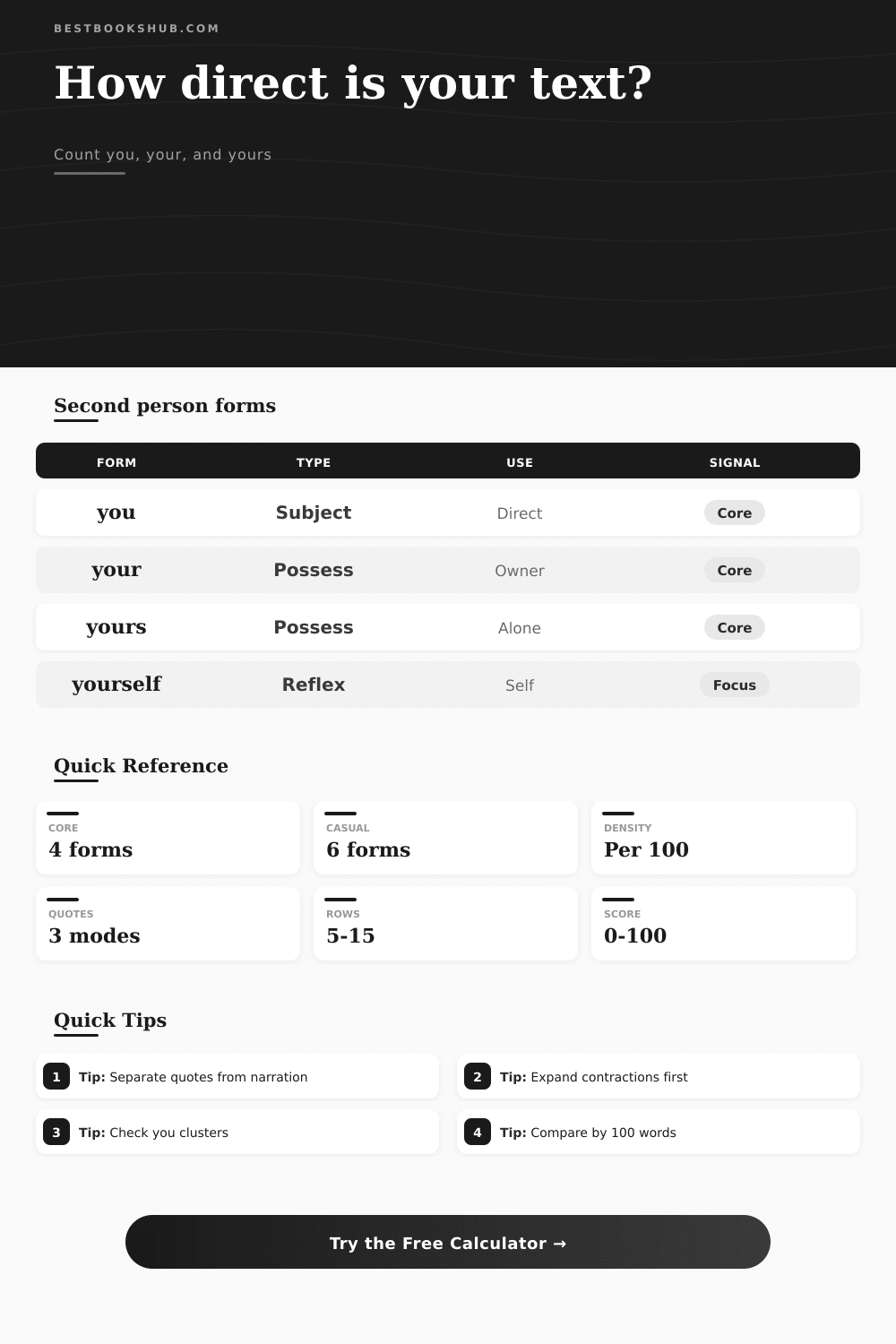
Measure how often a passage addresses the reader with you, your, yours, yourself, yourselves, and common direct-address variants.
| Form family | Included forms | Counting note | Typical signal |
|---|---|---|---|
| Subject and object | you | Same spelling covers subject and object positions | Direct address |
| Possessive determiner | your | Counts ownership or reader-specific framing | Personal relevance |
| Possessive pronoun | yours | Counts standalone possession without a following noun | Ownership emphasis |
| Reflexive | yourself, yourselves | Counts singular and plural self-reference forms | Action returned to reader |
| Density band | Hits per 100 words | Direct-address score | Common interpretation |
|---|---|---|---|
| Minimal | 0 to 2 | 0 to 20 | Detached, report-like, or third-person centered |
| Balanced | 3 to 7 | 21 to 45 | Reader-aware without sounding crowded |
| Directive | 8 to 14 | 46 to 70 | Useful for tutorials, prompts, and guided copy |
| Heavy | 15+ | 71 to 100 | Dialogue, coaching, or strongly direct prose |
| Scan setting | Best when | What changes | Watch point |
|---|---|---|---|
| Count quoted text | You want the full passage voice | Dialogue and narration combine | Dialogue may dominate the score |
| Ignore quoted text | You want narration or article copy only | Quoted spans are removed before matching | Nested quotes are treated simply |
| Quoted text only | You are checking dialogue or transcripts | Only quoted spans feed the counter | Unquoted speech labels are excluded |
| Casual variants | You scan chat, posts, or dialogue | Forms like ya and yall can count | Casual spellings may be context-specific |
DISCLOSURE: This post may contain affiliate links, meaning when you click the links and make a purchase, I receive a commission. As an Amazon Associate I earn from qualifying purchases.
But second-person pronouns is like pointing fingers. They are like invisible hands that reach out to you, the reader, and make you feel immediately invited or obligated. When you see lots of “you” and “your,” you read something like a conversation. When those words dissapears, text seems to step back and become an impersonal report. It’s not a huge distinction, but it determines whether people lean in or check out.
And that’s why knowing how it works has less to do with the rules than it does with the psychology: Who’s got the power? Now, most writers assumes a sort of neutral middle ground, but the safest space tends to be invisible. So how do you know where to land? That depends on document’s context.
How to Use You and Your in Writing
In a user manual, for instance, you’re aiming to keep that guiding hand steady and in view: The reader has to sense you’re addressing them, otherwise they won’t know what to do next. But when you writes a more formal policy document, the equivalent direct address might read as presumptuous and even aggressive. Why? It seems to suggest an intimacy between writer and reader that simply doesn’t exist in this context.
The key is to understand exactly what we’re measuring. Are we counting words, or are we really trying to count instances of connection? Once you’ve pasted your text into the calculator above, it will handle the math. The guesswork is removed from estimation of tone.
That’s where it gets complex: when you examine actual forms. While the subject form (“you”) create direct command or observation, the possessive form (“your”) shows relevance and ownership. The reflexive form (“yourself”) adds self-reflection to the mix making a criticism more intense (or softening an instruction). It’s a balance that typically indicates naturaly speech.
A clump of possessives could signal salesy or accusatory intent; the page’s reference table classifies these family, helping you identify whether your directness sounds like unwanted pressure or helpful guidance. It enables you to not only audit volume but also flavor of your address.
It’s a higher score in a dialogue scene in fiction, after all: a feature and not a bug! It is jarring in a piece of writing that is dry, technical, and abstract. However, the tool allows you to tune out quoted text. This makes a huge difference when working with interview-heavy pieces or transcriptions of speeches.
The score will spike if you include dialog because people are talking to each other. But if you exclude it, you get the narrative voice beneath. This allows you to avoid judging a piece of work by how well written it is and instead judge whether it have compelling characters. It forces you to consider who is saying what.
Watch how you string together the beats in a sentence. Using “you” multiple times within one or two sentences creates a choppy, nagging rhythm that readers will subconsciously reject. It will feel like a teacher tapping a pointer against a board. Spreading out the references give the reader time to absorb the information instead of feeling interrogated.
There’s nothing wrong with using only imperative verbs for directness; even removing the pronoun preserves the clarity of the command. The idea is to let the reader know they’ve been noticed while never making them feel like they’re being watched.
You should of considered this earlier. Ultimately, writing is about negotiating distance. It is the distance between you and the person you’re trying to persuade, close enough to be persuasive yet far enough to still seem credible. Second-person pronouns collapses that distance, and an intimate tone can make things feel too invasive.
Too little and you risk creating a barrier where people think what you say doesn’t apply to them. So the trick is to look at this data not as a score or grade, but as a map of how closely you’re talking to your readers. Adjust to match.
Tinker with settings for your genre. Get familiar with the bands on the density chart. Know that the most powerful kind of address tends to feel less like a shove then a nudge.
In other words: the more you forget about the invisible hand, the better it does its job, and the reader will be left with the impression that they decided the route all on their own.