🎓 Semester GPA Calculator
Enter your courses, credit hours, and grades to calculate your semester GPA instantly
| Course Name | Credit Hours | Letter Grade | Grade Points |
|---|
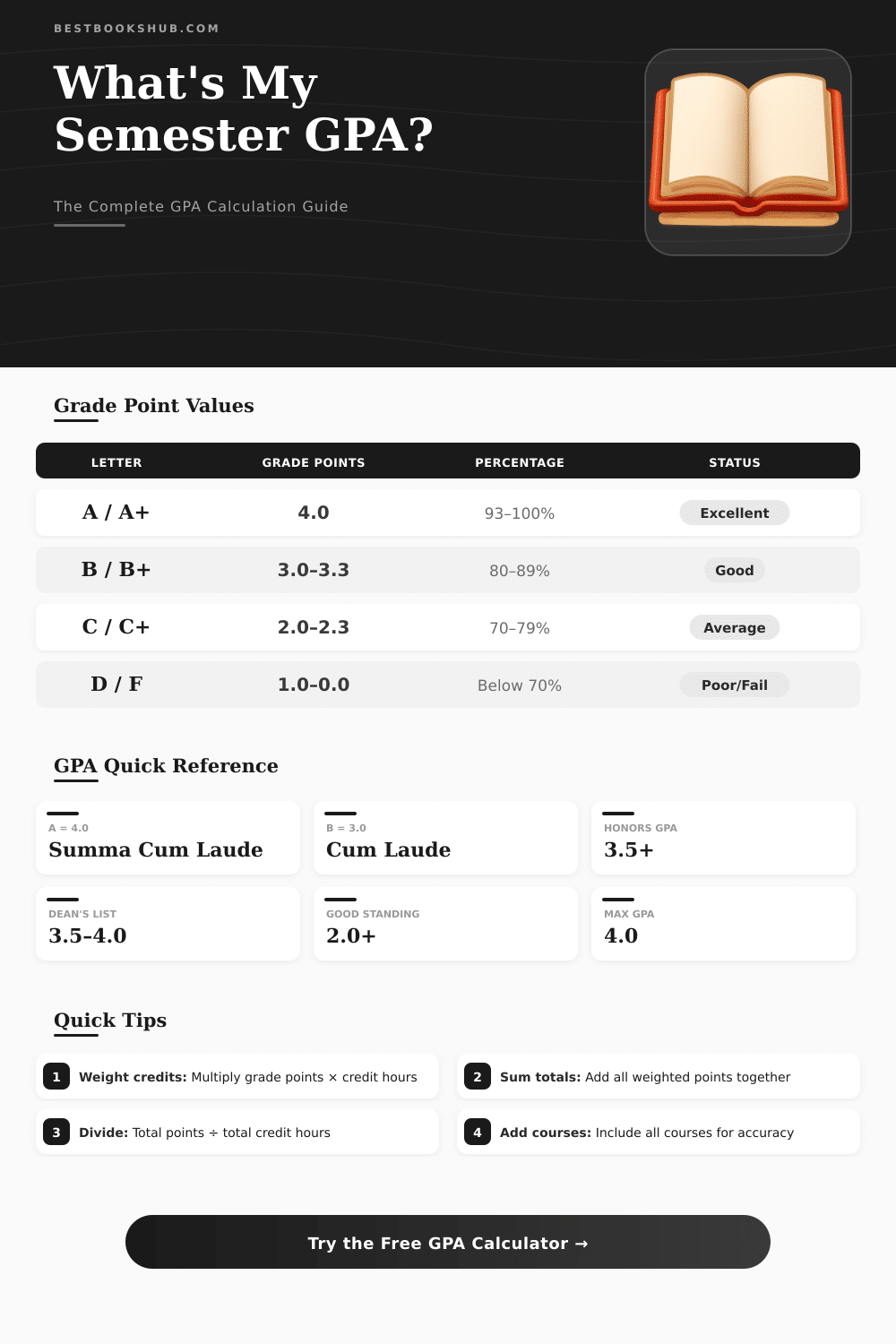
| Letter Grade | 4.0 Scale | 4.3 Scale | Percentage Range | Academic Standing |
|---|---|---|---|---|
| A+ | 4.0 | 4.3 | 97–100% | Exceptional |
| A | 4.0 | 4.0 | 93–96% | Excellent |
| A– | 3.7 | 3.7 | 90–92% | Excellent |
| B+ | 3.3 | 3.3 | 87–89% | Very Good |
| B | 3.0 | 3.0 | 83–86% | Good |
| B– | 2.7 | 2.7 | 80–82% | Good |
| C+ | 2.3 | 2.3 | 77–79% | Average |
| C | 2.0 | 2.0 | 73–76% | Average |
| C– | 1.7 | 1.7 | 70–72% | Below Average |
| D+ | 1.3 | 1.3 | 67–69% | Poor |
| D | 1.0 | 1.0 | 63–66% | Poor |
| D– | 0.7 | 0.7 | 60–62% | Very Poor |
| F | 0.0 | 0.0 | Below 60% | Failing |
| GPA Range | Academic Standing | Honor/Status | Notes |
|---|---|---|---|
| 3.9 – 4.0 | Outstanding | Summa Cum Laude | Top academic honor at graduation |
| 3.7 – 3.89 | Excellent | Magna Cum Laude | Second highest graduation honor |
| 3.5 – 3.69 | Very Good | Cum Laude / Dean's List | Common Dean's List threshold |
| 3.0 – 3.49 | Good | Good Standing | Meets most grad school minimums |
| 2.5 – 2.99 | Satisfactory | Good Standing | Acceptable for most programs |
| 2.0 – 2.49 | Average | Minimum Standing | Required for most scholarships |
| Below 2.0 | Poor | Academic Probation | May require academic improvement plan |
| Course Type | Typical Credit Hours | Hours/Week (Class) | Study Hours/Week |
|---|---|---|---|
| Standard Lecture | 3 credits | 3 hours | 6–9 hours |
| Lab Course | 1–2 credits | 2–4 hours | 2–4 hours |
| Seminar / Discussion | 1–3 credits | 1–3 hours | 2–6 hours |
| Studio / Art Course | 3 credits | 6 hours | 3–6 hours |
| PE / Wellness | 1 credit | 2 hours | 1–2 hours |
| Capstone / Research | 3–6 credits | Varies | 10–20 hours |
| Online Course | 3 credits | Async/Sync | 6–12 hours |
Semester GPA. Sometimes called term GPA, measures your average for only one academic semester. It is counted by the amount of your points divided by the number of credit hours that you actually studied.
DISCLOSURE: This post may contain affiliate links, meaning when you click the links and make a purchase, I receive a commission. As an Amazon Associate I earn from qualifying purchases.
Here is how it works: every grade that you receive in course becomes grade points, and those together create your total. Your semester GPA is then that total figure divided by your total GPA-credits
Semester GPA vs Cumulative GPA
To count your semester GPA, you must look at the points of every class. You add all those together for the whole semester and later divide them by the many credit hours that you studied. That final number is your semester GPA.
Cumulative GPA works a bit differently. Instead of only one term, it is made up of your total points of every class that you took, divided by all credit hours through all semesters. Think about it as a weighted average that gathers everything; all your classes together, regardless of when you studied them.
All semester grades affect your final cumulative GPA. For counting it, you enter your past courses and points, and then the hours and points of your current semester are automatically covered.
Most GPA-calculators allow you to type letter grades and credit hours on a scale of 4.0. You can add a course and immediately see as your semester and cumulative GPA adjusts in real tme. Interestingly, both A and A+ have the same value of 4.0.
Want to see your future position? You also can put in expected grades for courses that did not end yet to receive a projection about your GPA at the finish of the semester. Some calculators even allow you to organize courses by semesters or put in past data.
Cumulative GPA usually is more important, but that does not mean that semester GPA does not matter. There are many situations where one semester becomes decisive. For instance, some schools require that students stay above 2.5 cumulative GPA.
Schools that use a quarter system treat every term as a separate GPA-entry. If your school operates by semesters, both semester and final grades affect the result.
One bad semester must not destroy your whole record. Schools genuinely do not care if you received a C in your first year or had one or two bad quarters. What matters is how many credits you already completed.
If you ended 80 credits with 2.3 GPA, and later improve that with 20 additional credits with As. You will see that your average rises to around 2.64. Other important point: colleges receive a mid-year report of the first semester before most decisions decide, which gives you a chance to improve your causes if your GPA was low.
3.6 or higher as a newcomer? That is genuinely strong. Between 3.3 and 3.5 is reasonable territory.
If you fall under 3.3, you could start bother the admissionscommittee, especially if your target is medical school. If you have 3.4 in those first semesters, you show that you know how to win solid Bs and As at your school.