; Manuscript punctuation analyzer
Semicolon counter
Paste prose, essays, notes, or manuscript pages to count semicolons, measure semicolon sentence ratio, classify list versus clause use, and find paragraph hot spots.
Load a sample to test literary prose, academic paragraphs, legal clauses, list-heavy style, formal essays, and low-semicolon drafts.
| # | Sentence | Type | Confidence | Words | Context |
|---|---|---|---|---|---|
| Load text to see semicolon occurrences. | |||||
| Unit | Semicolons | Sentences | Ratio | Words | Preview |
|---|---|---|---|---|---|
| Hot spot rows appear after analysis. | |||||
| Band | Semicolon sentence ratio | Typical fit | Reading signal |
|---|---|---|---|
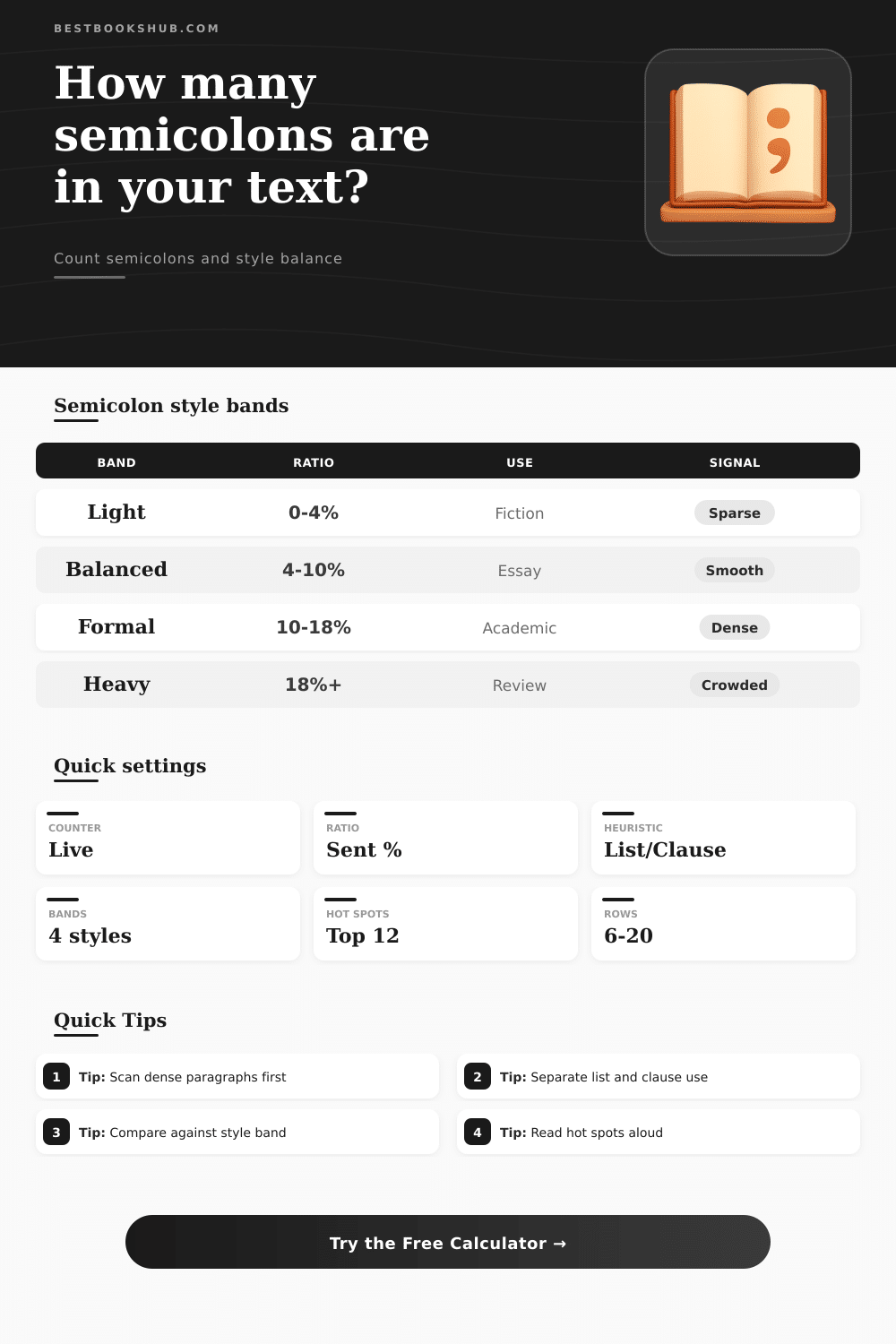
| Light | 0% to 4% | Commercial fiction, dialogue, newsletters | Mostly short or direct sentence rhythm |
| Balanced | 4% to 10% | Essays, reviews, literary nonfiction | Some formal linkage without crowding |
| Formal | 10% to 18% | Academic prose, criticism, formal reports | Dense but often controlled argument flow |
| Heavy | 18% and above | Legal drafts, archival notes, revision checks | Readers may feel stacked or slowed |
| Heuristic label | Common clues | Likely use | Review move |
|---|---|---|---|
| Clause-like | Words on both sides, no nearby comma list | Links two independent clauses | Check that each side can stand alone |
| List-like | Commas near items, repeated phrases | Separates complex list items | Confirm the list remains parallel |
| Bridge / contrast | However, therefore, instead, meanwhile | Shows transition between clauses | Check transition punctuation |
| Ambiguous | Short side, fragment, or mixed signals | Could be style choice or error | Read sentence aloud before revising |
| Document type | Low ratio | Typical ratio | High ratio |
|---|---|---|---|
| Fiction chapter | 0% to 2% | 2% to 6% | 10%+ |
| Literary essay | 2% to 5% | 5% to 12% | 16%+ |
| Academic section | 4% to 8% | 8% to 18% | 24%+ |
| Legal or policy note | 6% to 12% | 12% to 24% | 30%+ |
| Hot spot pattern | What it means | Risk | Useful check |
|---|---|---|---|
| One dense paragraph | Semicolons cluster in one unit | Local slowdown | Split or vary sentence shape |
| Many one-off marks | Even distribution through text | Likely style pattern | Compare to target band |
| List-heavy block | Complex list items dominate | Parallelism errors | Check item structure |
| Clause-heavy block | Linked independent clauses dominate | Overformal rhythm | Try periods on weak links |
DISCLOSURE: This post may contain affiliate links, meaning when you click the links and make a purchase, I receive a commission. As an Amazon Associate I earn from qualifying purchases.
Semicolon counter: This measures the ratio of sentences to semicolons; the semicolons themselves; and paragraph hot spots, formal style bands, and patterns in your manuscript text involving clauses vs. Lists. The semicolon is a tricky one for writers: Too few make your prose seem choppy, while too many makes the page feel dense. It’s hard to find the sweet spot using just your eyes. That is why having a tool that maps and counts each and every mark will help you revise better.
And there’s always two questions: Is it joining independent clauses that ought to be joined? Or separating items on a list that already have commas? Mixing this up randomly are going to make readers feel like the piece is dragging them down even if they can’t tell you why, though separating items in a list is what solves clarity issue.
How to Use Semicolons Well
I’ll sometimes do a quick read through of any manuscript to find groups hiding in single paragraphs while the rest of the chapter are empty. Those hot spots really count more then the total number, since an overloaded passage can slow things down for pages after. Fiction typically rely on restraint to keep the story moving and dialogue alive. Because of this, style bands can serve as a mirror to your own writing habits.
Academic or legal prose can handle more density, as precision sometimes require closer connections. However, when a novelist adopt the formality of another style, or a student paper remain too informal, the clash shows itself in the rhythm long before an editor picks up a red pen. Knowing how it sounds help you stay consistent.
A lot of writers fall into trap of thinking that a semicolon is magic, and hope it will stick limp ideas together; they fear making a choice between a period, which ends things, and a dash, which creates expectation. Or perhaps they’ve read somewhere that the semicolon makes them sound smart, so they sprinkle about some punctuation confetti. Both of these tendencies flatten your voice: the strength of the semicolon lie in its ability to give weight to either side while letting each stand alone; try reading those sentences out loud and if it sounds artificial, you’ll likely would of been better off with a period or a comma plus a conjunction.
So how do you know what each semicolon is really doing? Because transition words such as therefore or however often indicate that there’s a bridge, one that strengthens the argument. Commas nearby in a series more commonly point to list duty. This is why noticing these patterns will improve all later drafts, even if you are not checking the math.
There are always going to be ambiguous cases that require a human ear; accepting that ambiguity is just part of the craft. The other thing that paragraphs do is tell their own story: Four marks in one block and none in others isn’t an accident. More often than not, it is a spot where the writer thought fastest or research notes was pasted in without being polished; break these clusters, and the momentum often returns.
You’ve changed just one paragraph, but varying the sentence length or turning some of the marks into periods will benefit the rest of page as well, since the flow improves overall. A semicolon’s purpose isn’t necessarily to demonstrate mastery of the rules; it’s there to control the pacing (a lengthier pause then a comma), yet a briefer stop than a period. In the proper hands, that middle space can be indulgent, but in the wrong ones, tiring.
It becomes a conscious decision instead of a blind reflex once you learn to understand your rhythms. Use these punctuation marks wisely, with simplicity rather than showiness in mind. The numbers won’t produce the revision; they’ll still provide clarity on what’s wrong with a draft, while lighting up the places where your instincts were right and those where your instincts got sidetracked.
Knowing this, just knowing, is enough of an insight to get you past the next sentence more easily. The next sentence is nearly always the most important in any piece of writing, and paying attention to exactly how to tweak it will pay greater rewards.