📚 Cadence editing lab
Sentence Rhythm Analyzer
Paste prose to score sentence length variance, cadence waves, short-medium-long movement, paragraph pacing, and target style-band fit without reducing rhythm to a single average.
Average: 0 words
Run the analyzer to compare average length with your style band.
Spread: 0
DISCLOSURE: This post may contain affiliate links, meaning when you click the links and make a purchase, I receive a commission. As an Amazon Associate I earn from qualifying purchases.
Standard deviation shows how far sentence lengths drift.
Paragraph pace: 0
Paragraph averages reveal whether pacing changes by block.
Flat runs: 0
Flat runs repeat the same length class too many times.
| Style band | Average sentence target | Variance target | Cadence signal |
|---|---|---|---|
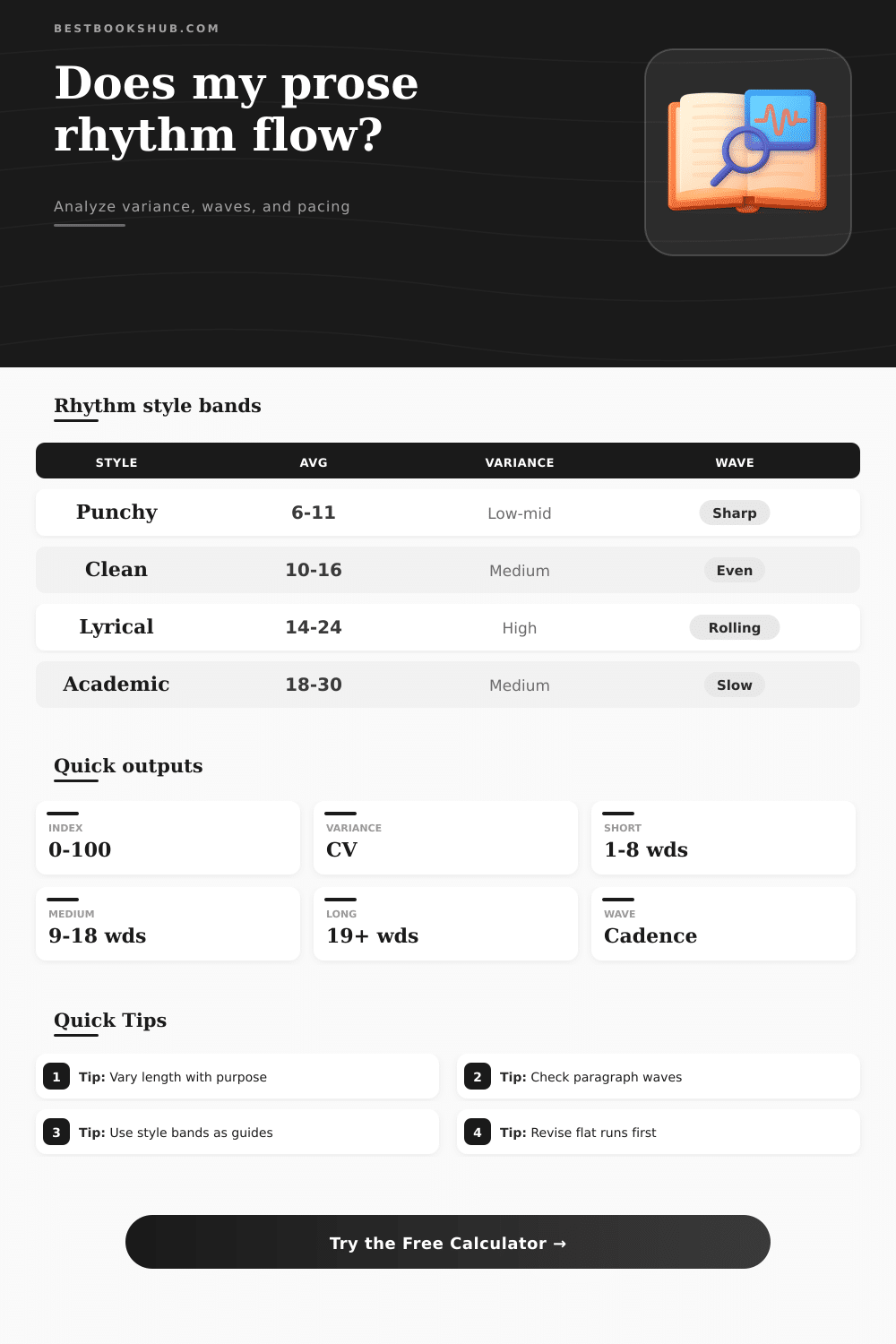
| Punchy action or early reader | 6 to 11 words | 0.22 to 0.55 CV | Short bursts with clear occasional reset lines. |
| Clean general prose | 10 to 16 words | 0.30 to 0.70 CV | Mostly medium sentences with visible but controlled waves. |
| Commercial fiction scene | 9 to 18 words | 0.35 to 0.85 CV | Flexible rhythm that rises and falls with tension. |
| Lyrical or reflective prose | 14 to 24 words | 0.45 to 1.05 CV | Longer rolling lines balanced by short emphasis. |
| Academic or technical prose | 18 to 30 words | 0.25 to 0.75 CV | Measured cadence with signposted long sentences. |
| Back cover or sales copy | 8 to 16 words | 0.40 to 0.95 CV | Hooks, medium setup, and short final punch lines. |
| Wave result | What it means | Best use | Revision move |
|---|---|---|---|
| Under 18% shifts | Very steady or potentially flat rhythm. | Instructions, controlled readers, simple explainers. | Add one short reset or one longer developed sentence. |
| 18% to 34% shifts | Balanced movement without whiplash. | Book pages, essays, newsletters, practical nonfiction. | Keep the pattern unless paragraphs feel samey. |
| 35% to 52% shifts | Energetic wave pattern with noticeable variety. | Fiction scenes, memoir, marketing copy, dialogue-heavy prose. | Check whether changes match tension and meaning. |
| Over 52% shifts | High contrast or possible choppiness. | Action peaks, comedy beats, high-emphasis passages. | Smooth abrupt jumps unless the effect is deliberate. |
| Paragraph signal | Typical pattern | Reader effect | Editing clue |
|---|---|---|---|
| Even blocks | Paragraph averages stay close together. | Stable, reliable, sometimes too uniform. | Vary one paragraph opening or closing sentence. |
| Rising blocks | Later paragraphs grow longer or denser. | Builds pressure, reflection, or complexity. | Make sure the reader gets pauses before dense turns. |
| Falling blocks | Paragraph averages shorten across the passage. | Creates acceleration and a closing snap. | Useful for suspense, blurbs, and endings. |
| Alternating blocks | Short and long paragraph averages trade places. | Creates breath, contrast, and a visible wave. | Check transitions so the pattern feels intentional. |
| Metric | Formula idea | High value means | Low value means |
|---|---|---|---|
| Rhythm index | Style fit plus variance and wave balance. | The passage matches the selected target band. | Rhythm may be flat, choppy, or off-target. |
| Length variance | Standard deviation divided by average length. | Sentence lengths differ noticeably. | Sentence lengths repeat closely. |
| Cadence wave score | Adjacent beat changes above sensitivity threshold. | Frequent rhythm turns between sentences. | Steady or monotone cadence. |
| Paragraph pacing spread | Variation among paragraph average lengths. | Paragraphs create large pace changes. | Paragraphs move at similar speed. |
| Flat-run count | Repeated length class beyond warning length. | Several same-class sentences cluster. | Class pattern changes before monotony builds. |
A rhythm analyzer measures the sentence lengths patterns in a piece of writing. A rhythm analyzer analyze the changes in sentence lengths and how the paragraphs changes, and it allow writers to see the invisible aspect of there prose. A rhythm analyzer does not judge the quality of the writing but allows writers to see the prose to adjust it to there preference.
Sentence length are important for the reading experience but does not determine the sentence rhythm. The spread between short and long sentences determine the sentence rhythm. Another factor that determines sentence rhythm is how often the pattern of sentence lengths change.
How a Rhythm Analyzer Helps Writers
Short sentences of the same length makes for a rhythm that is different than a passage containing varied sentence length. A rhythm analyzer looks at the variance in sentence length instead of there averages. A rhythm analyzer can also detect runs of sentences of the same length.
Five short sentence written consecutively have a different rhythm than five short sentences written throughout a text. The sensitivity setting for sentence length can also be adjusted. High sensitivity will focus on large change in sentence lengths that a reader will feel while reading a text.
Low sensitivity will detect small changes in sentence length. Readers experience sentence rhythm but also paragraph rhythm. A paragraph containing short sentences has a different reading experience than one that contains long sentences.
A paragraph containing many short sentence creates a faster reading experience for the reader. A long paragraph containing varied sentence length lacks contrast in its content that leave the reader reading at a slower pace. The rhythm analyzer group sentences into paragraphs to analyze the changes in average sentence length from one paragraph to the next.
This will show writers if their paragraph pacing are stable, rising, falling, or changing from one extreme to the other. A stable paragraph pacing is best for texts that provides instructions. An alternating paragraph pacing is best for scene in a story that require a contrast between the element of that scene.
Style bands provide context for the sentence length measurement that the rhythm analyzer produce. The style bands that a writer may use for sentence length contain elements that define prose that is punchy, lyrical, or academic. The prose that is punchy has short sentences of vary lengths.
The prose that is lyrical contains long sentences with short sentences that appear often throughout the text. Finally, the prose that is academic have medium variance in sentence length. The rhythm analyzer compares the writer’s text to these style bands to determine if the writer succeed in producing the type of prose they intended.
The fit score that the rhythm analyzer produce for each style band does not define the writer’s taste in prose but does provide information that highlight differences in prose that the writer may not have noticed. A rhythm analyzer can identify common mistake in writing. Writers often produce revision in their writing to achieve an average sentence length.
However, focusing on average sentence length can produce prose that lacks variety in sentence length. Writers also tend to produce varying sentence length in their opening paragraphs but produce many sentences of the same length in the middle of their texts. The wave strip that the rhythm analyzer highlight the flatness of these sentences of the same length.
Writers can fix this common mistake by adding one short sentence to the prose or one long sentence. The value of a rhythm analyzer for writers is that it allow writers to formulate questions about their writing. Writers can ask if the sentence lengths of their writing match the emotion that they want the reader to feel while reading their work.
They can ask if the technical information within their writing possess adequate sentence length signposts to aid the readers in understanding the information. Additionally, writers can ask if the sentences in the sales page for a product contain the same sentence length beat that is too often used within the product category that is being discussed in the sales page. Checking the sentence length within a writer’s text can become a habit as part of the writer’s editing process.
At some point during the editing process, writers will begin to recognize place where the sentence lengths of their text lack variation. Writers will be able to adjust these without the assistance of a rhythm analyzer. The rhythm analyzer can significantly speed up the learning process of writers regarding the sentence length pattern that their writing contains.