✍ Editorial punctuation
Serial comma checker
Paste prose, choose a style guide, and review sentence-level list punctuation for Oxford comma consistency and possible ambiguity.
The checker looks for lists with three or more items near a final and/or, then compares the punctuation to the selected editorial rule.
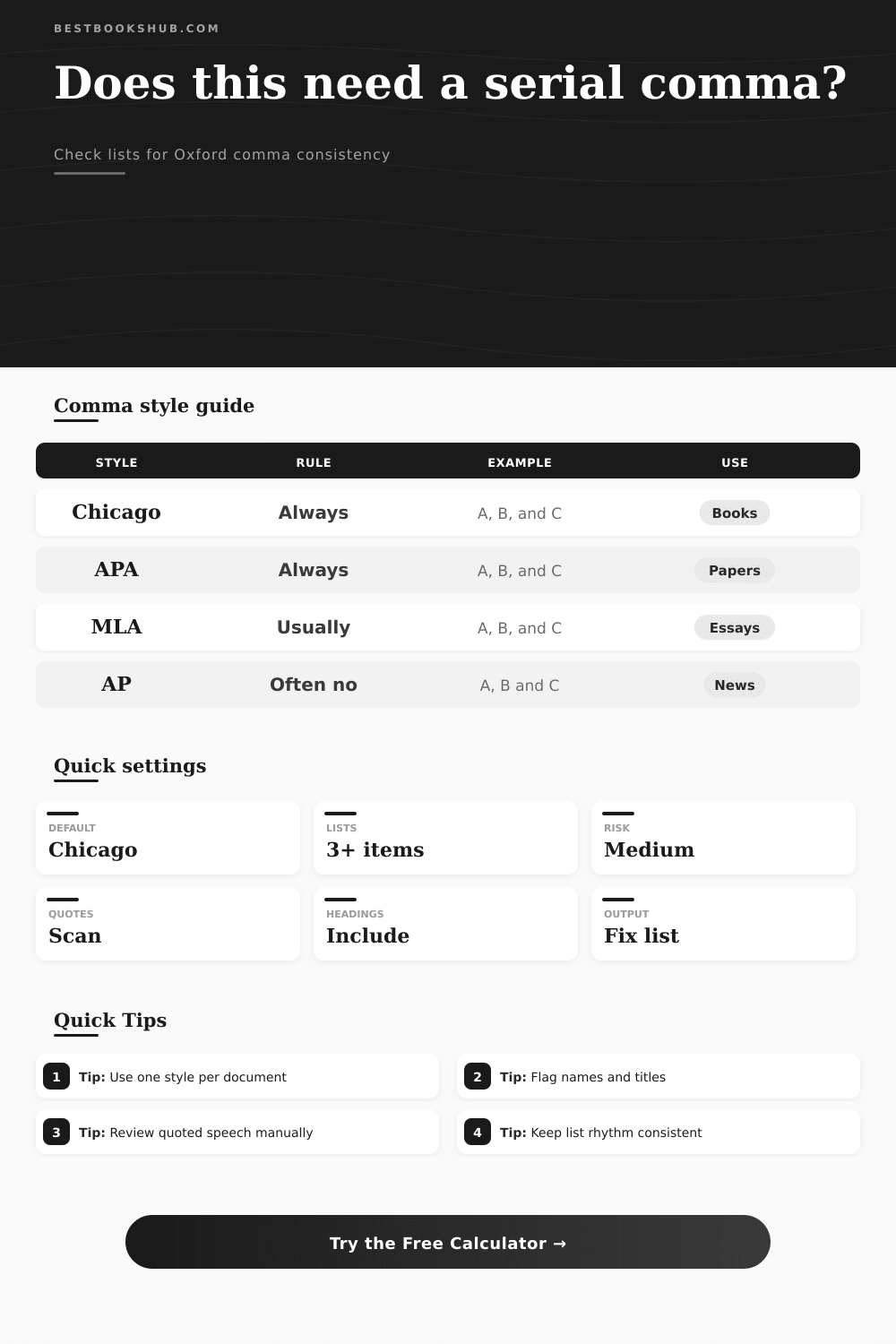
| Style guide | Serial comma rule | Preferred example | Best fit |
|---|---|---|---|
| Chicago | Use before final and/or | pages, notes, and captions | Books, manuscripts, essays |
| APA | Use in every three-item series | method, results, and discussion | Academic and research writing |
| MLA | Use for formal consistency | poetry, drama, and prose | Literary essays and citations |
| AP | Omit unless clarity requires | editors, writers and readers | News briefs and press copy |
| Pattern | What it means | Checker signal | Review action |
|---|---|---|---|
| A, B, and C | Serial comma present | Accepted in required styles | Keep for Chicago or APA |
| A, B and C | Serial comma absent | Fix in required styles | Add comma before conjunction |
| A and B and C | Loose joined list | Low confidence | Rewrite or punctuate manually |
| A, B, or C | Choice list with comma | Accepted in required styles | Keep if alternatives are equal |
| Ambiguity cue | Why it matters | Example type | Checker flag |
|---|---|---|---|
| Names | May read as appositives | my parents, Ana and Lee | High |
| Titles | Can merge roles with people | the dean, editor and author | Medium |
| Pairs | Compound items may split badly | bread and butter, tea and cake | Medium |
| Long items | Readers lose the list boundary | phrases over seven words | Medium |
| Compliance band | Score range | Meaning | Next check |
|---|---|---|---|
| Clean | 95-100% | Lists match the selected rule | Spot-check quoted speech |
| Light edit | 80-94% | A few commas need review | Apply listed fixes |
| Inconsistent | 55-79% | Mixed serial comma style | Choose one rule |
| Needs pass | 0-54% | Many lists conflict with style | Run a punctuation edit |
DISCLOSURE: This post may contain affiliate links, meaning when you click the links and make a purchase, I receive a commission. As an Amazon Associate I earn from qualifying purchases.
Why Do We Use the Serial Comma? This brings us back to the example of the dinner invite. When I say “My friends, Mom and Dad”, it suggests that the writer is serving their parents as appetizers. If we add a comma between “friends” and “and”, it indicate that they’re two separate people. In other words, the serial comma eliminates confusion. It’s one little comma with big consequences. That’s why the Serial Comma Checker exists.
Without getting too stuck on why the pause matters, let’s discuss how you can use it best: How Does the Serial Comma Checker Work? Which means of clarity do you prefer? Some style guides (like the Chicago Manual of Style and APA) says to use a comma with the last conjunction in a series of three or more items. Because otherwise the reader might be confused. But the sentence is clear enough. The Associated Press style guide say not to use a comma if it isn’t needed for clarity. So the industry is split. One paper doesn’t like the comma, another paper does. Your book gets picked up by a publisher who demands the comma, and your next article goes to a paper that refuses it.
How the Serial Comma Checker Works
The calculator solves that debate: Choose which rule set you want to apply. While each individual instance matters, overall consistency wins. Jumping around makes you seem sloppy. Consistently applying one rule make you appear professional.
Commas aren’t its only counting tool. It hunts for tricky reading patterns. One source of this is names. If you write “I spoke to my lawyer, the judge and the mayor,” it sounds like the judge is the mayor. It lacks the last comma, the way it is written changes who the sentence is about. The checker checks for those, too.
And it scans for long or complex list items so the reader can get one last beat to understand: This is the end of the list. When there are two final items, they may read as if they were a compound noun. In fact, many people believe the comma is purely a matter of following grammatical rules. But it’s a matter of how humans group words with their eyes. When the items is complex or long, we need the last comma to let us know: This is the last item on the list. The reference table show how various styles handle such edge cases.
Then there’s quoted text. Perhaps you’re editing a legal brief or some other kind of historical document and must keep its original punctuation. This punctuation may not match your style guide at the moment. Even so, you can select “quoted” text for exclusion from checking or marking as needing to be checked manually. Why does this matter? You don’t want to alter the tone of the text being quoted. You only want to make sure that your commentary is crystal clear. Sensitivity level (on ambiguity) also makes a difference here, because it lets you catch subtler errors than lower-level settings would find. It is a little thing, perhaps, but it counts when your reputation is on the line.
Some writers think commas are an unwarranted distraction. They say that, in most cases, the meaning will be obvious from the surrounding text. Trusting context is dangerous. Skimming readers don’t always give every word their full attention. The serial comma is a backup system. Even if a reader is distracted, they still pick up intended meaning.
You may find it’s faster to use set tests on familiar documents (e.g., legal clauses, academic bios) to ensure consistent results. Standardizing your work saves mental space and allows you to concentrate on substance instead of style. Punctuation isn’t about winning arguments; it’s about communicating clearly. If you want people to follow your list, make sure the list is easy to read. A well-composed list is a courteous list. It honors the reader’s time because it doesn’t require them to reread what you’ve written.
Trust is what style is all about. If your punctuation is consistent, readers will believe you’ve thought out each detail carefuly. If it’s erratic, they begin to suspect you haven’t paid much attention at all. How does this happen? You do this by using a tool that allows you to get there precisely while avoiding a degree in editorial theory. The thing flags risk, offers suggestions, and alerts you when your lists may become ambiguous.
At any time, though, you retain control. You may decide to break a rule for rhetorical effect. That’s your prerogative. Make sure you do so consciously.
Pick a style, start from scratch, and let the checker do its thing. Then return to the reason you write: to be read, not misunderstood. My friends, my Mom, and my Dad would of thanked you for checking.