📖 Series structure planner
Series Arc Word Count Calculator
Divide a full series target into book-by-book word counts, long-arc beats, finale payoff, subplot space, revision buffer, and current draft progress.
Load a common series shape, then adjust total words, book count, arc focus, payoff weight, subplot load, and drafting progress.
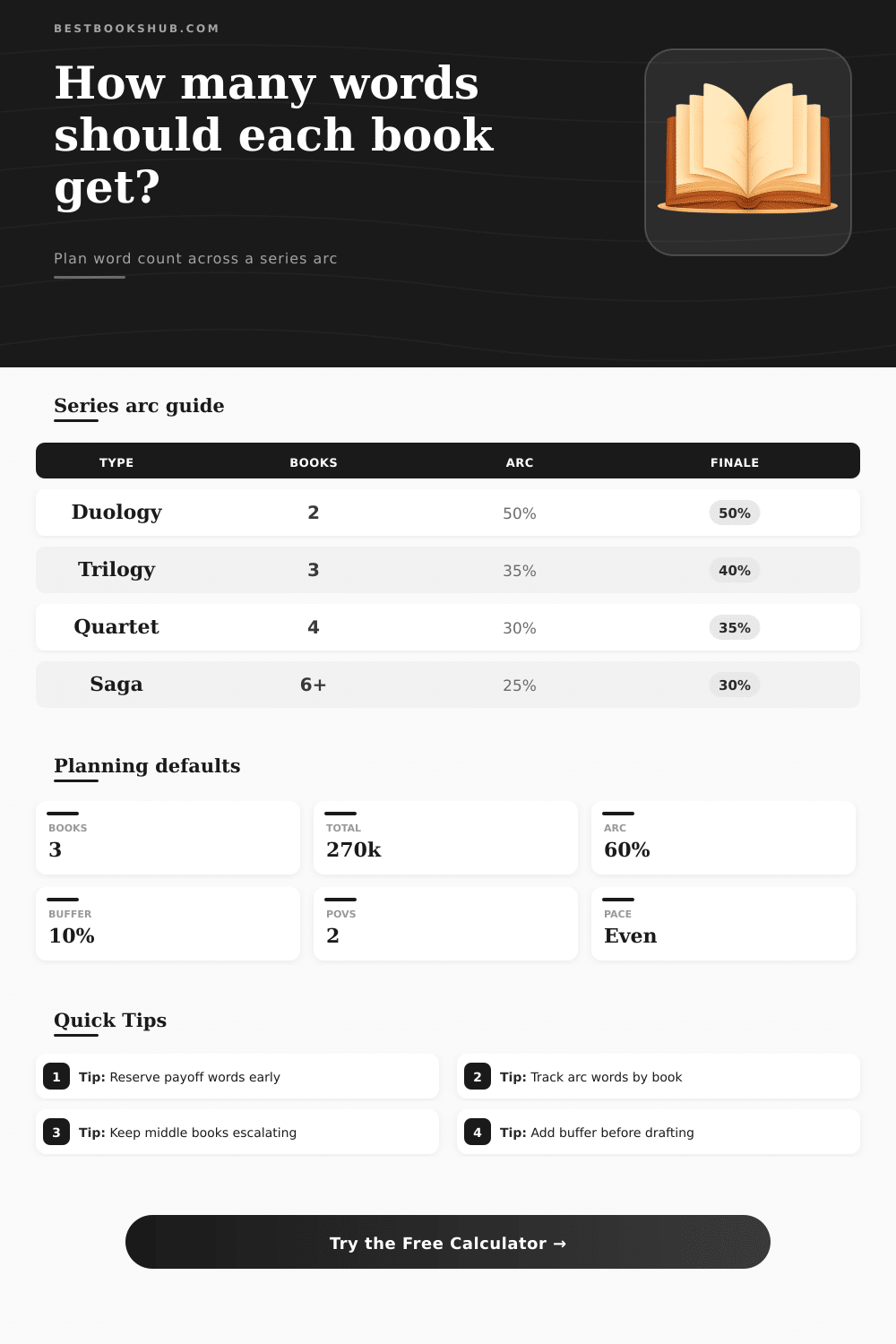
| Series shape | Common book count | Word count pattern | Arc emphasis | Best planning check |
|---|---|---|---|---|
| Duology | 2 books | Book 1 often carries setup, Book 2 carries reversal and payoff | Two-part promise | Make sure the first ending satisfies while still opening the larger conflict. |
| Trilogy | 3 books | Balanced 30/35/35 or finale-heavy 28/32/40 | Setup, expansion, payoff | Give the middle book a decisive turn instead of only delaying the finale. |
| Quartet | 4 books | Book 2 and Book 3 divide escalation and consequence | Layered escalation | Track which mysteries or promises are answered before the last book. |
| Five-book arc | 5 books | Often stable in the middle with a larger final volume | Long transformation | Reserve fresh stakes for Books 3 and 4 so the spine does not flatten. |
| Open-ended serial | 6 or more books | Book-level plots dominate while the series spine stays lighter | Episodic continuity | Keep a running ledger of unresolved arc words, reveals, and character turns. |
| Profile | Typical book range | Series arc share | Middle-book risk | Useful adjustment |
|---|---|---|---|---|
| Lean commercial | 65,000 to 90,000 words | 45% to 58% | Underdeveloped recurring stakes | Give each book one sharp series-level reveal. |
| Balanced fiction | 75,000 to 105,000 words | 50% to 65% | Subplots crowding the central spine | Cap recurring subplot space before drafting Book 2. |
| Expansive genre | 95,000 to 140,000 words | 55% to 70% | Worldbuilding replacing consequence | Tie new setting words to a turn in the series conflict. |
| Literary saga | 85,000 to 130,000 words | 40% to 58% | Diffuse payoff after many character threads | Map emotional payoffs beside plot payoffs. |
| Fast serial | 35,000 to 70,000 words | 25% to 45% | Thin individual-book closure | Protect enough words for one complete book problem. |
| Beat lane | Series job | Suggested share | Word count signal | Watch for |
|---|---|---|---|---|
| Opening promise | Introduces the question only the full series can answer | 8% to 14% | Usually concentrated in Book 1 | Too much explanation before the first book has its own engine. |
| Escalating consequence | Turns local victories into wider cost | 20% to 35% | Should rise across middle books | Repeating the same obstacle at a larger size. |
| Reversal and reveal | Changes what the reader thinks the series is about | 12% to 22% | Often peaks near the central book | A twist that has no setup budget in earlier books. |
| Finale payoff | Answers the promise and completes the transformation | 22% to 40% | Needs protected space in the final book | Rushing emotional aftermath after the external climax. |
DISCLOSURE: This post may contain affiliate links, meaning when you click the links and make a purchase, I receive a commission. As an Amazon Associate I earn from qualifying purchases.
A common source of panic among writers is Book Two of a series. Suddenly it’s bloated way past expected word count. Perhaps you began the project imagining a trilogy, but now realize that the finale requires more room then you budgeted? Almost everybody has this sort of structural drift because planning a series feel like arranging furnitures when you really need to be doing load-bearing engineering.
Once you input your desired number of books, and the total word count you’re aiming for, the calculator does the math for you, and saves you from guessing the actual word counts per story. How do you divide your attention between the immediate plot and the long arc? That’s the core problem of this thing. You have to satisfy the reader who just purchased one book while also laying track for the reader which is going to purchase three. Spend too many words on the overarching saga and each book feel like an incomplete chapter. If you spend too many words on local problems, the series’ potential fades and readers lose interest in what comes next.
How to Plan Word Counts for Your Book Series
This is mostly a matter of knowing how it’s realy being measured. What’s actualy getting given the most attention? You are not just counting words; you are allocating narrative oxygen to different character needs. The main spine (the beginning, middle and end) gets roughly half of the overall word count. The rest is what’s left over for character development, subplots, and connective tissue (making it feel like a lived-in world). Use the arc share slider in the tool to adjust how much space you devote to those kinds of detours. A lean thriller will want to keep things tight to stay on pace, while an expansive fantasy might need some breathing room to develop its magic systems or get into some political intrigue. The genre profiles are laid out in the reference table on the page so you know where to place your project before committing to a number.
To pace a story over several books, you need to make those books deliberately unbalanced. The last should seem like it has more weight: It’s the one that resolves everything. When each installment is precisely eighty-thousand words, the last one often feel hurried (even though it has the same number of pages). By adding a bend in the curve towards the end, the writer gets to linger on some loose ends and emotional aftermath without jamming them all into the last few hundred pages. We allow you to vary the importance of the set-up, the rising action, and the payoff. For example, if you have a lot of exposition in your opening, you might want to frontload the discovery. Or maybe you’ve got a massive climactic sequence with lots of resolution scenes, you’d prefer to load the payoff at the back.
Subplots is where series word counts quietly vanish. The romantic plot line that felt doable in book one will require time and space in each subsequent volume to keep the reader who cares about it from getting mad. Political tension or mystery arcs takes up space because they need to be mentioned repeatedly as they are gradually revealed. This explicit budgeting ensures you don’t take away the space your main plot needs to work. It makes you realize every subplot is a rival for the reader’s finite attention span.
A revision buffer, on the other hand, can make all the difference between a panicked re-write or a slick draft. Series structure seldom holds up under first-draft review. In Book Three you’re bound to find out you forgot to plant a clue in Book One that you need to insert. If you have a structural reserve of ten percent of your word count, then instead of going overboard and blowing by your targeted page counts, you can backfill and add that crucial set-up. This turns doomsday edits into manageable revisions instead of unworkable constraints.
Bottom line? These numbers aren’t about making writing harder; they’re about making it easier by setting up boundaries. Knowing you have x amount of words to fill in the middle books allows you to stop extending a scene at a particular point without knowing if you’ve gone too far or not. You can feel comfortabley pruning bits that don’t further the story’s arc and sure about keeping those that do. And while the math creates the frame, you fill it with life through your story. That combination of creative freedom and rigid structure is what prevents a series from buckling under its own gravity.