🔎 Manuscript sentence ranker
Shortest sentence finder
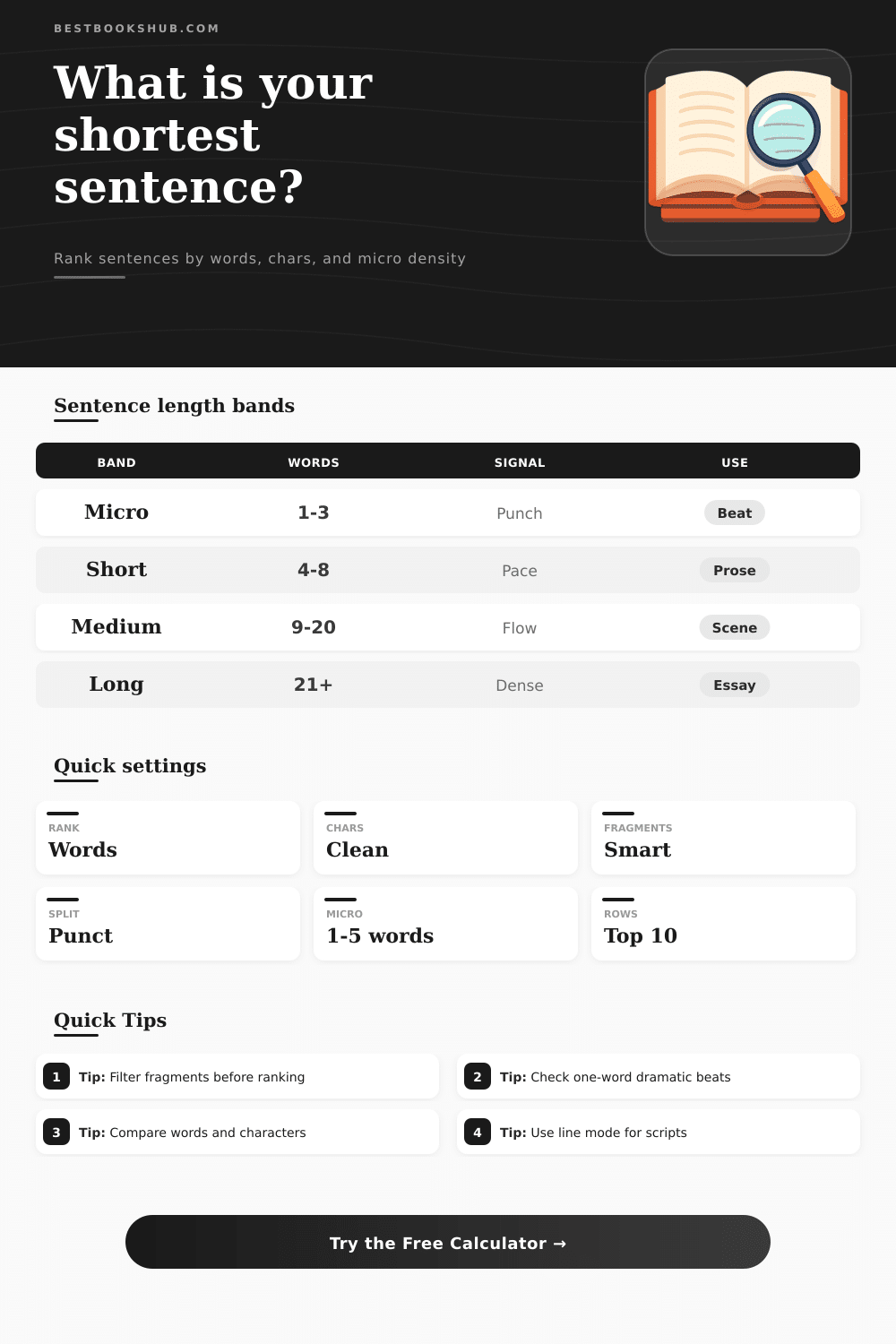
Find the shortest complete sentence by word count or character length, filter fragments, tune punctuation handling, and measure micro-sentence density across a draft.
Load a prose sample, script page, study note, or fragment-heavy draft, then adjust how strict the finder should be.
DISCLOSURE: This post may contain affiliate links, meaning when you click the links and make a purchase, I receive a commission. As an Amazon Associate I earn from qualifying purchases.
Rank complete sentences, short dialogue beats, or every punctuation-delimited unit. Fragment filters are heuristic, so flagged rows stay visible in the rank list.
Rows are sorted by the selected shortest metric. Fragment status shows why a unit was kept or skipped by the active filter.
| Rank | Sentence preview | Words | Chars | Punctuation | Status |
|---|---|---|---|---|---|
| No ranked sentences yet. | |||||
| Band | Definition | Count | Share | Editing signal |
|---|---|---|---|---|
| Run the finder to see sentence length bands. | ||||
| Ending type | Count | Shortest words | Shortest chars | Use note |
|---|---|---|---|---|
| Punctuation buckets appear after analysis. | ||||
| Context | Micro range | Typical effect | Review trigger |
|---|---|---|---|
| Literary prose | 0-8% | Controlled emphasis | Clusters of many tiny beats |
| Thriller scenes | 8-22% | Speed and tension | Choppy rhythm after action peaks |
| Dialogue-heavy fiction | 12-35% | Fast exchange | One-word replies without context |
| Academic essays | 0-5% | Clear topic pivots | Fragments from headings or bullets |
| Scripts and notes | 20%+ | Cue-like pacing | Use line mode before editing |
This is the sentence length checker, to sort out your manuscript’s shortest sentences based off either number of characters or words. Before you edit for rhythm, you will see where sentences tend to be short, what punctuation rules apply, and how to filter out possible sentence fragments.
Why would writers wish their writing had more rhythm? How can you tell where that might occur? A short sentence can be strong here and weak there. That depends on knowing whether those sentences should of being short at all, and if so, which ones matter most. When you count your own shortest sentences first, you get the point.
How to Fix Short Sentences in Your Writing
The tool on this page doesn’t just count words: It breaks apart full thoughts and fragments. It lets you decide whether a one-word reply counts as dialogue or noise. Based off your preferences, it will respect or ignore abbreviations. And it treats a period after a word different than that same word floating without terminal punctuation. This is important: All of those differences affect your total. Let the calculator worry about them, so you can focus on the answer.
One-word to five-word units are micro sentences. Think of these as the rests in the music score. A couple give emphasis and create space. Too many and the prose starts to feel like it is hyperventilating. Urgency can be deliberate; it’s also an accident of style. Checking the density show what happened. High percentage may be okay in a thriller scene. Same percent would sound harsher in literary fiction. It’s all context.
Another level that most writers do not see are punctuation settings. For formal work, an analysis would be more honest if it required a period. But when they is loosened, we find poetic prose and even half-sentences in scripts. Neither setting is better than the other. Each poses a different question of your draft.
Run it through two or three configurations. Observe which version has shortest sentence. This experiment can show where true beat lies.
Short is good. It is common wisdom. It is half true. Short is good in contrast to the surrounding average. It loses impact without that contrast. So the average-length card itself is a helpful signal. When your average length is 5 words and your shortest is four words, you’re just writing short sentences. You are not creating emphasis. The tool points out this disparity, so you can choose whether to lengthen adjacent sentence, or leave it as-is.
The most challenging are dialogue pages. ”No.” can be a complete sentence when it carries weight and context. When written down it’s likely part of a fragment. Both human judgement and mechanical counting matter to the finished manuscript. Use both approaches together for the best workflow. Have the finder bring up candidates, then read them aloud within their context. What the numbers begin, your ear completes.
Novice writers think each brief line deserves extra credit, while veteran writers know it’s valuable space. Do they advance narrative? Or are they merely copying favorite phrasings? Compare your raw word count to your character count; you’ll get the drift. Lots of names = short lines that feel longer. And dual ranking will keep you honest on those points.
But, often enough, that’s not the point of the shortest sentence. That’s just something your draft does to itself. If you’re looking at what your draft gives you, then you either keep it, cut it, or use it as building blocks for more. Rhythm matters more than number, and that’s where real craft start happening.