🔍 Word length lab
Shortest word finder
Paste a passage and find the shortest word or words, compare ties, and see how case and punctuation settings change the result.
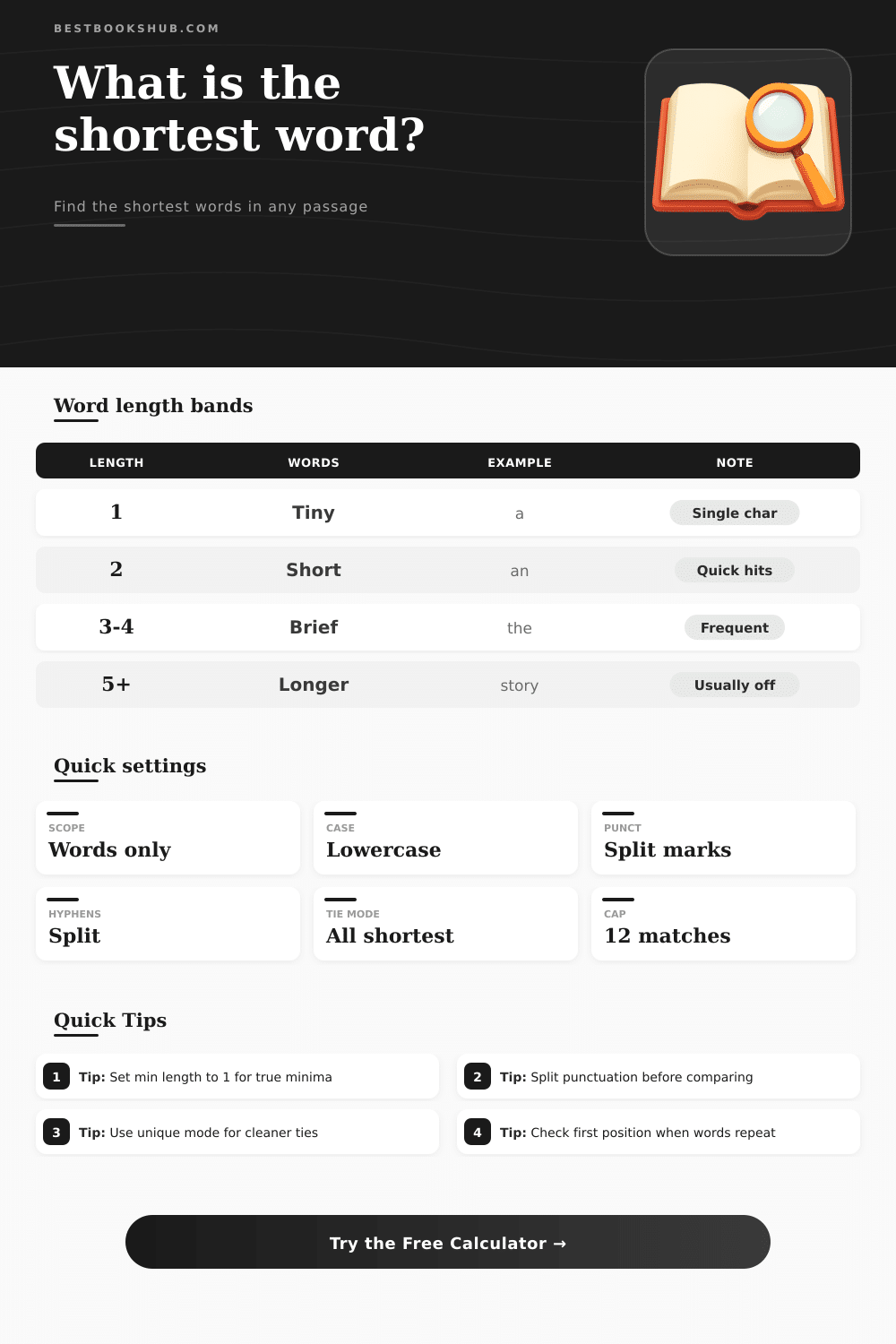
| Length band | Examples | Label | Use |
|---|---|---|---|
| 1 | a / I | Tiny | True minimum |
| 2 | an / to | Short | Common tie |
| 3-4 | the / and | Brief | Frequent |
| 5+ | story | Longer | Usually off |
| Match mode | What it does | Best use | Note |
|---|---|---|---|
| First | One hit | Quick scan | Fastest |
| All | Every hit | Review | Full tie |
| Unique | Deduped | Clean list | No dupes |
| First uniq | Keep order | Passage flow | Stable |
| Token scope | What counts | Best for | Tradeoff |
|---|---|---|---|
| Words | Letters | Prose | Skips nums |
| Words+nums | Alpha-num | Notes | More hits |
| Exact | Whitespace | Raw text | Broad |
| Strict | Cleaned | Messy copy | Tighter |
| Case mode | Result | Best use | Note |
|---|---|---|---|
| Preserve | Keep case | Quotes | Source form |
| Lowercase | Lower | Most text | Best compare |
| Uppercase | Upper | Labels | Visual scan |
| Accent strip | ASCII | Mixed text | Cross-lang |
DISCLOSURE: This post may contain affiliate links, meaning when you click the links and make a purchase, I receive a commission. As an Amazon Associate I earn from qualifying purchases.
Finding the shortest word in a passage requires certain rules to be establish beforehand. The process of finding the shortest word in a passage allows individual to glean certain information about the passage. Many writer use the process of finding the shortest word in a passage to identify where sentences begin to become heavy.
Writers use the process to determine if changing a syllable will change the rhythm of the passage. Editors use the process to find any word that may make it difficult for the reader. Language learner use the process of finding the shortest word in a passage to determine if a passage is of the correct reading level.
How to Find the Shortest Word in a Passage
To find the shortest word in a passage, individuals first must understand how to define a word. For example, some rules will consider any group of words that is connected by a hyphen as one word. However, other rules may state that the rule should count each word within a hyphenated phrase separately.
Another decision that must be made is whether or not numbers should be included in the word count. Additionally, rules may state that any word that contains an apostrophe is to be considered one word, or that any word that contains an apostrophe are to be split into two separate words. These type of rules will inform the individuals of the settings that will be used for the process of finding the shortest word.
These settings will ensure that the word count is repeatable and accurately. Once the rules have been set for the passage, the results must be read. The shortest word may only contain the instances of that word once throughout the passage, or it may appear numerous times within that passage.
The position of that shortest word can reveal to the reader if the shortest word within the passage is an essential word for that passage, or if the word is located in the start of the passage. Additionally, the total number of instances of that shortest word throughout the passage can reveal information to the reader about the passage as a whole. It can reveal whether the passage is to be considered light or typical.
As with most processes, individuals can make mistake. Many individuals may skip the rules setup step. Instead, they may simply copy and paste the text into the calculator of the process of finding the shortest word, and use the default setting for the passage.
However, changing the punctuation rules may cause a contraction to become two separate words of less syllable each, and changing the case settings may cause two identical words to be counted as two separate words. To avoid these types of error, it is best to use a word calculator that will complete the math for the reader after the reader has chosen the rules for the passage. It is important to use the same rules for each passage that is analyzed.
For instance, the shortest word in a picture book may have a more different length than the shortest word in a research note. However, the rules for defining words such as hyphenated words and numbers must be the same in each passage. Using the same rules for each passage will ensure that any comparison of word counts between passages are accurate and valid.
In addition to the shortest words in a passage, it is also important to review how the shortest words interact with the remainder of the words in the passage. For example, a passage may contain numerous three-letter words. However, it may also contain many word that contain five letters each.
The length band tables located on the page provide example of the length of words that are common throughout passages of text. These tables provide the reader with a mental map of the passage that will be analyzed for the shortest word. Another decision that can be made relates to the match mode for the shortest word.
For example, if the user is to keep every instance of the shortest word in the passage, the focus will shift to the repetition of that shortest word. However, if only the first instance of the shortest word is to be kept, the focus will be placed on the position of the shortest word within the passage. Neither option is inherently better than the other.
The correct match mode should of been chosen to match the goal of the reader when using this process to find the shortest word in a passage. Over time, individuals that use the process of finding the shortest word in a passage will begin to notice when a long word is necessary within a passage, versus when a long word is used to take up space. Additionally, the individual will begin to understand when it is better to leave short word within a sentence, as removing those short words may damage the readability of the passage.
While the process of finding the shortest word in a passage will not make these types of decision for the reader, it will give the reader the information necessary to make such a decision. The shortest word in a passage is rarely the most important word in that passage. However, the process is still of much use to those that perform the task of measuring the shortest word in a passage.