📘 One-clause sentence analyzer
Simple sentence counter
Paste prose to estimate simple sentences using a one-clause heuristic: no subordinator flags, no independent coordinator flags, and false-positive controls for lists, dialogue, and compound predicates.
Load a sample with a different sentence pattern, then tune strictness and false-positive controls before interpreting the simple sentence ratio.
DISCLOSURE: This post may contain affiliate links, meaning when you click the links and make a purchase, I receive a commission. As an Amazon Associate I earn from qualifying purchases.
Simple lines show zero coordinator and subordinator flags. Review rejected lines manually when lists, names, or dialogue tags may have confused the heuristic.
| # | Status | Words | Verb groups | Flags | Preview |
|---|---|---|---|---|---|
| Load a preset or paste text to see sentence rows. | |||||
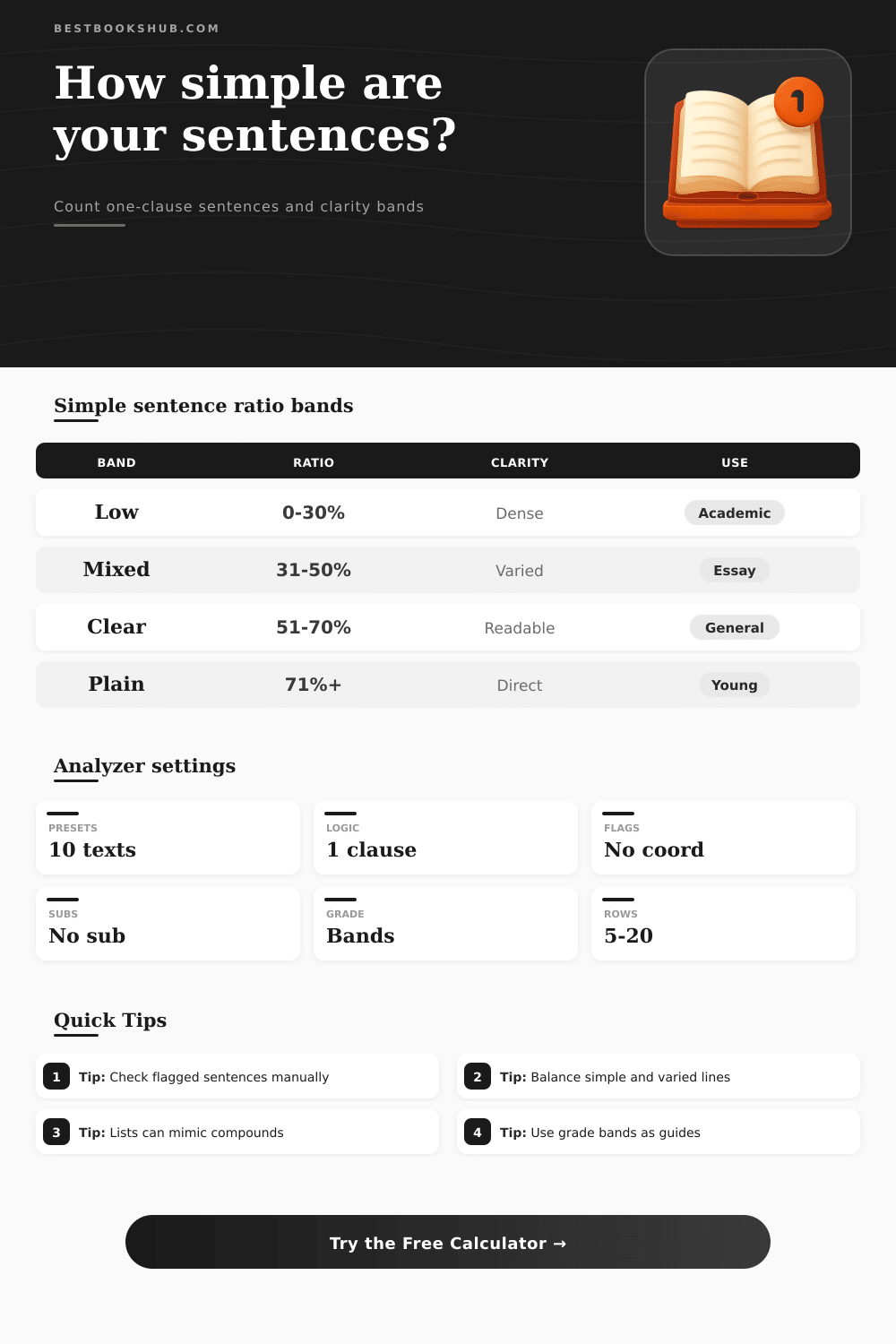
| Simple ratio | Clarity band | Likely reader feel | Editorial check |
|---|---|---|---|
| 0-30% | Dense | Complex or academic | Look for clause stacking. |
| 31-50% | Mixed | Varied but demanding | Check long clusters. |
| 51-70% | Clear | Readable balance | Keep rhythm varied. |
| 71%+ | Plain | Direct and fast | Avoid choppiness. |
| Flag type | Examples | Why it matters | False-positive risk |
|---|---|---|---|
| Subordinator | because, if, when | Often starts a dependent clause. | Titles and fragments. |
| Coordinator | and, but, or | May join two independent clauses. | Lists and compound predicates. |
| Relative marker | who, which, that | Often adds a modifying clause. | That can be determiner. |
| Heavy punctuation | semicolon, colon | Often separates clauses. | Labels and citations. |
| False-positive control | What it protects | Best for | Tradeoff |
|---|---|---|---|
| Balanced | Lists and dialogue tags | Most prose samples | May miss rare clauses. |
| Strong | Names, labels, fragments | Notes and worksheets | More conservative count. |
| Light | Only obvious extras | Clean edited prose | More flags in lists. |
| Off | No protection | Testing raw rules | More false positives. |
| Grade band | Simple ratio guide | Sentence length guide | Use carefully when |
|---|---|---|---|
| Early reader | 75-95% | 6-12 words | Dialogue has tags. |
| Middle grade | 55-80% | 9-16 words | Fantasy names are long. |
| General adult | 40-70% | 12-22 words | Voice varies by genre. |
| Academic | 20-50% | 18-30 words | Methods need precision. |
To get started: Use this handy sentence counter to find sentence length (in words), simple sentence ratio, coordinator and subordinator flags, clarity bands, and sentence-level revision targets.
Simple sentences conveys an idea in a sentence. No detours. That’s why reading them out loud is such a good idea: It gives you time to breathe.
How to Write Simply and Clearly
Complexity sounds smarter. Complexity seems more literary. Not true. Simpler is better, and when working with readers who are student, busy professionals, or even scanning text on a phone, clarity tends to win.
When do you want to write a one-clause line? When don’t you? How do you vary the beat so you’re not drilling yourself into nothingness? Simple isn’t always obvious. You may see a sentence on paper and think, “that’s simple.” Then, your eyes land on a subordinating word like “although” or “because.” This word introduce a dependent clause. Two thoughts may come together via “and” or “but” so that the sentence becomes a compound of two independent ideas.
These things makes a difference, since they affect the density of the writing. When the text includes too many stacked-up clauses, readers has to do more work; if the pendulum swings different than that direction, the writing can grow too choppy. Somewhere between those extremes lies the sweet spot, and this is where judgment enters the picture.
That said, the ratio is not equal across all types of writing; a children’s book could have much higher one-clause sentence ratios then a scholarly article, or a how-to guide might use short direct lines when the topic lends itself to potential confusion. Young adult fiction can rely on short direct lines as dialogue mimics speech. Academic writing allows lower ratios since sometimes qualifications is necessary to add precision to your argument.
With help of the calculator, you can visualize where your own draft falls along this spectrum without having to actualy count by hand. The controls allow you to set it to match the way you write in the real world; for example, you can tell it to be strict about compound predicates, or just to ignore parenthetical asides. Those are real options with real tradeoffs.
A simple counter can be duped into believing there’s more than one clause in a sentence when there isn’t: Lists does the same thing. Setting the filters higher or lower will alter results, which means you still need to check the flagged sentences manually. But the numbers point you in the right direction, and then your ear takes over.
A second level of analysis come from average sentence length. Very short lines mixed with many simple sentences can read as childish or choppy. The same ratio using slightly longer lines is more likely to seem direct and confident. Combining this with word counts provides a richer view. You could find that your draft falls into the “clear” range for most readers yet still needs tightening because the verbs clusters too heavily.
The errors are all familiar: Some writers justify vague writing as stylish, but it’s just a habit. Others get hung up on achieving an ideal score. They write so flatly they might be reading off a cereal-box label. It isn’t about one number; it’s about balance. Submit something, check the results, and then tinker around within the clarity band and the ratio range. Reread it out loud, and you’ll know instantly which direction to go, toward what feels most true to your intent.
False positives also teach us sharp lessons. For example, “When” may be a complex sentence when read aloud in an essay, but it is a fragment in your notes. The tool flags those edge cases for you, and then you can decide (rather than guess). Over time, you begin to internalize the patterns. You begin to feel where a coordinator links ideas … versus simply adds rhythm.
And remember: It’s not about making every sentence robotically simple; it’s about controlled variety to serve the reader. A simple sentence in the right place anchors an entire paragraph. Once you get good at that placement, the choices you make with style aren’t fighting unclear foundations; your style has freedom. When you see how your next draft comes out, you’ll know where the support’s already doing its job, and where a couple tweaks would of steady the whole structure.