📖 Reading depth planner
Skim vs deep read time calculator
Compare how long a book chapter, article, report, or study packet takes when you skim for structure versus read deeply with notes and review passes.
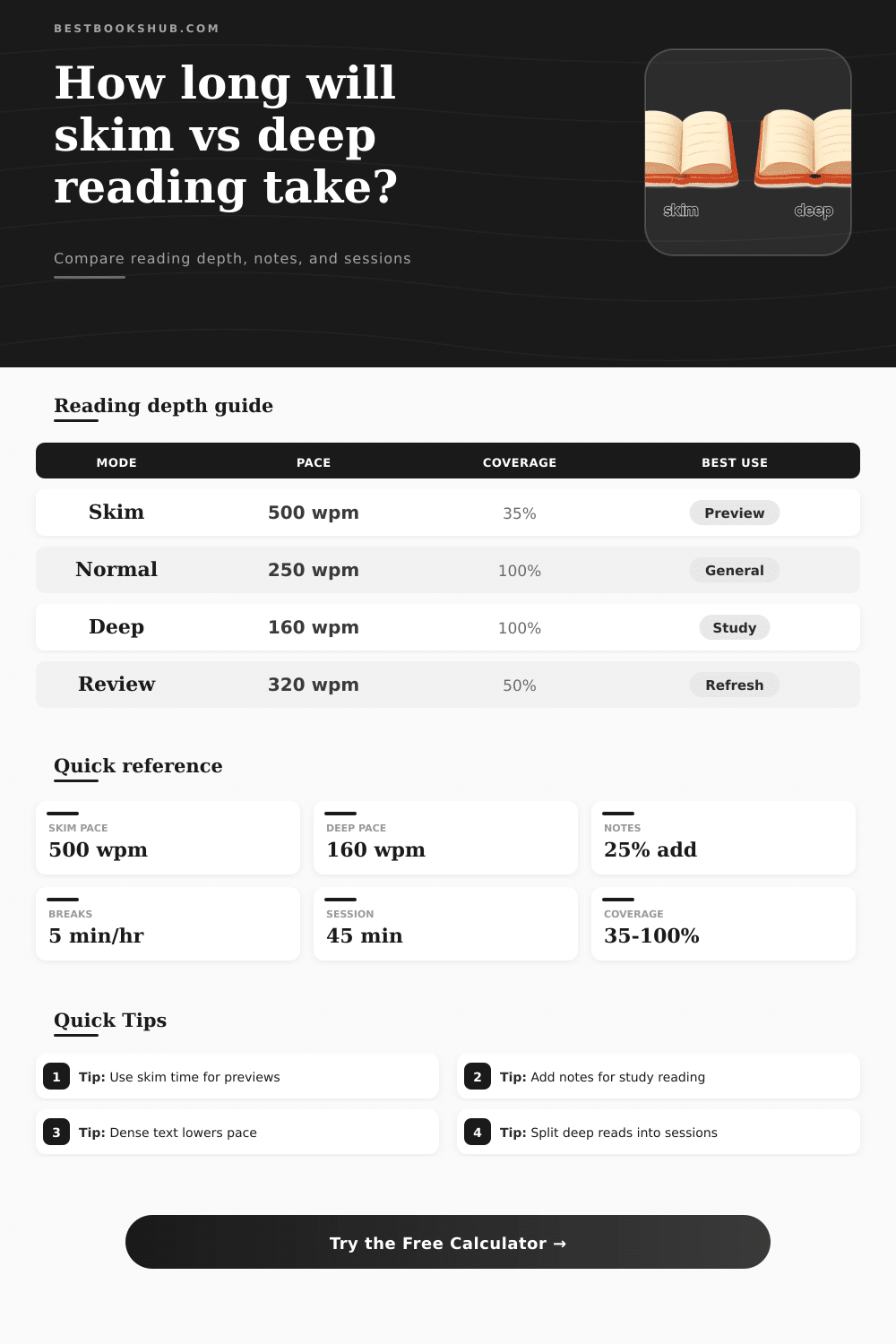
Reading mode comparison
| Mode | Typical pace | Coverage | Use when |
|---|---|---|---|
| Skim preview | 500-700 wpm | 25-45% | You need structure, argument direction, headings, examples, or relevance. |
| Selective skim | 400-600 wpm | 45-70% | You read introductions, conclusions, topic sentences, charts, and marked sections. |
| Normal read | 220-300 wpm | 100% | You want a full pass with moderate comprehension and few notes. |
| Deep read | 120-220 wpm | 100% | You need retention, argument tracking, margin notes, or exam preparation. |
| Analytical reread | 90-160 wpm | 100% | You are extracting quotes, comparing claims, or building a written response. |
| Text type | Words/page | Deep pace | Planning note |
|---|---|---|---|
| Trade nonfiction | 280-340 | 170-230 wpm | Examples and narrative sections usually read faster than argument-heavy parts. |
| Textbook chapter | 350-500 | 120-180 wpm | Figures, worked examples, and problem sets add time outside word count. |
| Journal article | 450-650 | 100-160 wpm | Methods, tables, citations, and theory sections slow the close pass. |
| Fiction chapter | 240-320 | 190-280 wpm | Deep reading may mean motif notes rather than constant annotation. |
| Technical manual | 300-550 | 90-150 wpm | Terminology, examples, and verification steps often require pause time. |
| Session length | Best for | Expected output | Break pattern |
|---|---|---|---|
| 20 minutes | Preview skim | Outline, relevance check, key questions | Short reset after each document |
| 45 minutes | Deep study block | Notes, highlighted claims, summary bullets | 5 minutes between blocks |
| 60 minutes | Long article pass | Main argument, evidence list, quote marks | 5-10 minutes after each hour |
| 90 minutes | Chapter synthesis | Detailed notes and a concept map | Split with a midpoint pause |
DISCLOSURE: This post may contain affiliate links, meaning when you click the links and make a purchase, I receive a commission. As an Amazon Associate I earn from qualifying purchases.
How fast will you read something depending on what you’re doing with that information once you have it? Is it a fiction chapter or a technical manual? One average reading speed won’t work for every text. Studying for a test is different than having a quick look through something. This also alters your reading time plan. You’d be surprised at how much slower you read when you has to reread complicated passages or make notes on them.
You don’t need to guess how these factors interact, just plugging in variables to the calculator does the math for you. It’s also designed to convert pages into words according to your chosen density (because you know: not every page is as densely packed with content). That’s what stops you from making the mistake of treating all pages as if they’re equally dense. A novel page isn’t nearly as information-dense as a textbook page. When you treat a dense PDF as if it were a trade book, your schedule will fall apart fast.
How to Plan Your Reading Time
Is it lazy reading? Skimming sounds like it’s just laziness, but it’s really a powerful form of filtering. You’re not attempting to understand each sentence when you skim; you’re getting a sense of the structure and determining whether or not the remainder are worth your time. The tool replicates this through a coverage percentage (typically around 40% for a standard preview). Coverage means that you’ll read headlines and topic sentences, but skip most of the evidence. Quick, yes. But also: incomplete. You get the map, not the territory. And that’s precisely what makes skimming work for sorting (but not for remembering.)
Reading deeply requires a wholly different set of gears in your head. Instead of simply recognizing words, you’re now sifting through arguments, which make speed much lower. To account for that, you can includes review passes and the extra time from taking notes. For example, if you need to study for a test, tack on another 30% for notes and do a light review pass. Again, it seems trivial, but really it’s doubling your raw reading time. And that’s what most students misses. When they figure out how long something takes to read, they don’t think about how long it takes to process. Reading deeply is active work; it’s not passive taking in.
On the page itself, it breaks it down into a table of references that let you compare various modes side-by-side: As you can see, normal reading falls in-between skimming and deeper study. It covers everything without over-burdening you with annotations. That makes it ideal for reading most non-fiction. It will give you an understanding of the main points of what you’re studying, but won’t ask you to remember all of it.
But other stuff like more technical manuals or denser theoretical works, those call for reading at a slower rate because you’re going to pause to verify and translate things. This app allows you to set your difficulty levels based off that fact, slowing down its predicted reading speed to match.
Similarly, it’s all about the accuracy, which is hugely dependent on your session lengths. You’re not going to be able to concentrate deeply for three consecutive hours. The calculator assumes breaks and breaks down total into manageable chunks (e.g., 45-minute sessions). This reflects human productivity. If you design a six-hour study marathon but fail to account for mental burnout, you’ll probably complete only four hours of actual work. The tool forces you to establish the session length, and thereby discourages unrealistic scheduling. It won’t let you trick yourself into thinking that more time mean more understanding.
In the end, the decision between deep read or skim comes down to knowing what you want from it. Want to write a literature review? Skim fifty articles until you get three you know you can read deeply. You’ll save days of wasted effort. Preparing for a certification exam? Skimming won’t fill in the gaps when the pressure is on.
Try this scenario out with the tool first. Before you commit, plug your numbers into the tool, see how note-taking extra costs increases the grand total, and adjust your plan as needed. You should of checked this earlier. Smart planning isn’t about reading faster. It’s about understanding exactly how long every kind of engagement actualy takes.