🔗 Slug length audit
Slug length checker
Measure URL slug characters, words, hyphen count, stopword share, encoded length, keyword position, SEO fit bands, and duplicate hyphen cleanup without analyzing the whole URL.
Choose a realistic slug pattern, then adjust cleanup and SEO guardrails. The checker focuses on the path slug only, not full URL length.
DISCLOSURE: This post may contain affiliate links, meaning when you click the links and make a purchase, I receive a commission. As an Amazon Associate I earn from qualifying purchases.
Paste the last path segment, a proposed slug, or a title you want cleaned into a slug. Optional cleanup rewrites only the output preview.
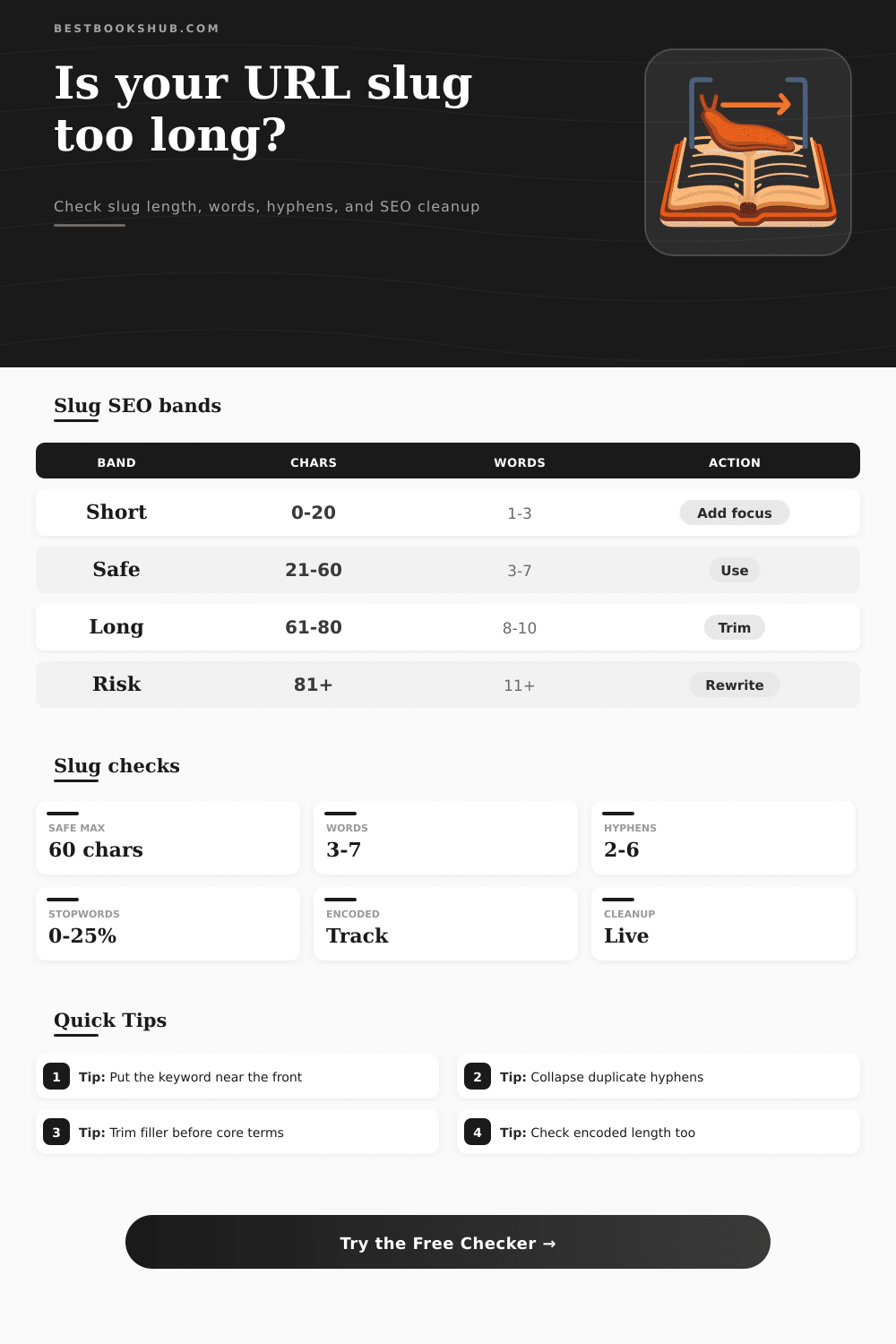
| SEO band | Character range | Word range | Recommended action |
|---|---|---|---|
| Very short | 0-20 characters | 1-3 words | Add a clarifying term if the slug feels generic or ambiguous. |
| Safe working range | 21-60 characters | 3-7 words | Use if the primary keyword is visible and hyphens are clean. |
| Long but workable | 61-80 characters | 8-10 words | Trim stopwords, dates, repeated nouns, or weak modifiers. |
| Rewrite candidate | 81+ characters | 11+ words | Rebuild around the core keyword and remove copied headline fragments. |
| Signal | Healthy cue | Warning cue | Cleanup move |
|---|---|---|---|
| Hyphen count | One hyphen between meaningful words | Duplicate hyphens or long chains | Collapse repeated hyphen runs and trim edges. |
| Stopword share | Most tokens carry topic meaning | More than a quarter are filler words | Remove weak words unless readability suffers. |
| Keyword position | Keyword starts in token one or two | Keyword appears late or not at all | Move the core phrase toward the front. |
| Encoded length | Encoded and raw length are similar | Symbols or non-ASCII text expands length | Use ASCII words or fold accented letters. |
| Cleanup setting | What it changes | Best use | Watch out |
|---|---|---|---|
| Lowercase cleanup | Converts visible letters to lowercase | Public slugs and consistent CMS paths | Leave off only for case-sensitive internal IDs. |
| Unicode folding | Turns accented characters into ASCII | Slug systems that prefer simple characters | Names may lose exact spelling. |
| Duplicate hyphen cleanup | Collapses repeated separators | Copied titles, messy exports, and redirects | Use before measuring final length. |
| Stopword trim | Removes words from the custom list | Long phrase cleanup and keyword focus | Keep natural words when they clarify meaning. |
| Slug pattern | Example | Strength | Risk |
|---|---|---|---|
| Tool slug | slug-length-checker | Short, exact, and easy to remember | Can be too broad without context. |
| How-to slug | how-to-track-reading-goals | Natural query language | Stopwords may add length. |
| Best-list slug | best-books-for-new-managers | Clear commercial or discovery intent | Dates and adjectives can pile up. |
| Headline copy | the-complete-guide-to-building-better-reading-habits | Descriptive and readable | Often needs trimming before publishing. |
Professional sites know how to build a URL slug. Type your title in your CMS, click publish, and then you’re met with a jumble of punctuation and filler words for website’s web address. That string is what search engines read, what people bookmark, and what gets truncated on social platforms. Get the length incorrect, and no one knows what they clicked on until after clicking.
It’s not so much that we don’t know how to measure things; knowing which ones to measure are the tricky part. One example is character limits. Most platforms cuts off text at about 60 characters. But you have to be careful there, because raw word length will trick you. A well-populated slug of concise but relevant terms will read more effective than a larger one using empty connecting words to pad the limit.
How to Build Good URL Slugs
In those cases, counting words is more helpful. We’re talking three to seven words here which allows for the inclusion of both intent and topic without appearing bloated.
And then there’s the part where hyphens come into play. A single clear hyphen separating key terms make it easier on the eyes. Visual clutter comes from run-ons and wrong double-hyphen. These show lazy writing.
Then there’s the issue of stopwords. Common words such as “how,” “and” and “the” may be fine in a headline, but overuse turns them into word-bloaters. If you’re losing sight of how much of your last line is taken up by these fillers, the answer lie in percentages. Ideally, most pros try to hold this figure at less than 25 percent… Any more and the message gets drowned out.
Another factor is where keywords appear in the URL. The search engines do pay attention to the sequence of words in a URL. If your main term appears toward the beginning, it remains helpful if the address is shortened. Put it all the way at the tail-end and you might of as well not have bothered creating this signal at all.
And there’s one more twist on length: encoded. Spaces and other special characters gets converted to percent codes that expand overall URL. Something that seems reasonable in plaintext suddenly exceeds limit after the server encodes it.
Everything downstream depends on your cleanup decisions. If you’re dealing with a case sensitive system, converting to lowercase will eliminate duplicate content problem. If you’ve got accented characters, folding them into their plain ASCII equivalent ensures that it’s still readable by every server. Getting rid of extraneous stopwords and extra hyphens leads to the version you’re going to publish anyway. They aren’t cosmetics: they have a direct impact on how well the slug works in the wild.
But then you begin to check, and common errors become glaringly apparent. Slugs are far too long, nearly all of those result from copying an entire headline into the slug field for instance. Adding category names or dates without considering length until it is too late pulls a neat address dangerously close to the edge. There is also the unique challenge facing product pages, where commercial slugs must be both short enough to fit on a mobile screen but filled with sufficient description.
But best slugs don’t break when someone shares them; they aren’t all gobbledygook that looks like it was spit out by an auto-garbage bot. They’re short and to the point, and make clear to both humans and search engines what’s on the page. It’s not coincidence. It’s measuring the right stuff before you press publish.
Your digital front door is a slug. People read or ignore a headline before they click through. If it is too long, they will walk past without reading it. If it is too vague, they won’t know what’s in there. It is just right when the address works for you rather than against you. In the numbers, it shows itself in click-through rates, the quality of your bookmarks, and the satisfaction of knowing your URLs match the sharpness of your content.