📚 Memory schedule lab
Spaced repetition interval calculator
Estimate the next review date for flashcards, book notes, vocabulary, quotations, and study facts using recall grade, ease, lapses, retention target, and daily workload.
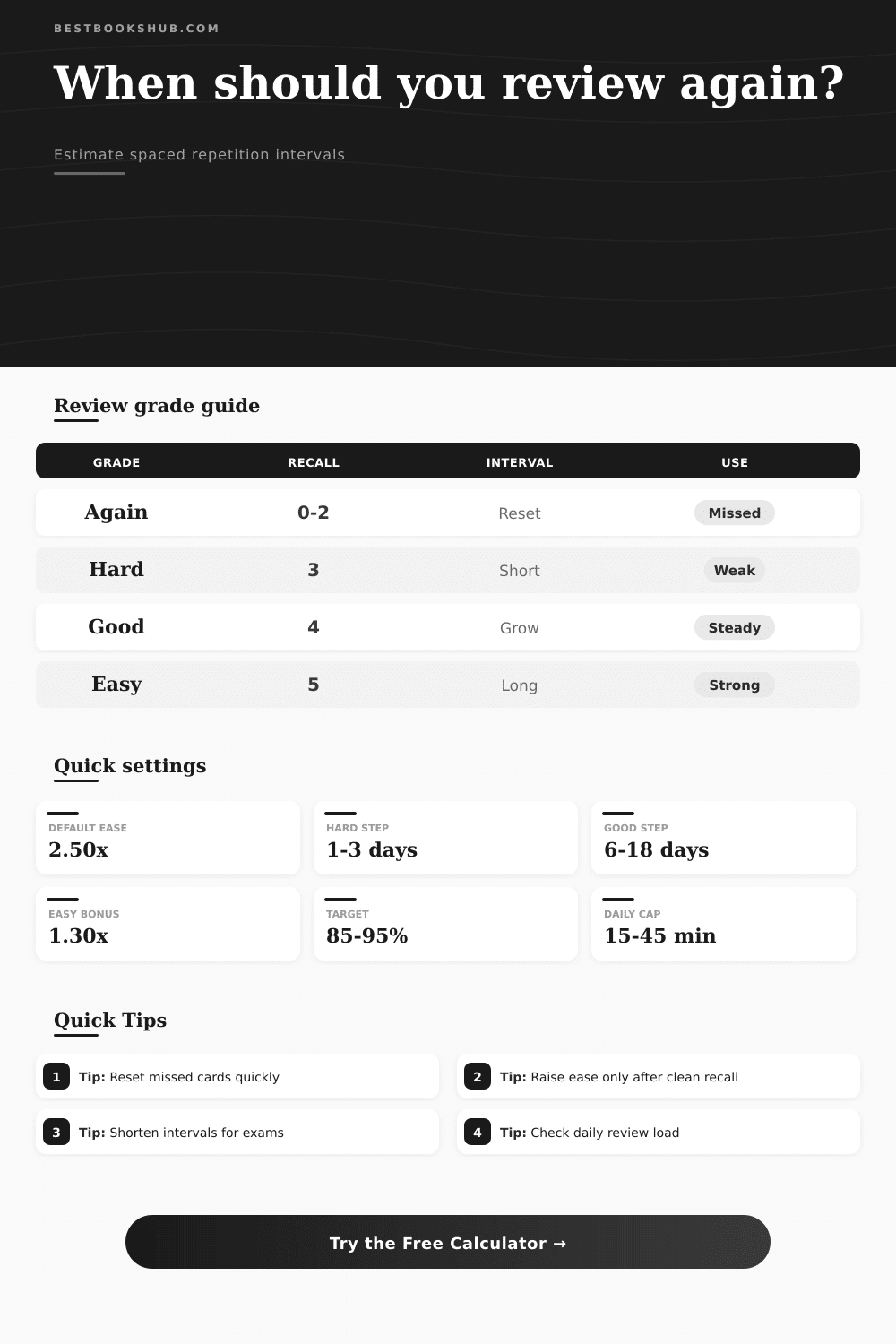
Choose how the last review felt, then tune the deck profile. The calculator estimates the next interval and whether the daily review load is sustainable.
| Grade | What it means | Ease effect | Interval effect |
|---|---|---|---|
| Again | Forgot, guessed, or needed the answer | Ease drops sharply | Reset to minutes or tomorrow |
| Hard | Correct but slow or uncertain | Ease drops slightly | Small interval increase |
| Good | Correct with normal effort | Ease stays stable | Standard interval growth |
| Easy | Immediate clean recall | Ease rises modestly | Longer interval with bonus |
| Material | Stability factor | Good for | Planning note |
|---|---|---|---|
| Vocabulary or terms | 1.00x | Language, glossary, definitions | Works well with short prompts and fast reviews. |
| Fact recall | 0.92x | Dates, names, facts | Use shorter intervals when the answer is exact. |
| Concept notes | 1.10x | Book notes and summaries | Longer intervals work when cues are meaningful. |
| Quotes and passages | 0.82x | Lines, poems, citations | Exact wording decays faster than recognition. |
| Formula or syntax | 0.88x | Math, code, notation | Shorten intervals until use feels automatic. |
| Reading annotations | 1.18x | Themes, scenes, arguments | Conceptual links often tolerate wider spacing. |
| Card age | Typical interval | Review goal | Watch for |
|---|---|---|---|
| Learning | 10 minutes to 1 day | Recognize the cue | Repeated misses or vague prompts |
| Young | 1 to 6 days | Recall without hints | Hard grades piling up |
| Growing | 1 to 4 weeks | Stable retrieval | Ease below 2.0x |
| Mature | 1 to 6 months | Long-term retention | Exam dates or exact wording |
| Maintenance | 6 months or more | Low-load refresh | Cards you cannot explain aloud |
DISCLOSURE: This post may contain affiliate links, meaning when you click the links and make a purchase, I receive a commission. As an Amazon Associate I earn from qualifying purchases.
Why? Because you’re spacing it right. It is not because you don’t try. You cram all week, and by Tuesday morning you’ve forgotten it all. That’s not your effort’s fault; it’s the timing. Timing is key to spaced repetition. It hit your brain at the exact point when it begins to forget, strengthening those connections. So the calculator know exactly when that will happen and schedules accordingly.
You know what you’re reviewing. It gets its most fundamental input by asking whether or not you remembered the material at all. Marking a card as again indicates that you forgot what you were trying to remember. The system then reverts back to the beginning with a big bump in interval. This guards against creating a deck where every single card are marked as “remembered” even if you really only thought it was true.
Why Spaced Repetition Works
Marking it as hard means you did get it right, but you had to work for it, so the interval will increase slightly. And this is important, because hard memorization strengthens memory more effective than easy recall does. Your markings informs the tool’s adjustment to an ease factor, a sort of multiplying value that tells it how aggressively to increase intervals over time.
When should I cycle? It depends heavily on type of material. Because words are semantically hooked into so many other ideas, vocabulary tend to stick better than more complicated code syntax or precise dates. We give different content types stability factors that reflect this. Robust concepts can be reviewed less often and fragile ones needs to be refreshed earlier. Don’t worry about remembering those coefficients yourself, though. If you’re curious about how quickly your own material decays compared to typical values, the page’s reference table spells it all out for you.
The biggest reason people fail at spaced repetition is that they underestimates their daily workload. “Okay, I’ll add 10 cards per day.” That sounds doable, right? This happens until the cards becomes mature and begin coming back to you all at once in huge bunches. You need to be able to visualize that future burden of card so you can know whether you’re adding cards faster than you should of. Use the calculator to get an idea for what’s going to happen next month if you keep adding cards at your current pace. If the fit score gets too low, stop creating new cards instead of just stopping review completely. Memory work is about consistency, not intensity.
Many people also misuse the retention target lever. Ninety-five percent retention sounds like a great goal… Except when it causes you to over-review card you’ve memorized to perfection. That’s wasting time you could spend reviewing something you’re weak at or learning something entirely new. If you lower the target a bit, then the algorithm will pace out your mature cards more aggressively. Eighty-five to ninety percent is typically the sweet spot, it strikes a balance between being repetitive (to avoid catastrophic forgetting) and efficient.
The rules are different when it’s exam cram time. A deadline is set; instant recall matters more than long-term retention. Modes exist to artificially shorten intervals so that all of this stuff will be fresh on test day. That’s not a sustainable learning strategy, it’s temporary stress management. Longevity is traded for short-term access, but that’s a fair trade if you’re aware the knowledge won’t matter in six months’ time.
This is how your brain works. Spacing out repetitions follows that fact and doesn’t fight against it. You don’t need to worry about when to review something again. That’s all taken care of by the math. Focus on understanding what you’re learning, not when you’ll have to learn it again. Remembering more isn’t the point. Forgetting less is the point.