📖 Elementary readability lab
Spache readability calculator
Paste an early-reader passage to estimate Spache grade level, familiar-word percentage, unfamiliar-word count, sentence load, and the target grade band for elementary texts.
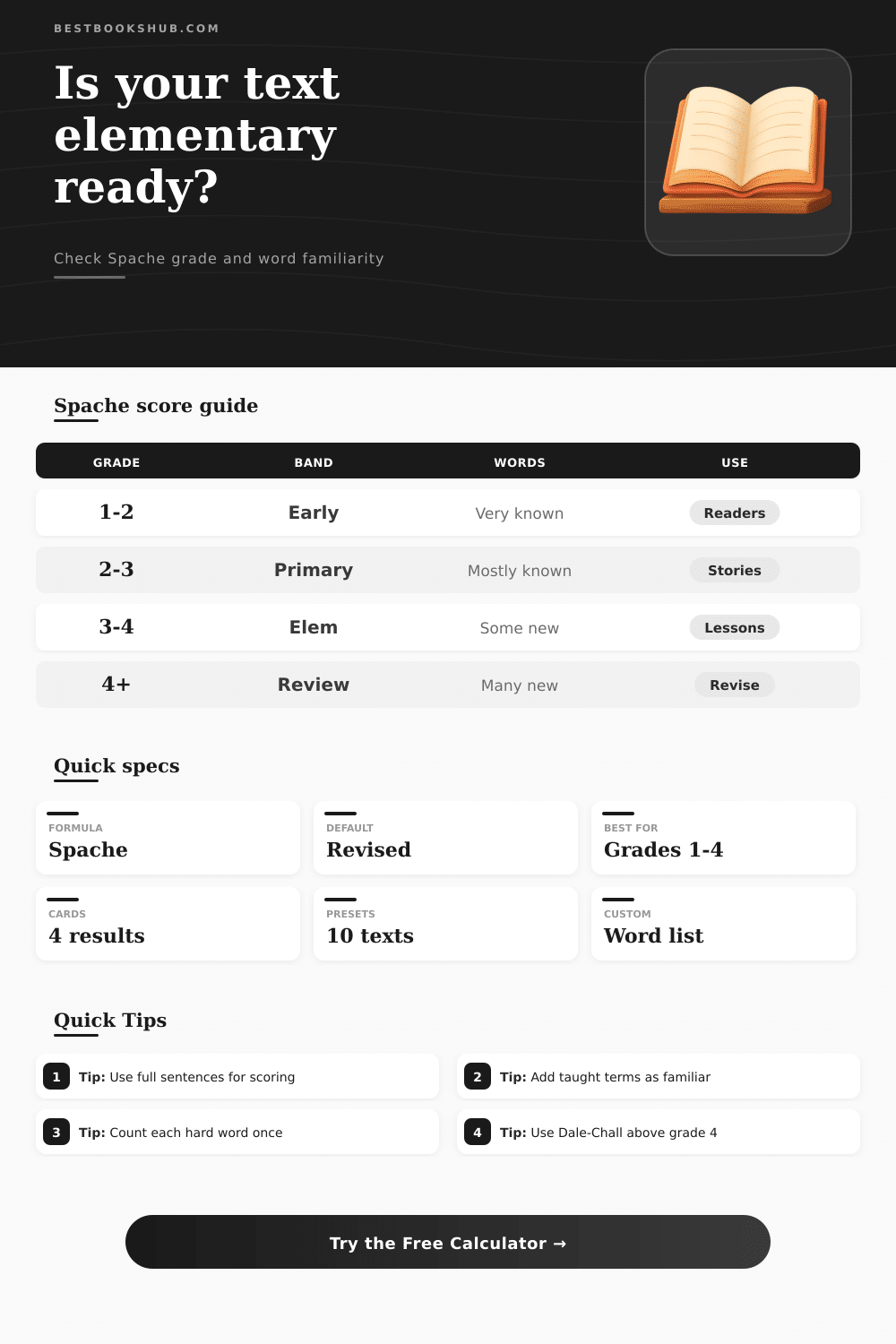
| Spache Grade | Reader Band | Typical Text Feel | Review Signal |
|---|---|---|---|
| 0.5 to 1.4 | Kindergarten to grade 1 | Short sentences, repeated sight words, strong picture support | Watch for too many new nouns in one page |
| 1.5 to 2.4 | Grade 2 | Simple story logic, mostly familiar words, occasional new terms | Explain new vocabulary near first use |
| 2.5 to 3.4 | Grade 3 | Longer clauses, more topic words, less repetition | Break dense facts into shorter sentences |
| 3.5 to 4.4 | Grade 4 | Elementary nonfiction, chapter-book style, broader vocabulary | Check whether the audience is still primary-grade |
| 4.5+ | Above Spache sweet spot | Likely better checked with an upper-grade formula | Use Dale-Chall or another older-reader metric |
| Version | Sentence Term | Unfamiliar Term | Constant |
|---|---|---|---|
| Revised Spache | 0.121 x average sentence length | 0.082 x percent unfamiliar words | + 0.659 |
| Original Spache | 0.141 x average sentence length | 0.086 x percent unfamiliar words | + 0.839 |
| Unfamiliar percent | Unique unfamiliar words | Divided by scored word count x 100 | Used in grade |
| Familiar percent | Familiar tokens | Divided by scored word count x 100 | Context check |
| Setting | What Counts as Familiar | Why It Matters | Best Use |
|---|---|---|---|
| Core elementary list | Common sight words and early reader vocabulary | Approximates a Spache-style known-word check | General elementary passages |
| Broad list | Core words plus school and classroom terms | Prevents over-penalizing taught academic language | Lessons and handouts |
| Strict list | Only exact core familiar entries | Highlights every possible vocabulary burden | First drafts for early readers |
| Custom familiar words | Teacher-added names, unit terms, and decodable words | Matches the score to what readers already know | Classroom or leveled texts |
DISCLOSURE: This post may contain affiliate links, meaning when you click the links and make a purchase, I receive a commission. As an Amazon Associate I earn from qualifying purchases.
The Spache formula is used to measure the difficulty of a text for young readers. Additionally, the Spache formula will help you to identify if a text is too difficult for the grade level for which it is wrote. When a second grader struggle to read a sentence, it is typically due to either too many unfamiliar word within the text, or because the sentences within the text are too long for the child to read.
The Spache formula identify these two problems by calculating a grade level for the text based off two measurements of the text: average sentence length and the percentage of unique unfamiliar words within the text. The grade level for a text is calculated by multiplying the average sentence length by a coefficient and adding a constant to the product, and also by multiplying the percentage of unfamiliar words by a coefficient and adding a constant to that product. The resulting number are the grade level for that text.
How the Spache Formula Works
The Spache formula is made sensitive to the vocabulary that the child know by using a small list of familiar words. As a result, any words that the student has studied in the classroom will change the grade level. Beyond calculating the grade level for a text, the Spache formula also calculates the length of the sentences within the text.
Sentence length is important to understanding the text, as short sentences are typically thought to be easy to read. However, extensive use of short sentence can be difficult to read. The Spache formula allows for individuals to understand if the sentences in the text are too long, or if the punctuation within the text make the text difficult to read.
Based upon these calculations, an individual can make a decision regarding whether or not the sentences within a text should be shortened. The Spache formula also creates a list of the specific unfamiliar words within the text. Based upon this list, an individual can determine how readers can best manage the unfamiliar words.
For example, the formula counts each instance of a hard noun as only one in the list of unfamiliar words. This reflects the way in which children actualy learn words; it is more likely that a child will learn how to read one hard noun that is repeated throughout a text than that the child will learn how to read many different hard nouns that each appear only once within the text. Thus, an individual can evaluate each unfamiliar word listed in the Spache formula to determine whether it should be taught to students, or whether those words can be replaced with other words.
People may believe that the Spache formula is a hard limit for the level of knowledge of a student; however, the formula provide a data point for teachers to use to decide how to the best support that student. For instance, if a text scores 2.8 on the Spache formula, other readers understand it to be close to the highest grade level for a second grade student. Thus, support can be provided to that second grader.
The support may be in the form of a preview of the words that will be used in the text, or may be in the form of simply allowing the student to read the text twice. Another mistake that people may make is to use the Spache formula to analyze only the first paragraph of a text. Instead, the Spache formula should be performed on a middle section of a text that is representative of the entire text.
The first paragraph of a text typically contains many unfamiliar names and setting details that the reader must read. Thus, the first paragraph will score higher on the Spache formula then the remainder of the text. By using the Spache formula on both the first hundred words of a text and the second hundred words of a text, for example, an individual can determine whether the difficulty for reading the text decreases or increases as the reader continues into the text.
The best use of the Spache formula is for authors and teachers to make decisions about text based upon the calculations of the formula. For instance, if the passage that is to be used in teaching science concepts has a high score for the formula, the list of unfamiliar words can be reviewed. Each of these words can be replaced with other words, or a diagram can be created alongside the passage.
After making these changes, the passage can be evaluated again with the Spache formula. The result will be a passage that students can read more easier, yet still includes the same information and concepts for the students to learn.