📖 Reading pace lab
Speed reading improvement calculator
Estimate realistic WPM growth, comprehension-adjusted pace, pages per hour, time saved, and the practice load needed to reach a reading goal.
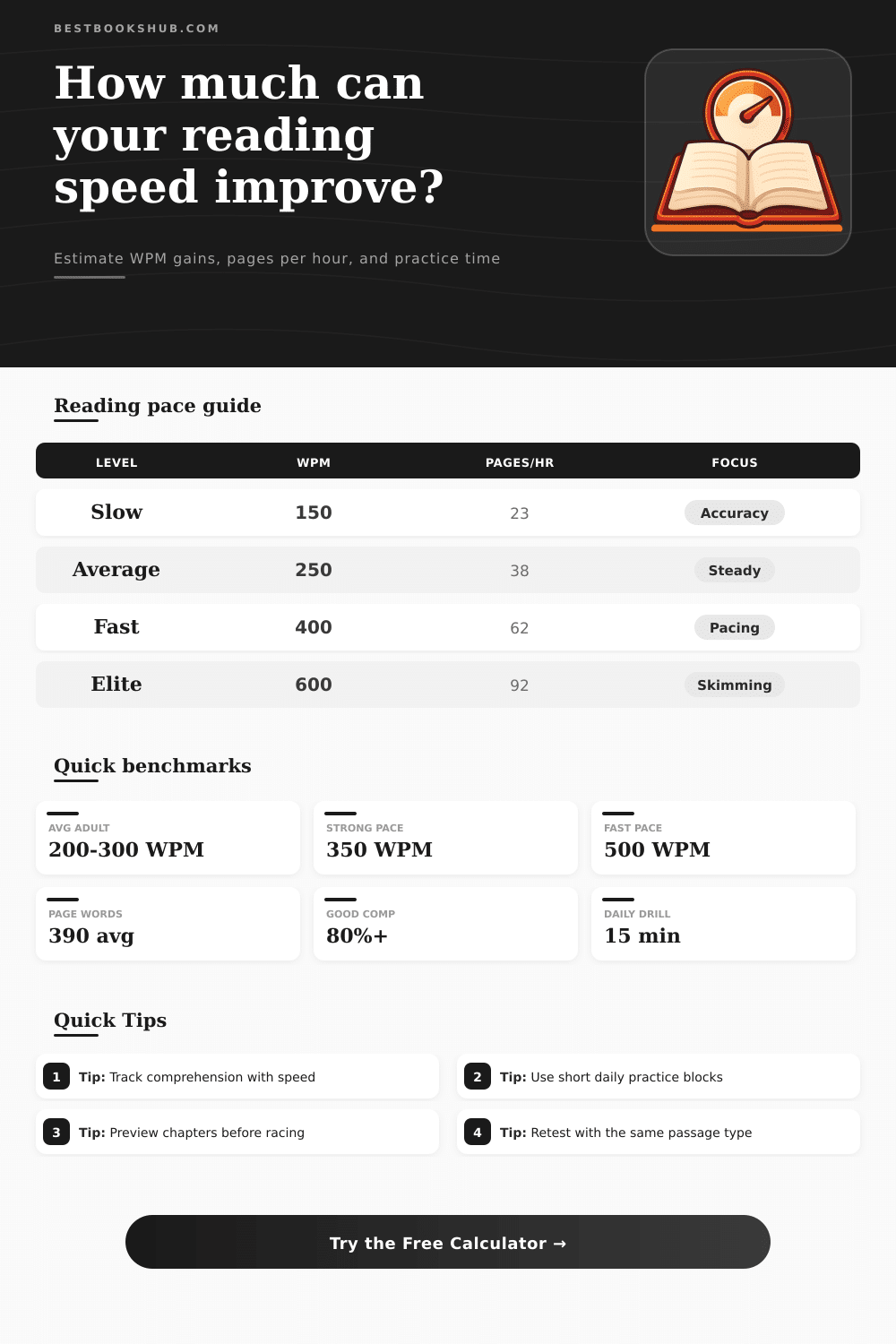
| Reader pace | Words per minute | Pages per hour at 390 words | Best use |
|---|---|---|---|
| Careful study | 120-180 WPM | 18-28 pages | Dense academic reading, annotation, memorization |
| Average reading | 200-300 WPM | 31-46 pages | General nonfiction and everyday books |
| Fast reading | 350-500 WPM | 54-77 pages | Familiar topics, lighter nonfiction, fiction |
| Skim and survey | 600-900 WPM | 92-138 pages | Previewing, review passes, locating ideas |
| Training method | Typical gain range | Comprehension risk | What it changes |
|---|---|---|---|
| Timed reading only | 5-12% | Low | Awareness, pacing consistency, baseline confidence |
| Pointer or pacer | 10-25% | Low-medium | Eye movement rhythm and reduced drift |
| Preview and purpose | 8-18% | Low | Faster context building before each chapter |
| Phrase chunking | 12-30% | Medium | Larger visual chunks and fewer fixations |
| Regression control | 10-28% | Medium | Less rereading and fewer backward jumps |
| Mixed drills | 18-45% | Medium-high | Combined pacing, chunking, preview, and recall work |
| Book type | Common page words | Useful pace target | Notes |
|---|---|---|---|
| Paperback fiction | 250-330 | 300-500 WPM | Dialogue and familiar story flow can support faster pace |
| Trade nonfiction | 320-430 | 250-420 WPM | Use chapter previews and recall checks |
| Textbook | 450-650 | 120-260 WPM | Charts, formulas, and examples slow reading |
| Academic article | 500-800 | 100-220 WPM | Abstract, methods, and citations need careful passes |
| Practice schedule | Weekly minutes | Likely effect | Retest rhythm |
|---|---|---|---|
| Light tune-up | 45-75 minutes | Better consistency and lower backtracking | Every 2 weeks |
| Steady plan | 90-150 minutes | Measurable WPM gains with recall checks | Weekly |
| Focused month | 180-300 minutes | Visible gains if comprehension is protected | Twice weekly |
| Exam cycle | 300+ minutes | Use speed only after accuracy stabilizes | Every 3 sessions |
DISCLOSURE: This post may contain affiliate links, meaning when you click the links and make a purchase, I receive a commission. As an Amazon Associate I earn from qualifying purchases.
People think that their reading speed is like their engine in a car: Faster is always better, so they aim to get more “horsepower.” When they try to improve reading speed, they fail because they assume this. There are some who can read six hundred words per minute, but they remember nothing. They’re not reading; they’re scanning pieces of paper. Raw speed doesn’t matter; it’s efficiency of comprehension that counts.
This changes how you think about what to track in your daily habits and how to practice for improve. This tool lets you parse out what’s useful from what’s vanity. You don’t have to guess how long it will take to reach a certain number of words per minute. Instead, it calculates how much you need to practice to reach your goal while still understanding what you readed.
Why Understanding Is More Important Than Speed
Because speed without recall isn’t useful, there are two inputs: your existing reading speed and comprehension score. For example, if you’re already reading at two hundred fifty words per minute but only remember half of what you read, then speeding up to four hundred is going to make the same sort of memory problem worse. The calculator takes this into account, allowing you to specify an absolute comprehension level (as a percentage) below which projected increases won’t work well enough for your own specific learning needs.
The other key variable that most people overlook is the type of training you use. Common sense tells us that one drill will be just like every other drill, but that is wrong. In fact, different drills yields different benefits. Pacer or pointer drills tend to give good gains at little risk of hurting your ability to understand what you’re reading (because they force your eyes to move steadily forward). Phrase chunking takes it up a notch by teaching you to read groups of words as a unit, which increases speed but also risks losing some details if you overdo it.
These are average gain ranges laid out in tool’s reference table. Use this to select the approach that best suits your skills and ambitions.
The other factor that has an enormous impact on actual reading speed is the complexity of the text itself. If you try to read heavy academic journal articles at the same speed as fluff books, you’re going to be very frustrated. Academic papers usually use highly technical language with complex sentence structure that requires longer processing times. You can compensate for this using the calculator by choosing type of text you’re reading. This will change the results to match, so it doesn’t encourage you to set impossible goals that lead to false confidence or burnout.
But here’s what really matters: it saves time. Even a tiny percent boost in reading speed adds up to hours of extra time over the course of a year if you read one hour per day towards school or work. It tells you right there, in the results section, how many more pages per hour you can expect to cover and how much total time you will save on your current project. Suddenly, abstract goals become real rewards. No more aimlessly trying to hit arbitrary numbers. Now you’re improving your reading with real-world efficiency.
Intensity is not as important than consistency in developing these skills. You’ll learn a lot more from a small daily block of study than a single marathon session every once in awhile. This calculator takes into account the amount of time you need to spend each day. It shows how many minutes you need for the specific number of days or weeks you want to train. This helps you fit training into your real life instead of an idealized version.
It also considers how much stuff you have to review, and how much it will regress, because let’s face it: Some texts are smooth sailing; other texts has some chapters that need to be reviewed.
In conclusion, speed isn’t a trophy, it’s a tool used to take in more relevant info quicker; provided you don’t do so at the expense of understanding. Strike a delicate balance between speed and precision, reading becomes a strategic advantage rather than a chore. Let the calculator do the math while you hone on the stuff that really matters.