🔤 A-Z first-letter analyzer
Starting letter distribution calculator
Count first-letter starts in words, titles, names, or line lists; exclude stopwords; compare vowel and consonant starts; and measure drift from an expected English baseline.
Load a realistic sample, then switch between word mode, title mode, and name mode to see how first-letter distributions change.
| Rank | Letter | Type | Count | Share | Baseline | Delta | Bar |
|---|---|---|---|---|---|---|---|
| Load a preset to fill the A-Z table. | |||||||
| Group | Letters | Count | Share | Expected share | Signal |
|---|---|---|---|---|---|
| Group rows appear after calculation. | |||||
| Delta rank | Letter | Actual | Expected | Point gap | Interpretation |
|---|---|---|---|---|---|
| Baseline comparison appears after calculation. | |||||
| Mode | What is counted | Best for | Stopword advice |
|---|---|---|---|
| Every word | Each word token | Prose excerpts | Common stopwords optional |
| Title mode | First significant word per line | Book title lists | Exclude The, A, An |
| First name | First token per name line | Character rosters | Usually no stopwords |
| Last name | Last token per name line | Author lists | Remove suffixes manually |
DISCLOSURE: This post may contain affiliate links, meaning when you click the links and make a purchase, I receive a commission. As an Amazon Associate I earn from qualifying purchases.
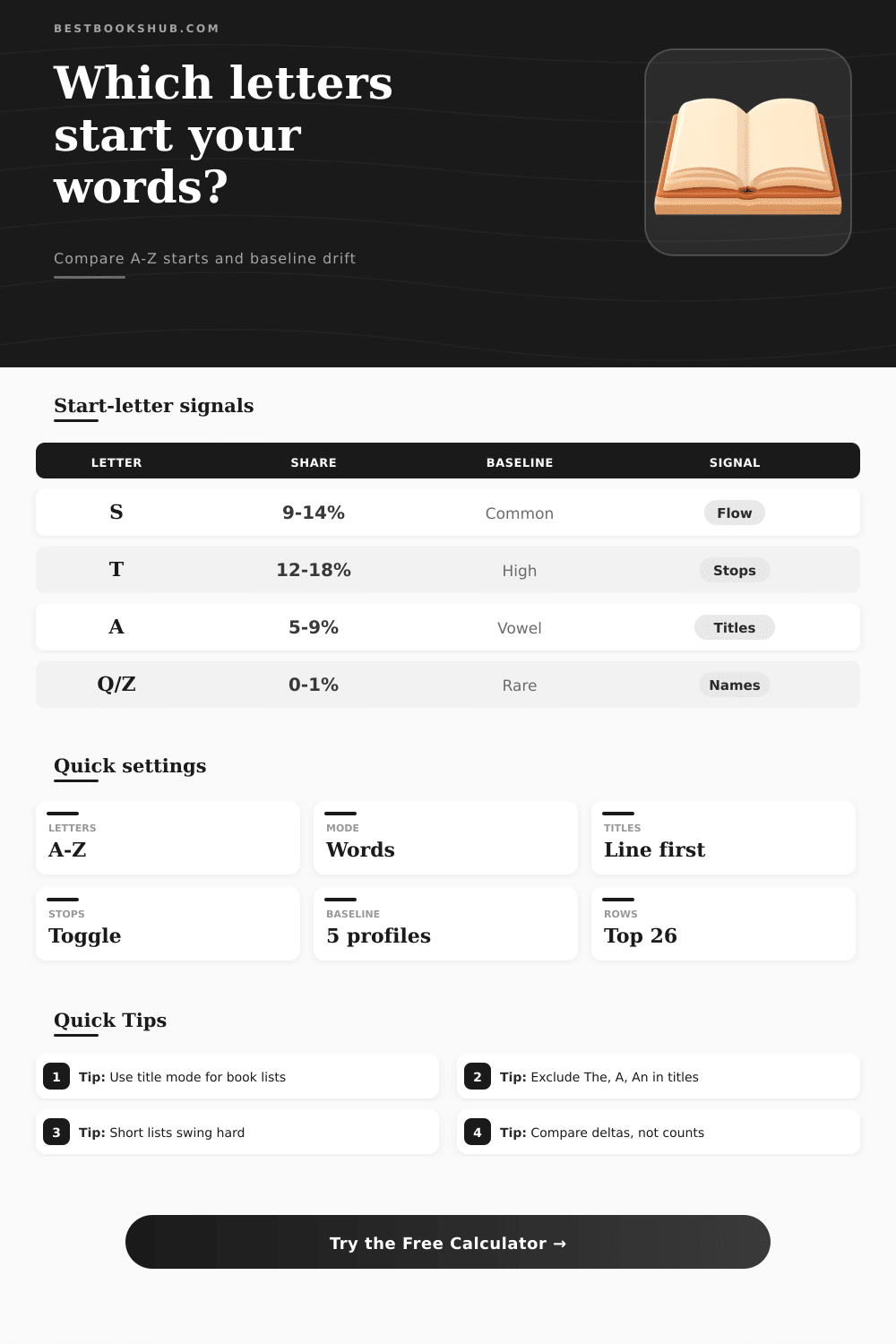
Use this initial letter frequency calculator to count first letters, compare consonants and vowels, ignore stopwords, and detect shifts away from names, titles, or standard English. The first letter of a word matter when we’re reading it aloud, fitting it into memory, or scanning a list of titles. Some letters is dominant; others show up rarely in English texts. Game designers, writers, editors, and librarians knows that much about words’ first letters isn’t random. It reveals the habits by which you tell stories, name things, and form your thoughts.
Knowing this order shift how you might analyze a manuscript, craft a heading, or build a list. Plug in a list or passage and it shows you which letters take the lead. Naturaly, you’d assume that vowels would front quite frequently. But most of the time, function words (such as “the,” “some” and “to”) sucks the distribution toward consonants, hence their prevalence in day-to-day writing.
Why First Letters Matter
Toggle the unit type to title style, however, and you see a different view. The leading articles dissapears and the subject words emerge. In book lists, A, S and C fight for first place. That’s why your bibliography looks one way and your novel manuscript another when they land on paper.
The stop words makes an enormous difference, far more than newbies expects. No, common pronouns and articles aren’t noise. They change the impact of every percentage point. Run them through, and your results will swing wildly, especially on short samples. The calculator enables you to run it both ways, with and without common pronouns and articles.
And that’s where you’ll get short lists with often-extreme results. Twelve character names can spits out big differences, but those go away when you gets up to several hundred entries. That’s why the tool displays baseline drift measured in average points. A two-point gap seems like a huge deal … till you learn most naturaly occurring English text lie within three to four points of what you’d expect.
Names has patterns. In most of West, people prefer certain sounds when they name their kids (hence why there’s a lot of J, M, and A as first names). For whatever reason, it used to be the case that your surname tended to be clustered around S, M, and B. If you run the same list twice… Once with names in first-name mode, once with them all switched to last name mode, it feels like you’re reading two different languages. Those real world patterns are baked into baseline of the calculator, which is why the differences you see is meaningful.
Another insight is how the vowel setting affects it. For most prose, changing to include Y as a vowel impact the split by just a few percent, but that difference can pushes a close decision over edge. For example, beginning a title with an obvious vowel sound favors that cover when designing for children’s books. With this tool, you can hear out each definition without guessing.
But then there’s taste, which doesn’t get captured by the numbers. What appears balanced across a screen might sound flat to the ear. Sometimes surprise itself becomes part of the signal, when it breaks statistical rules in ways that make for the best heading. Knowing what the baseline is turns such acts of rebellion into intent, not accident.
The truth is, though, the first letter’s just a little door hinge opening bigger doors than I could of imagined. Play around for a minute with the calculator; let your shares go up and down on each click, and soon you’ll start to pick out the rhythm English’s kept all this time. No, the letters weren’t spaced in even intervals. When you see the rhythm, you stop resisting and start conducting.