📚 Storytime planning tool
Storytime Session Planner Calculator
Build a balanced read-aloud schedule from session length, books, songs, activities, age group, transitions, pace, and attention span.
Choose a session model, then adjust the book count, read-aloud pace, transition time, songs, activities, and age range to match your group.
DISCLOSURE: This post may contain affiliate links, meaning when you click the links and make a purchase, I receive a commission. As an Amazon Associate I earn from qualifying purchases.
This grid turns the calculated blocks into a practical order that alternates quiet listening with movement and participation.
| Age group | Typical session | Book count | Attention span used | Planning note |
|---|---|---|---|---|
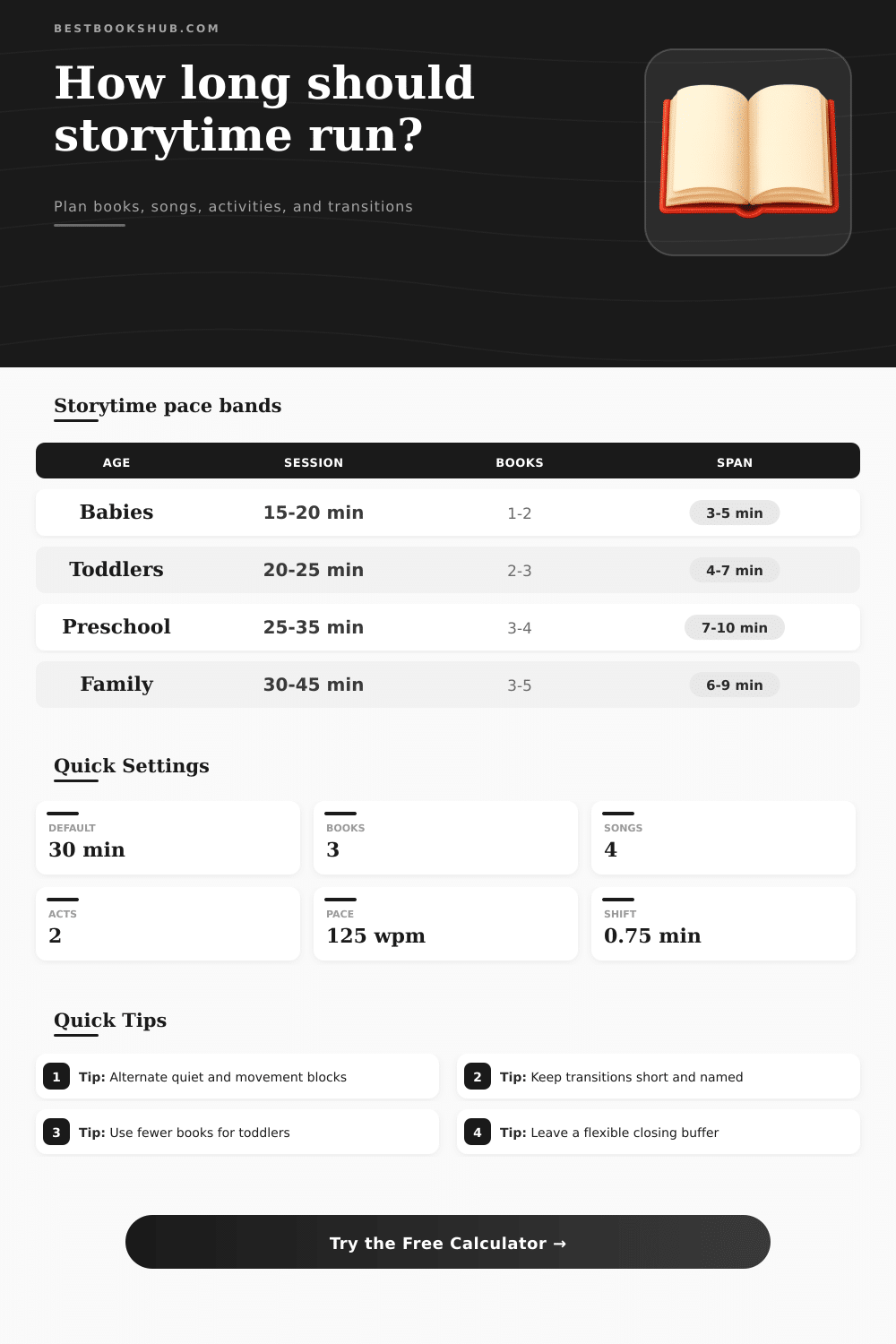
| Babies and crawlers | 15-20 minutes | 1-2 short books | 4 minutes | Use repetition, lap rhymes, and very short read-aloud segments. |
| Toddlers | 20-25 minutes | 2-3 short books | 6 minutes | Plan frequent songs, motions, and transitions with clear cues. |
| Preschool | 25-35 minutes | 3-4 picture books | 9 minutes | Balance story structure, questions, movement, and one longer activity. |
| Kindergarten | 30-40 minutes | 3-5 books | 11 minutes | Use prediction prompts, vocabulary talk, and longer response windows. |
| Mixed family | 30-45 minutes | 3-5 varied books | 8 minutes | Keep the plan flexible for siblings with different attention needs. |
| Early elementary | 35-50 minutes | 4-6 books or excerpts | 13 minutes | Add discussion, retelling, drawing, or literacy extension blocks. |
| Pace setting | Words per minute | Best for | Effect on plan |
|---|---|---|---|
| Very expressive | 80-100 WPM | Babies, toddlers, humor, repeated refrains | Longer book time, more room for page pointing and vocal play. |
| Standard storytime | 110-135 WPM | Most picture-book read-alouds | Balanced speed with time for questions and page turns. |
| Brisk familiar book | 140-165 WPM | Rereads, cumulative books, older groups | Shorter reading time, but can reduce response time. |
| Discussion-heavy | 90-120 WPM | Dialogic reading and school readiness sessions | Use higher interaction level so the calculator adds response space. |
| Block type | Typical length | Good count | Planner role |
|---|---|---|---|
| Hello or goodbye song | 1-2 minutes | 2 total | Creates a predictable frame and helps the schedule feel complete. |
| Fingerplay or rhyme | 0.5-1.5 minutes | 2-5 | Resets attention between books without changing the room setup. |
| Movement song | 1.5-3 minutes | 1-3 | Balances seated listening with gross-motor release. |
| Prop or flannel activity | 3-6 minutes | 1-2 | Adds participation and sequencing, but needs transition time. |
| Craft or extension | 6-12 minutes | 0-1 | Works best when the session length allows a larger final block. |
| Preset | Age focus | Length | Books | Design intent |
|---|---|---|---|---|
| Baby Bounce | Babies | 18 minutes | 1 | Short book, lap rhymes, repeatable songs, minimal transitions. |
| Toddler Wiggle | Toddlers | 22 minutes | 2 | Movement-heavy plan with compact read-aloud blocks. |
| Preschool Rhythm | Preschool | 30 minutes | 3 | Balanced books, songs, and one activity with a small buffer. |
| Family Library Hour | Mixed family | 42 minutes | 4 | More flexible time for varied ages and caregiver interaction. |
| School Readiness | Pre-K to K | 40 minutes | 4 | Longer response windows with vocabulary and sequencing activity. |
The toddler wriggles in their seat, and the clock glares back at you, making you panic. Three books! There are two fingerplays. There is a craft activity. And now the whole thing seem to be coming down around itself. The energy is flagging and attention wanders. The goodbye song comes too late to salvage what was left of structure.
It isn’t that you failed creatively. More likely, you failed numerically. Telling storytime tend to be based off the number of books you loved instead of how many the human brain is capable of holding up to in a circle. Tools for planning makes both you and your audience happier and more engaged, and keep you sane.
Plan Your Time Well
Not everyone has an attention span. It varies, especially depending on age, how many people are in the group, the time of day, and so on. An infant’s attention span is measured in seconds (they need rapid shifts every few minutes!), while a preschool group may be able to sustain more extended narratives as long as they’re broken up with activity.
Use the calculator above to enter how long you want each session to last, and it’ll break it down into manageable chunks for you. It’ll also make you consider all those “invisible” time sucks which trip up any good storytime planner. There isn’t enough time given between transition. Whether it is sitting songs or standing dances, resetting props or rearranging chairs take energy and requires some leadership, but these tasks adds up over time. Otherwise, you risk creating a storytime plan that’s more akin to a tightrope walk, one wobbly moment and you’re off kilter for the next forty-five minutes.
Another one that catches folks off guard is how fast they actualy read. Interactive reading really does slow things down a lot. This is because you are slowing down your words per minute. You do this by pausing to point out pictures, asking questions, and letting kids fill in repeated phrase. To account for that, you can play with an interaction level multiplier. Clearly, a straight-forward read-aloud will be faster than a more conversational session where you has lots of back-and-forth between child and parent.
Not accounting for the added time here means that you end up either rushing toward the end of books or skipping part of the closing routine just to get out the door on time. It’s laid out nicely in the reference table on the page, you can see how each pace affect your overall runtime.
Also, there’s the interplay of active participation vs. Quiet listening: Every minute or two, toddlers need to move around again to re-focus; preschoolers can go a bit longer (but still appreciate breaks between sitting and standing stuff). You’ll be able to see that balance in action with the calculator, which display the quiet-to-active time ratio. Too many books? It’ll tell you if you’re going past the average kid’s ability to sit still at that age. Again, just little things, but they matter so much when you want to keep kids from fidgeting out of their seat before you get to the good part of book.
In the end, while all of this takes serious preparation, a solid storytime will appear smooth. That’s what the buffer time can do for you. It provides a safety net if something goes wrong, a child asks a question, or there is simply a need to repeat a song that was way too much fun. Don’t waste this time! Use it as the oxygen mask, keeping the session alive when it gets a little off track.
Trusting your numbers over your gut feeling makes room for realy having a great time interacting with those kids. You aren’t focused on the clock anymore; you’re in the moment. So pick a pre-set that matches your crowd and adjust variables accordingly for the space and dynamic of the kids in the room. Perfection isn’t our goal here, flow is what we’re after. If it clicks, you’ll forget all about the wall clock and instead watch the kids’ faces. And before you know it, everyone is leaving happy (not rushed). Plan the math; let the story unfold.