🔗 Dependent clause scan
Subordinating conjunction counter
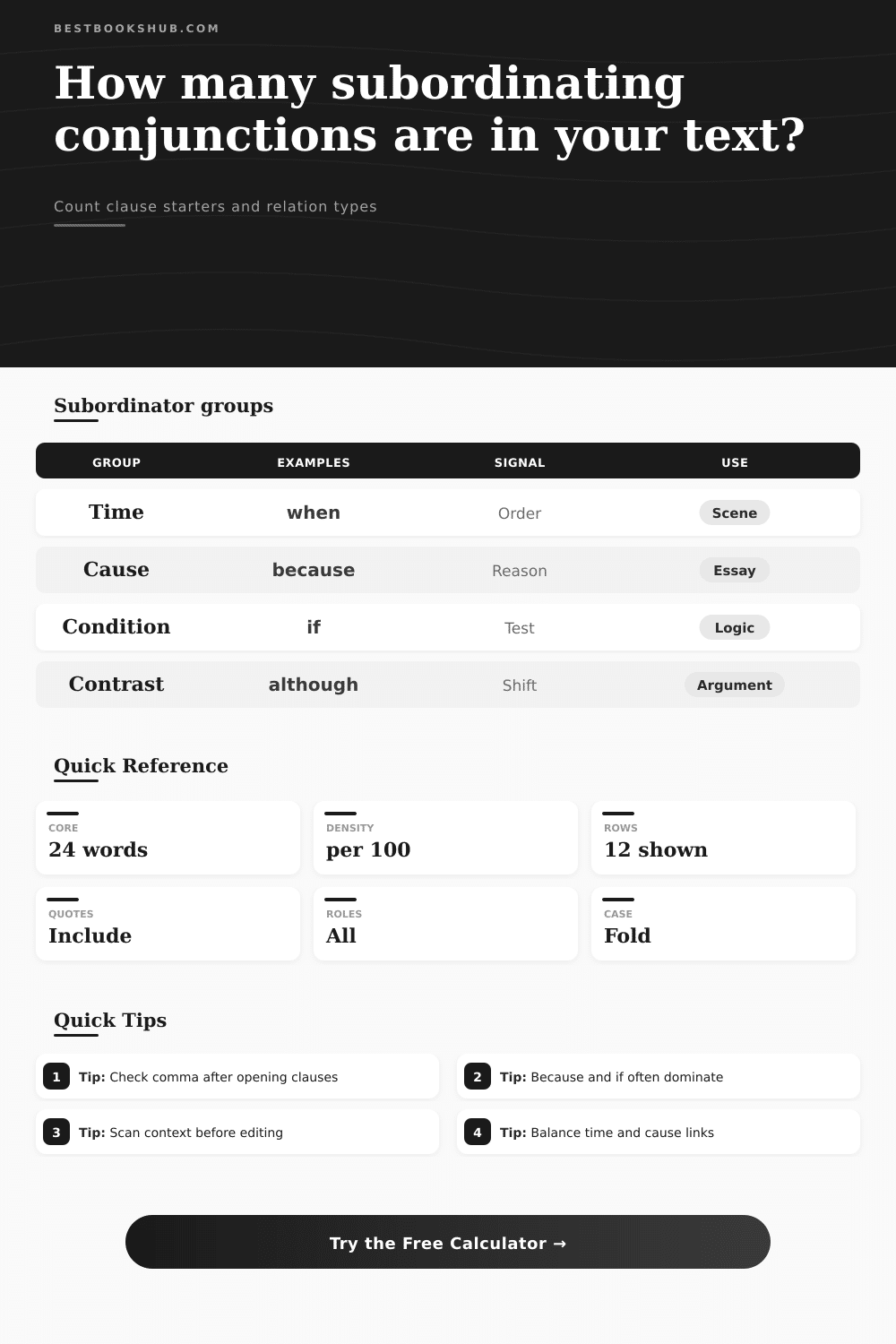
Paste prose, essays, dialogue, academic notes, or article drafts to count subordinating conjunctions, estimate dependent-clause patterns, and compare time, cause, condition, contrast, purpose, place, and manner links.
Load a preset to compare common clause patterns across narration, argument, instruction, dialogue, analysis, summary, and revision passages.
DISCLOSURE: This post may contain affiliate links, meaning when you click the links and make a purchase, I receive a commission. As an Amazon Associate I earn from qualifying purchases.
The scanner matches whole subordinators and selected multiword links, then estimates clause position from punctuation and nearby words. Review context rows for borderline uses such as that, since, while, and once.
| Match | Relation | Position | Clause cue | Context |
|---|---|---|---|---|
| Load a preset or paste text to show matched subordinating conjunction rows. | ||||
| Relation | Common subordinators | Typical clause question | Editing note |
|---|---|---|---|
| Time | after, before, when, whenever, while, until, once, as soon as | When does it happen? | Opening time clauses usually need a comma. |
| Cause | because, since, as, now that, seeing that | Why does it happen? | Because gives a direct reason; since may be temporal or causal. |
| Condition | if, unless, whether, provided that, even if, only if | Under what condition? | Check whether the main clause still stands alone. |
| Contrast | although, though, even though, whereas, while, despite the fact that | What contrast appears? | Many contrast clauses can make argument flow feel hesitant. |
| Purpose | so that, in order that, lest | For what purpose? | Purpose clauses should clearly attach to the intended action. |
| Position | Example shape | Punctuation cue | What to check |
|---|---|---|---|
| Opening | Because the draft changed, the ending works. | Comma after clause | Make sure the comma follows the whole dependent clause. |
| Middle | The chapter, although short, changes the argument. | Pair of commas | Check whether the inserted clause interrupts cleanly. |
| Ending | The ending works because the draft changed. | Often no comma | Check whether the ending clause is essential. |
| Compound | The rule applies only if the source is clear. | Phrase boundary | Multiword subordinators should be counted as one signal. |
| Word | Can be subordinate? | Can be another part? | Manual review cue |
|---|---|---|---|
| That | Yes, content clause marker | Demonstrative or relative marker | Look for reporting verbs such as says, thinks, or knows. |
| Since | Yes, time or cause | Preposition in short phrases | Ask whether it means from then or because. |
| While | Yes, time or contrast | Noun in rare cases | Ask whether it means during or although. |
| As | Yes, cause, time, manner | Comparison marker | Check nearby words before assigning relation. |
| For | Usually not counted here | Preposition or coordinator | Use because if you need a clear reason clause count. |
| Passage type | Typical density | Common relation | Revision focus |
|---|---|---|---|
| Narrative prose | 3 to 7 per 100 | Time and cause | Watch stacked when and as clauses in action scenes. |
| Academic paragraph | 5 to 10 per 100 | Cause, condition, content | Balance that clauses with direct noun phrases. |
| Instructional copy | 4 to 9 per 100 | Condition and time | Keep if and when conditions close to the action. |
| Dialogue | 2 to 8 per 100 | Content and cause | Reported speech can inflate that-clause counts. |
| Review or editorial | 4 to 9 per 100 | Contrast and cause | Too many although or while turns may blur the stance. |
If you’ve been editing for more than a few minutes, chances are you’ve come across countless sentences where everything seem fine except for one little thing: something just doesn’t sound right. There’s no issue with the logic or even the rhythm, but something about how it sounds isn’t quite clicking. That’s typically an issue with what we call “subordinating conjunctions.”
Think of these as words like if, when, although, or because that stick two independent thought together. By using a subordinating conjunction, you’re creating a ranking and you’re indicating to the reader what your main idea is versus what supports it. Without knowing where to place your subordinating conjunction, your sentence lose their anchoring point.
How to Use Subordinating Conjunctions for Clear Writing
Plug in your sentence into the calculator above, and let it do the math work for you (no need to guess distribution or count). Let it strip out the noise so you can see skeleton of your sentence.
There’s a common problem among most writers: they spend far more time worrying about vocabulary than structure. Instead of substituting small words for large ones (a tactic which usually fails), they should of focus more on how to convey intelligence through structure.
“Although” suggests a concession, telling the reader that you are about to pivot. “Because” implies a reason and require evidence. Too many identical-signal sentence make your writing monotonous. The tool hunts for these patterns and clusters them according to their relationship types.
Can you tell if you’re using too many conditional-logic sentences? Or maybe you lean too hard on time clauses? Reading alone doesn’t provide this kind of insight. But raw totals aren’t everything. A research summary may have a higher density of cause links than a dialog scene. And that’s okay, as long as context make sense.
The need for precision is what fuels academic style: those links provide the detailed information about where each piece of evidence support the claim. For narrative prose, we want variety: we don’t want a checklist feel; we want things to flow through time. Narrative prose needs variety and needs to move through time without feeling like a checklist.
The reference tables gives you an idea of what’s normal, genre by genre. You might find that the average number for instructional copy is at or near the ceiling. You might find that the average for argument essays is on the lower end. That suggests that you’re filling in the gaps in your logic (too little?) or that you’re overexplaining (too much?). But again: this is all guidance. Meaning is what counts.
Ambiguity is a silent killer. Tricky words include as, while, and since. They might mean contrast or time depending on their placement. Since may mean a reason for something or a starting point in history. These are borderline cases for the scanner. They invite you to look closer. And this should be seen as a feature rather than a bug.
Always check your weakest links. Not sure if a clause is essential? Eliminate it and then read the sentence. If the main point holds up, then the subordinate clause was likely clutter. If the point falls apart, that’s when the link was doing most of the work.
This is what most people don’t get. A comma should separate the opening clauses and, unless there’s a good reason, they shouldn’t be closed with one as well. It sounds like an easy rule but it’s one that’s prone to breaking under pressure. Under pressure. Meaning when we’re writing quickly, we often forget where one idea ends and another begins.
The tool divides openings, middles and endings. What does this tell us? We might be stacking our clauses mid-sentence, creating a breathless feeling. Or perhaps we avoid having any at all; that makes for choppy writing. Clause positioning adds variety, which adds rhythm. It allows the reader time to breathe. It stops things from becoming monotonous.
Editing is a process of taking out friction, not putting in words. You want your argument to glide on down the page with no one noticing the mechanics at work. The mechanics are the subordinating conjunctions. If they are not noticed, then that’s good writing. If they’re clunky, they trip you up.
This calculator provides you with a map. It tells you when the road gets rough, and it tells you how to smooth the edges. You don’t have to remember all the rules. It tells you just where to look. Point the tool the way, and then you get to make the call.
Do I keep the shift? Is this contrast valuable? Do I really need this condition? Clarity. It always has been. Be clear in what you say and how you say it. Structure should provide clarity that supports your content instead of distracting from it.
This knowledge about these conjunctions helps you have more control over the sound of your voice. And you will depend less on chance. You stop relying on luck. You create more of your own sentence designs.
The numbers are only a beginning place; they show you trends. They help you identify patterns, but you still must read the outcome and decide for yourself if it works or doesn’t work. Feel the flow. Read it aloud. See if it makes sense. If it’s good, then it holds its weight. If it’s not, then pare it back.
Strong foundations build good writing. It holds up under examination. It takes the reader where you intend them to go.