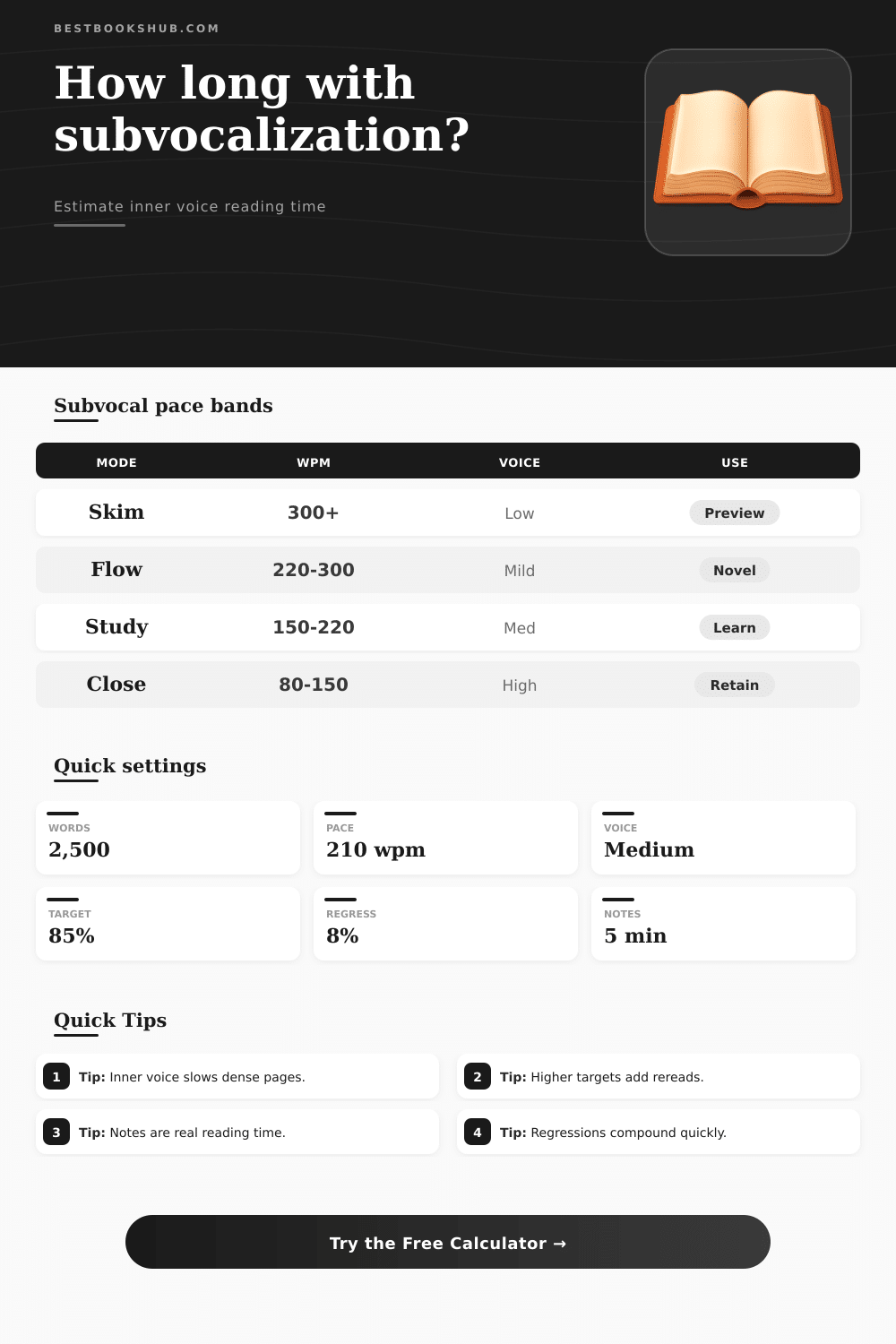
📖 Inner voice timing lab
Estimated Subvocalization Reading Time Calculator
Estimate reading time when your inner voice, target comprehension, text difficulty, regressions, and note-taking all change the pace.
| Subvocalization band | Multiplier | Typical signal | Best fit |
|---|---|---|---|
| Minimal inner voice | 1.00-1.08x | Visual recognition | Skimming |
| Light inner voice | 1.09-1.16x | Phrase sound | Fiction flow |
| Strong inner voice | 1.17-1.40x | Mental speech | Study text |
| Nearly oralized | 1.41-1.70x | Word-by-word | Poetry or scripts |
| Base WPM | Light voice | Moderate voice | High voice |
|---|---|---|---|
| 300 wpm | 280 wpm | 255 wpm | 225 wpm |
| 240 wpm | 224 wpm | 204 wpm | 180 wpm |
| 200 wpm | 187 wpm | 170 wpm | 150 wpm |
| 160 wpm | 150 wpm | 136 wpm | 120 wpm |
| Text difficulty | Difficulty factor | Regression cue | Reading use |
|---|---|---|---|
| Easy prose | 0.94x | 0-5% | Relaxed read |
| Standard prose | 1.00x | 5-10% | Most books |
| Dense nonfiction | 1.16x | 10-18% | Concept load |
| Technical text | 1.32x | 18-28% | Study notes |
| Session type | Words | Notes per 1k | Target range |
|---|---|---|---|
| Speed practice | 800-1,500 | 0-1 min | 60-75% |
| Book chapter | 2,000-4,000 | 2-5 min | 75-85% |
| Study section | 1,200-3,500 | 5-9 min | 85-92% |
| Close read | 400-1,500 | 8-14 min | 90-97% |
DISCLOSURE: This post may contain affiliate links, meaning when you click the links and make a purchase, I receive a commission. As an Amazon Associate I earn from qualifying purchases.
Subvocalization is the mental speech that a person perform while reading text. Subvocalization is also a process that change the speed at which a person reads. When a person reads, many peoples subvocalize and hear the words in there head.
However, this process increase the amount of time that it takes for a person to finish reading the text. An estimated subvocalization reading time calculator will help to calculate the time that it will take for a person to finish reading a text when including the time used for subvocalization. The estimated subvocalization reading time calculator use specific reading habits for a more accurate reading time estimation.
How Subvocalization Changes Reading Time
The estimated subvocalization reading time calculator will allow a user to set an intensity level for their subvocalization. The estimated subvocalization reading time calculator will also allow a user to set a custom multiplier for the subvocalization that they perform when reading. This is because different levels of subvocalization will impacts the reading speed of the individual.
If a person have high subvocalization, they will read at a slower rate then if they have low subvocalization. Another feature of the estimated subvocalization reading time calculator is the ability to enter the comprehension target that the reader desires to achieve when reading the text. If a high level of comprehension are targeted, it will take the reader more time to read the text.
The estimated subvocalization reading time calculator also incorporates the difficulty of the text and the regression that a reader may experience while reading. Regressions occur when a reader’s eyes moves back to words that they have already read. High text difficulty create more regressions than low difficulty text.
Because high text difficulty result in more regressions, the reading time will be higher for texts of more higher difficulty. Furthermore, the calculator also takes into account the time necessary to take notes and to take breaks. Taking notes is the act of writing summary and highlighting important points, which take time away from reading.
Taking breaks is a period of mental rest, which also adds to the total amount of time that it takes to read a given text. The calculator can be used to compare the time that is required from different reading strategies. For instance, one could use a low target for comprehension and take minimal note to read a text quickly.
Alternatively, using a high target for comprehension and taking notes will result in the text being remembered after reading, but it may take more time. Thus, the calculator allows an individual to make a decision as to how fast they would like to read versus how much comprehension they would like to gain from reading. It is likely that the calculated time to read a text will be higher than expected.
The reasons for this include the time to take notes and breaks, as well as the regressions that the reader may have while reading. Thus, if the individual calculates with a high rate of regressions and taking notes, the time will be longer than if they were simply reading the text without taking any notes. If the calculated time to read a text is more higher than expected, the individual should of review the input for subvocalization, regressions, and taking notes.
Finally, this reading time calculator is a tool that allow individuals to go from general estimate of reading time to specific plans for reading by using the individuals specific habits to calculate the reading time required to read a certain amount of text.