📖 Reading speed lab
Subvocalization speed adjuster calculator
Estimate how inner voice strength, visual span, regressions, text complexity, and comprehension targets change real reading speed without pretending every reader should silence words completely.
Start with a measured base speed, then describe how much of the text you hear, how much you are trying to reduce it, and what the text demands for retention.
| Method | Speed effect | Comprehension effect | Best use |
|---|---|---|---|
| Finger pacing | Small to moderate gain | Usually stable | Reducing stalls and wandering eyes |
| Phrase chunking | Moderate gain | Stable when phrases stay meaningful | Fiction, essays, trade nonfiction |
| Peripheral span drill | Moderate to high gain | Depends on text density | Wider fixation and fewer eye stops |
| Metronome pressure | High short-term gain | Riskier for dense text | Training sessions, not first-pass study |
| Auditory masking | Variable gain | Can reduce retention | Brief experiments, familiar material |
| Material | Typical base WPM | Voice benefit | Caution |
|---|---|---|---|
| Light fiction | 240-330 | Moderate reduction can help pace | Do not lose dialogue tone if it matters |
| Trade nonfiction | 190-270 | Chunking helps headings and examples | Pause for arguments and definitions |
| Dense classic | 150-230 | Small reduction only | Syntax often needs a slower pass |
| Textbook | 90-180 | Limited speed gain | Problems, diagrams, and recall dominate time |
| Research article | 70-160 | Usually low | Terminology and citation checks matter |
| Adjusted WPM | 250 wpp pages/hr | 325 wpp pages/hr | Good reading mode |
|---|---|---|---|
| 120 WPM | 29 pages/hour | 22 pages/hour | Study or proofread work |
| 180 WPM | 43 pages/hour | 33 pages/hour | Careful nonfiction reading |
| 240 WPM | 58 pages/hour | 44 pages/hour | General trade reading |
| 300 WPM | 72 pages/hour | 55 pages/hour | Fast familiar reading |
| 420 WPM | 101 pages/hour | 78 pages/hour | Skim or preview pass |
| Scenario | Base WPM | Inner voice | Likely outcome |
|---|---|---|---|
| Casual Novel | 240 | Moderate | Useful gain with low risk |
| Textbook Study | 155 | Heavy | Small gain, retention first |
| Preview Skim | 380 | Light | Fast pace, low detail capture |
| Proofread Pass | 130 | Near-aloud | Slower voice may be helpful |
| Speed Training | 230 | Heavy | Test in short controlled blocks |
DISCLOSURE: This post may contain affiliate links, meaning when you click the links and make a purchase, I receive a commission. As an Amazon Associate I earn from qualifying purchases.
For poetry, dialogue, proofreading, and difficult arguments, the inner voice may protect meaning even when it lowers raw speed.
Try a 10-minute passage, write a summary, then compare speed only if recall and confidence are still acceptable.
So you read a page, but when you look back up you have no idea what you just processed. It happens to all of us from time to time. This usually happens when text becomes dense or the inner voice in your head begins to race ahead than your eyes.
That inner voice is known as subvocalization, and this is the primary bottleneck that prevents most readers from increasing their speed. You’re literally limited to speaking internally at rate that you read. Four hundred words per minute is about as high as you’ll cap yourself without changing how you process information.
How to Read Better and Faster
The calculator above do the math for you after you input your current habits. No more guessing at conversions and coefficients; it gives you a realistic target and saves you the work.
People assume the idea is to entirely shut off little voice inside your head, but that doesn’t tend to work for complicated stuff. We understand what we’re reading in part because subvocalization anchors the meaning by letting our brain process it using sound (the same way we hear spoken words). You don’t want that voice turned down when you’re reading legal contracts and technical manuals.
You’ve got that option, the tool enables you to dial up or down based on how heavy the content is. For example: if you have your inner voice set at “light fiction” level but then attempt to skim-read a textbook, you’ll notice your understanding go down the toilet. There’s an entire reference table on the page explaining this.
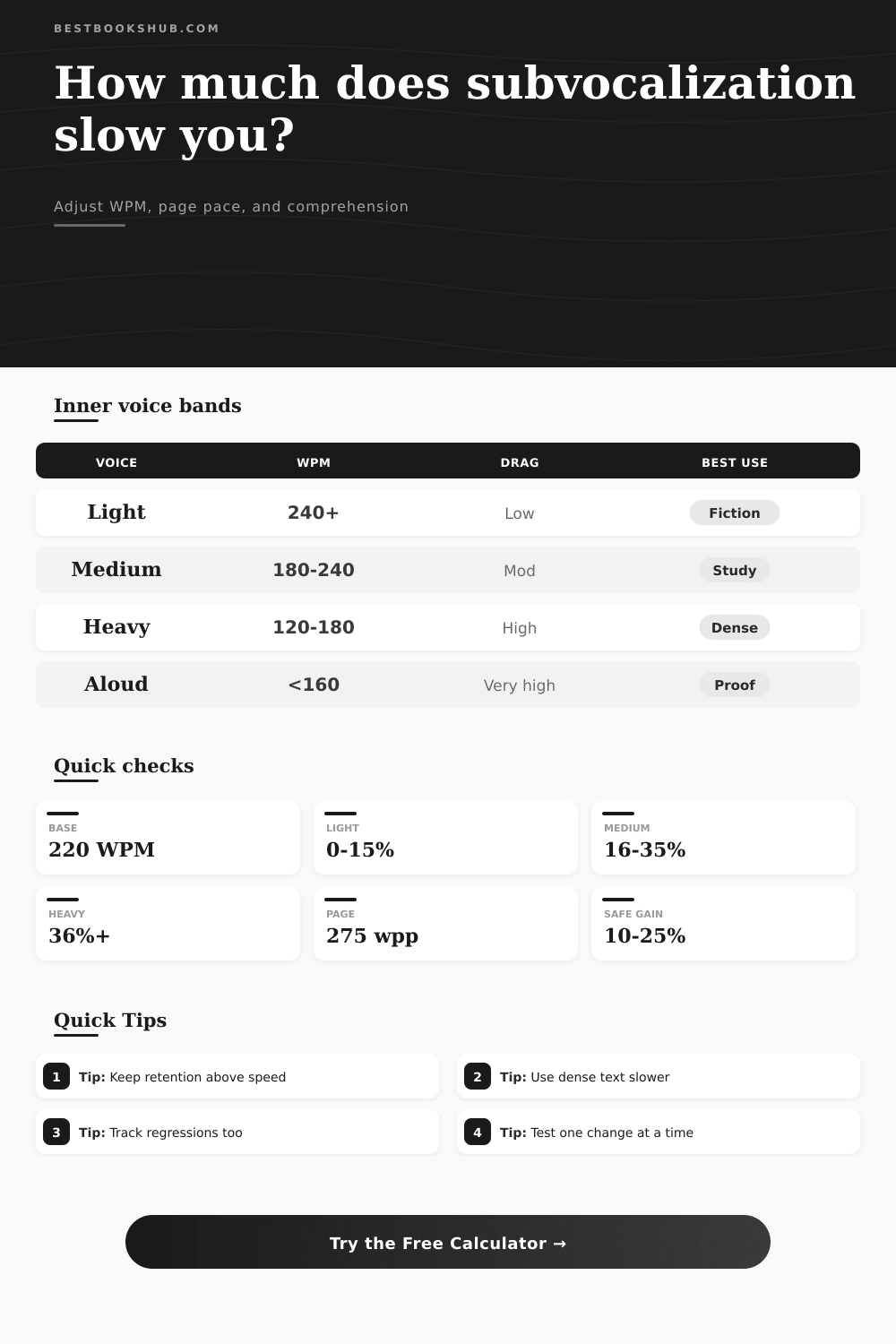
No matter how quickly your eyes move across the screen, dense writing require a slow pace. The tradeoffs are modeled through design of the tool’s inputs. Beginning with your current base speed, you’ll describe the strength of your inner voice: Is it light (i.e., used only when necessary, like remembering a name or difficult phrase)? Or is it strong (i.e., you’re pronouncing every word that comes to mind)?
Next, select your desired reduction level. Most folks fall into this trap here: They get greedy. Remember, aggressive reductions could of possibly double your speed on paper … but can result in zero comprehension. And what good is being twice as fast if you have no idea what you just read? That’s not reading; it’s eye training.
The inner voice isn’t the only thing that matters; visual span and regression patterns matter too. You’re not going to get much improvement from any subvocalization reduction if you’re only picking up on one word with each fixation. To make progress, you have to widen your peripheral vision and absorb chunks of three or four word. This reality is reflected in the choice of methods in the tool.
Finger pacing reduces stalls but offers only a small gain. Phrase chunking forces your brain to work with bigger units of meaning and thus gets you a moderate boost. Auditory masking has big potential for short term gains but also runs a big risk of missing detail. So it is best left as an experiment (for brief bits of stuff or familiar material) rather than as first-pass study.
Finally, consider how often you take breaks and what your daily reading routine looks like. Can you sit down and read for an hour at a time? Does that require breaks, or are you able to read for 45 minutes with no interruptions? The page pace output takes your adjusted words per minute and converts them to something tangible: pages per hour. From there you can use it to estimate how long it will take you to get through a chapter or even finish a book.
Say the tool tells you that you’ll be able to read three hundred pages an hour? Check the comprehension risk label before committing. Is it high? Slow down! In general, you should aim for a safe gain range between ten and twenty five percent. That way, you aren’t giving up too much in terms of meaning.
Block train in controlled settings instead of all at once. Apply these pre-set scenarios to a book of your choosing (with varying difficulty) to mimic various reading conditions. Try fast fiction on an easy novel, and then careful study on a textbook. How do they compare? What’s your retention like?
The section called “breakdown” reveals exactly how much of your final score comes from each factor. That way you know which is holding you back: your inner voice or your visual span. To find out, adjust one variable at a time.
No speed target is right or wrong. It depends on what you’re trying to accomplish, how demanding the material is, and how quickly you prefer to process words. Sometimes, we want the gist; sometimes, we want to absorb all the details. The calculator will measure those trade-offs so you can find your ideal balance.
If you’re chasing higher scores, fine. But be prepared to pay for it in terms of comprehension. Set real world expectations using the calculator. Test them against real world reading. Track your results over time.
Remember, the inner voice is not the enemy. It’s a tool designed to help you understand. Use it wisley.