📖 Prosody checker
Syllabic verse validator
Paste a poem, choose a named syllabic form, and inspect every line against the target pattern with custom word overrides for names, dialect, and poetic elision.
| Line | Verse text | Words | Count | Target | Delta | Status |
|---|---|---|---|---|---|---|
| No poem lines scanned yet. | ||||||
| Verse form | Syllable pattern | Line count | Validation note |
|---|---|---|---|
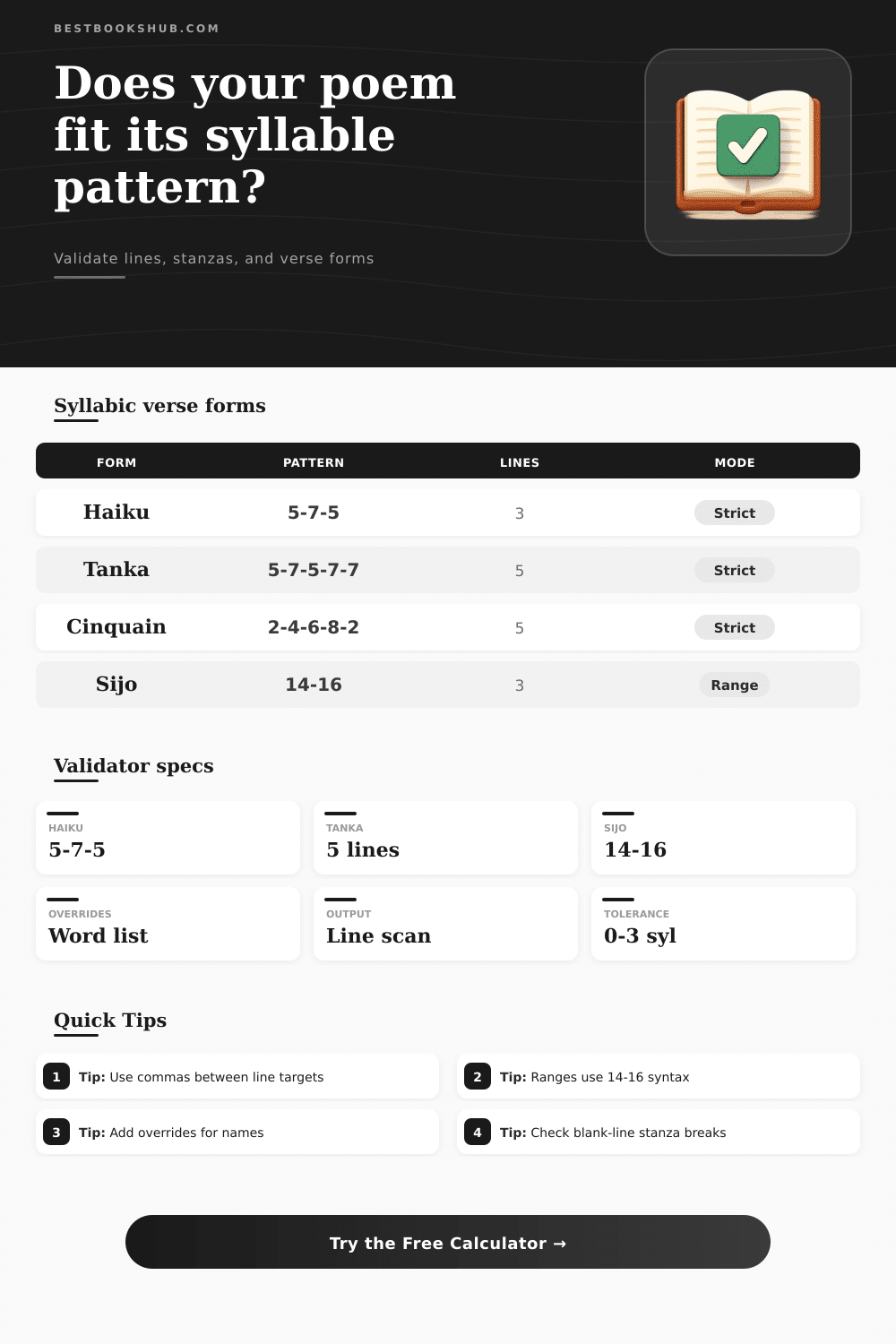
| Haiku | 5-7-5 | 3 lines | English haiku often treats 5-7-5 as an optional target, but this validator can check it strictly. |
| Tanka | 5-7-5-7-7 | 5 lines | The first three lines echo haiku shape, followed by two seven-syllable lines. |
| American cinquain | 2-4-6-8-2 | 5 lines | Adelaide Crapsey's syllabic form uses a rising and closing profile. |
| Etheree | 1-2-3-4-5-6-7-8-9-10 | 10 lines | A steadily expanding syllable ladder, often reversed or doubled. |
| Fibonacci poem | 1-1-2-3-5-8 | 6 lines | Uses the opening Fibonacci sequence as line syllable targets. |
| Sijo | 14-16 each line | 3 lines | English sijo commonly uses three long lines with flexible syllable ranges. |
| Counting feature | Default treatment | When to override | Example |
|---|---|---|---|
| Silent final e | Usually removed | Override when the ending is sung or archaic | time is 1, cafe is 2 |
| Final -ed | Auto by word ending | Use spoken mode for blessed or learned as adjectives | walked is 1, blessed can be 2 |
| Vowel teams | Counted as one sound group | Override poetic separation or compression | fire can be 1 or 2 |
| Hyphen compounds | Split by default | Join if the compound is pronounced as one unit | moon-bright scans as two words |
| Form family | Strictness | Best pattern mode | Common validator risk |
|---|---|---|---|
| Japanese-inspired English forms | Medium to strict | One complete form | English syllables do not equal Japanese on units. |
| Invented syllabic forms | Strict | One complete form or repeat | Short lines make one-syllable errors obvious. |
| Long-line syllabics | Flexible | Range targets | Caesura and phrasing may matter beyond total count. |
| Stanzaic syllabics | Strict by stanza | Restart at stanza breaks | Blank lines must mark stanza divisions clearly. |
| Pattern notation | Meaning | Good use | Input example |
|---|---|---|---|
| Comma list | Exact target per line | Haiku, tanka, cinquain | 5,7,5 |
| Hyphen range | Minimum to maximum | Sijo or flexible lines | 14-16,14-16,14-16 |
| Repeat mode | Cycles through targets | Multiple haiku or repeated quatrains | 8,8,8,8 |
| Stanza restart | Resets after blank line | Linked stanzas with same pattern | 5,7,5 per stanza |
DISCLOSURE: This post may contain affiliate links, meaning when you click the links and make a purchase, I receive a commission. As an Amazon Associate I earn from qualifying purchases.
Perhaps the first hurdle for poets trying to master this type of verse is that it seems like a no-brainer on paper: You tap out three lines, count the number of syllables, and think you’ve got the hang of haiku. In English, however, counting isn’t always quite as easy than tapping along with a metronome. There are elided vowels; there are silent letters; there are compound words whose length depends on how quickly they’re spoken. That is why a validator is needed.
It allow a poet to check his or her work and see how the piece work as a draft. Because it counts by using particular engines on the word themselves (instead of making you guess at your own pace) the calculator lets you get the number without having to question whether something looks correct but doesn’t sound like it’s in time with anything.
How to Count Syllables Correctly
Poets do leave out sounds when they read, compressing omissions that occur naturaly when speaking, and this tool differentiates between that and an estimated count in standard moddern English usage. The word “fire” have two syllables (or so the textbooks say) if you are being all strict about things, but spoken casually reduces to one. If you’re writing for breath or speed, it’s better to have the count reflect that, rather than more formal version of what the word is written as. These options allow you to adjust for both strict grammatical count and a flowing oral approximation.
Preset is important because each form has expectation based off its history. In English, haiku follow 5-7-5 pattern as do their Japanese counterparts but they count different. A tanka uses five line to grow the form’s longer narrative arc. Experimental poems such as the Etheree construct a ladder of syllables, starting at one and ending at ten. The Fibonacci poem sets length of lines through mathematical sequence. Each form constrain creative expression in a particular way.
Tables laying out the forms make clear where those constraints lie, where your draft conform to the traditional form, or where you break it deliberately. Proper names and suffixes are some of the more challenging elements to account for with syllabic counting. For example: “blessed” is two-syllable while “walked” is one syllable (ending in “-ed” depends on what came before it). You can also tell the validator that certain dialect words or character name should be counted different than their default setting.
Accuracy is important in voice-driven poetry; if you say a name have two syllables but the tool thinks it has three, it throws off whole line balance and disrupts any tension you’re aiming for. Keep other things in mind, such as stanza breaks and tolerance levels. When you’re starting out, it’s good to be strict: Any variation is flagged as invalid. As you gain experience, though, you tend to allow yourself one or two syllable drift on every line. But still try to stick close to the pattern.
It’s about combining precision with intuition; it’s better to use the data to ensure your structural choices are intentional rather than just guessing. If you’re working with sijo (traditionally with longish lines that vary from 14 to 16 syllables), a range check would of been better than a strict count. You can set your form looser or tighter in the tool: either way is supported.
Checking syllabic verse doesn’t simply yield a green checkmark; it yields confidence in one’s structural decisions. Knowing why a line sounds light or heavy allows for fine-tuning word choice instead of guesswork. You get the data from the validator, yet only by reading the poem out loud do you experience the actual rhythm.
Your ear gives it the soul, while the numbers gives it the scaffold. Combine these two and you have work that’s both emotionally moving and structurally sound. This makes the process less mechanical and more like a craft.