📚 Submission length desk
Synopsis Length Calculator
Estimate synopsis words, formatted pages, compression ratio, agent or editor range fit, chapter allocation, and revision pressure from your manuscript word count and submission target.
Choose a descriptive scenario, then tune the range or formatting fields to match a specific submission guideline.
DISCLOSURE: This post may contain affiliate links, meaning when you click the links and make a purchase, I receive a commission. As an Amazon Associate I earn from qualifying purchases.
The calculator blends percentage-based length, requested range, synopsis type, page formatting, chapter coverage, and compression ratio into one practical target.
| Synopsis type | Typical range | Best use | Compression focus |
|---|---|---|---|
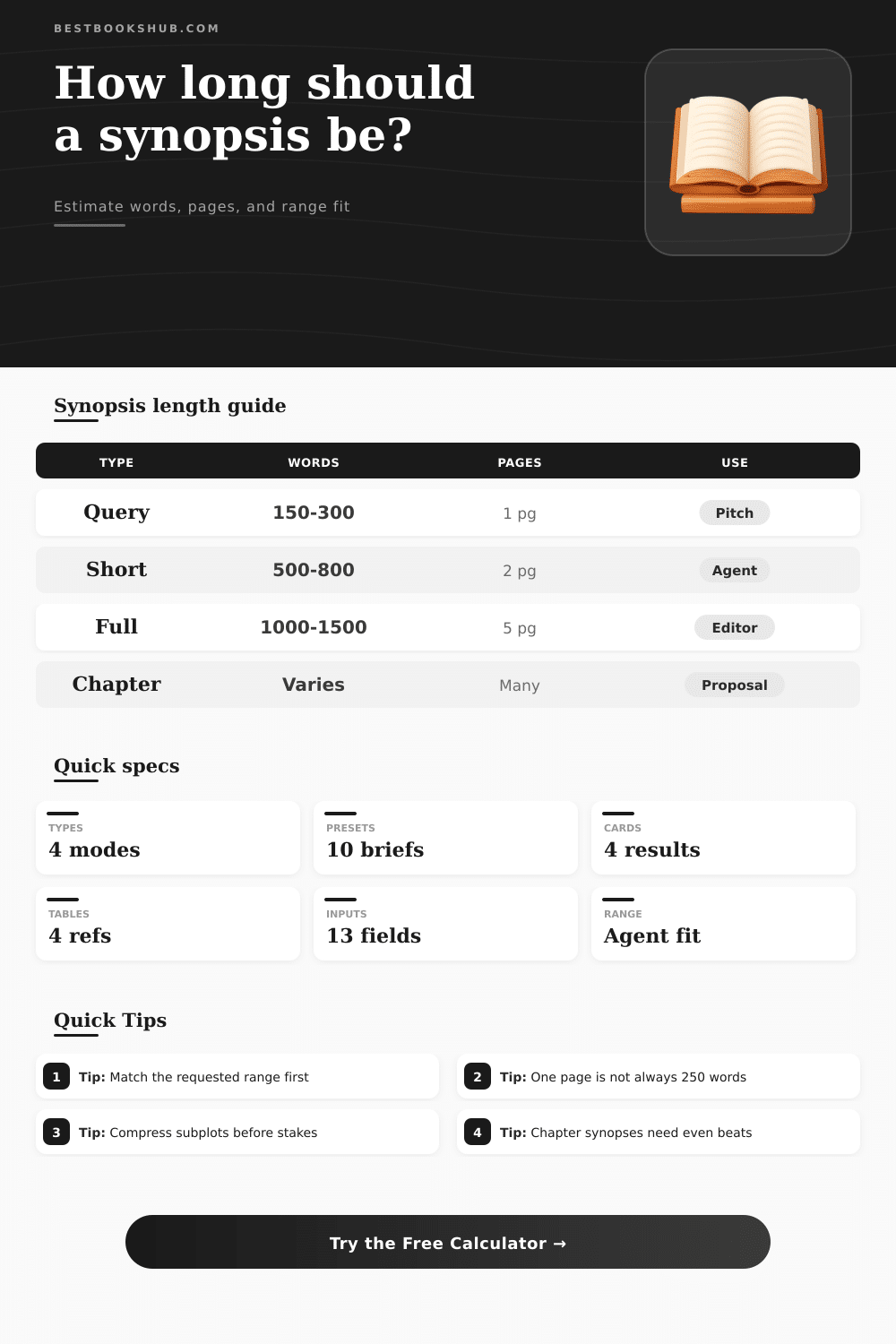
| Query synopsis | 150 to 300 words | Brief query package, form field, or pitch attachment. | Protagonist, central conflict, stakes, ending cue. |
| Short synopsis | 500 to 800 words | One- to two-page agent request. | Main arc, major reversals, ending, only necessary subplots. |
| Full synopsis | 1000 to 1500 words | Editorial review or longer submission packet. | Complete plot logic, emotional arc, ending, key secondary turns. |
| Chapter-by-chapter | 80 to 150 words per chapter | Proposal, outline, or nonfiction plan. | Chapter purpose, turn, outcome, and handoff to the next chapter. |
| Format setting | Words per page | Page estimate behavior | When to choose it |
|---|---|---|---|
| Double-spaced submission | About 250 WPP | More pages for the same word count. | Use when guidelines say one page, two pages, or manuscript format. |
| 1.5-spaced review | About 330 WPP | Middle length with readable spacing. | Use for internal editorial briefs or flexible upload boxes. |
| Single-spaced compact | About 500 WPP | Fewer pages with dense layout. | Use only when the guideline asks for single spacing or word count. |
| Custom WPP | User supplied | Matches known template or form requirements. | Use when an agency, editor, or contest provides exact formatting. |
| Manuscript size | Short synopsis target | Typical compression | Planning note |
|---|---|---|---|
| Novella, 25,000 to 40,000 words | 350 to 600 words | 65:1 to 90:1 | Lean on central premise and ending; avoid scene-by-scene retelling. |
| Short novel, 50,000 to 70,000 words | 500 to 750 words | 80:1 to 110:1 | Use one sentence per major act or turning sequence. |
| Commercial novel, 75,000 to 100,000 words | 650 to 950 words | 90:1 to 130:1 | Compress side characters and keep the main causality visible. |
| Epic or complex nonfiction, 110,000+ words | 900 to 1500 words | 100:1 to 150:1 | Prioritize spine, stakes, through-line, and the ending over world detail. |
| Chapter plan | Words per chapter | Total for 24 chapters | Best fit |
|---|---|---|---|
| Brief proposal notes | 60 to 90 words | 1440 to 2160 words | High-level nonfiction proposals and chapter maps. |
| Balanced chapter synopsis | 90 to 125 words | 2160 to 3000 words | Novel outlines, book proposals, and editor-facing structure checks. |
| Detailed chapter synopsis | 125 to 180 words | 3000 to 4320 words | Complex plots where each chapter needs cause and consequence. |
| Very compressed chapters | 35 to 60 words | 840 to 1440 words | When the request is for a short synopsis but chapter balance still matters. |
Writing a synopsis is a task that require you to condense a story into a shorter format. Writing a synopsis requires you to make a decision about which details of the story to include in that shorter format. You may know the story extremely well, you may know which character are important, but you must make a decision about how much of the story to include in the synopsis.
Not all requests for a synopsis require the same amount of detail about the story. Providing the wrong amount of detail could result in the synopsis not meeting the requirement of the person requesting the synopsis. The length of a synopsis can depend upon the purpose for which that synopsis is being written.
How to Choose the Right Length for Your Synopsis
Shorter lengths of synopsis may be requested if all that is needed is for the person reading the synopsis to understand the main plot of the story. Longer lengths of synopsis can be requested if the writer intend to demonstrate the entire story arc of the manuscript. A synopsis length calculator can assist the writer in determining the necessary length of the synopsis.
Many people use percentages to determine the length of the synopsis. However, if the number of pages is specified or a specific word count is requested, using percentages can create difficulties for the writer. For example, 500 words may be requested as the length of a synopsis as compared to 800 word.
The 500-word synopsis would allow for less room to discuss the subplots of the story as compared to the 800-word synopsis. A synopsis length calculator can help writers to understand these different lengths and how they may affect the creation of a synopsis that meet the requirements of the request for that synopsis. Another element that could affect the length of the synopsis is the page formatting for that synopsis.
Many submission packages request that the synopsis be written as double-spaced pages as this is the formatting that is the easiest for a person to read. If the synopsis is written for pages that are single-spaced, the synopsis will take up more pages if the formatting is changed to double-spaced pages. Additionally, most synopsis length calculators take into account header space and the number of words per page for the synopsis as well.
These elements ensure that a writer is aware of how many pages the synopsis will occupy once the synopsis is complete and formatted according to the requirement of the requesting individual. A chapter by chapter synopsis is a different type of synopsis than a story-length synopsis. With a chapter-by-chapter synopsis, the writer will allot each chapter of the manuscript a certain amount of space within the synopsis.
The length of each chapter-by-chapter synopsis will depend upon the number of chapters within the manuscript. Furthermore, each chapter could have a different length of description or information requested about that chapter. Some requests for a chapter-by-chapter synopsis may ask only for the turning point of each chapter in the manuscript.
In other instances, the request may ask for information about the emotional consequence of each chapter within the manuscript. By using the scene density setting for the synopsis, writers can understand the impact that their choices will have upon the length of the synopsis. Deciding what information to include in the synopsis is a more difficult task than calculating the word count for that synopsis.
The main plot and the goal of the protagonist are two elements that should be included in a synopsis. Subplots can be included only if they change the ending of the story or if they increase the stakes for the character in the story. Some writers will choose to include the ending to the story in the synopsis.
However, some manuscript agents will request that the ending be compressed as compared to other agents who request that the ending be included in it’s entirety. A synopsis length calculator will not make decisions for the writer about what information will be included in the synopsis. However, it will provide the writer with an idea of how many word will be left for the writer to include information about the manuscript when the writer has made their decisions about the content of the synopsis.
Many writers tend to make mistake when writing a synopsis. One mistake that many writers make is treating the synopsis as if it were a miniature novel. If every scene from the manuscript is included in the synopsis, the synopsis will be too long and the reader may find it to be difficult in understanding the story as told in the synopsis.
Additionally, if the synopsis contains only a list of the event that occurred within the story, the synopsis will fail in its requirement of conveying to the reader the experience of the manuscript. A helpful technique for writing a synopsis is to write a version of the synopsis that is slightly too long for the requirements of the request for the synopsis. This provides time for the writer to remove unnecessary part of the synopsis.
It is easier for a person to remove information from a long synopsis than it is to add information to a short synopsis. The lines of cause and effect that describe the story should be included in the synopsis. The moments within the story that answer the central question of the story should also be included in the synopsis.
After the synopsis has been written to the target length determined by the synopsis length calculator, each sentence in that synopsis should serve some specific purpose for the synopsis.