📖 Five-line poem validator
Tanka Syllable Validator
Paste a five-line tanka to test the 5-7-5-7-7 pattern, line syllable overrides, the line-three pivot, upper and lower phrase balance, and a modern-flex draft mode.
Load original five-line examples, then adjust validation mode, phrase split, pivot expectations, and overrides to test a draft rather than a generic syllable count.
DISCLOSURE: This post may contain affiliate links, meaning when you click the links and make a purchase, I receive a commission. As an Amazon Associate I earn from qualifying purchases.
The line table uses automatic syllables unless a word or line override is active.
| Line | Role | Target | Count | Status | Preview |
|---|---|---|---|---|---|
| Load a preset or paste a tanka to fill this table. | |||||
| Line | Syllables | Phrase role | Common function |
|---|---|---|---|
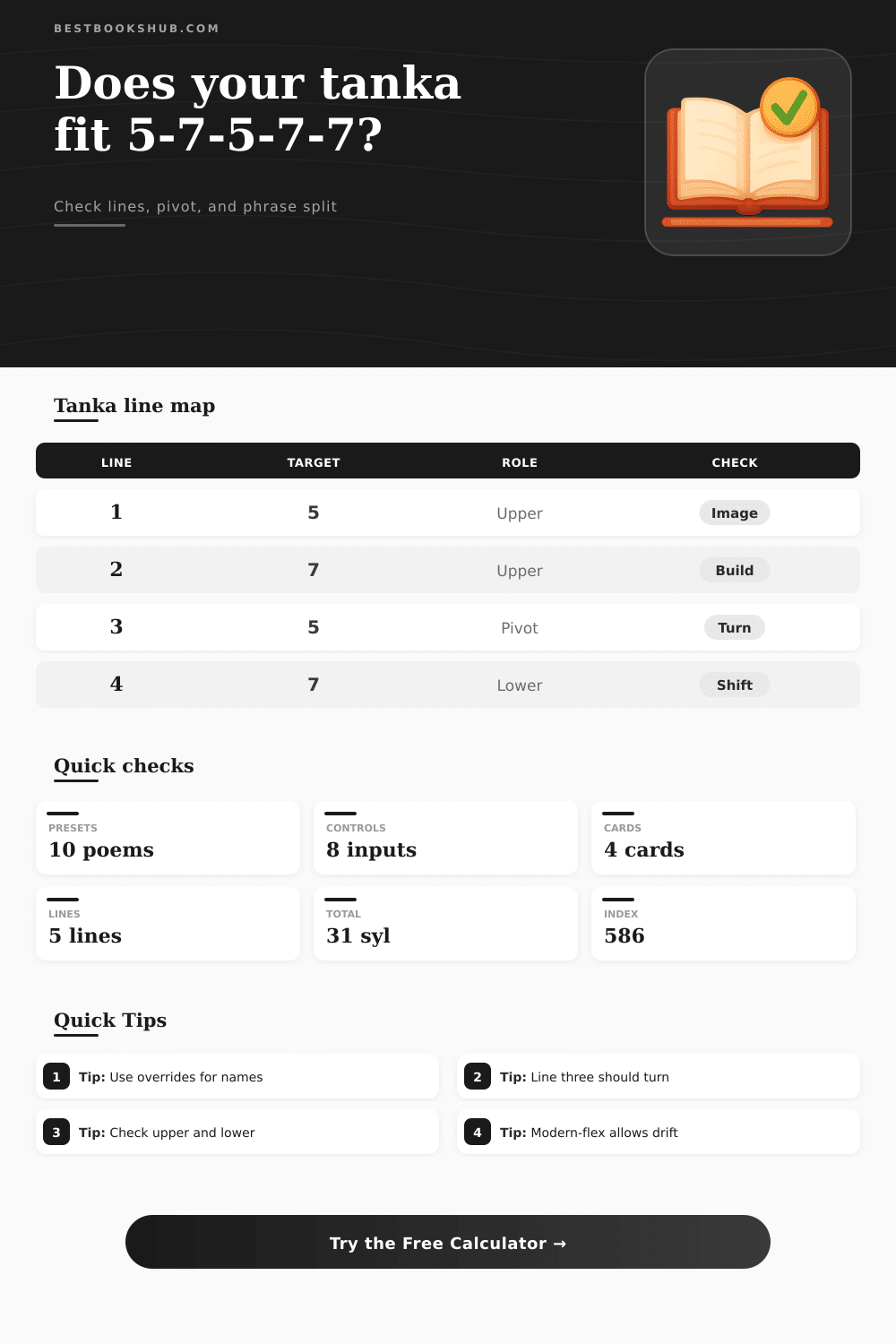
| Line 1 | 5 | Upper phrase | Initial image, scene, or emotional pressure. |
| Line 2 | 7 | Upper phrase | Extends the image or sets a condition. |
| Line 3 | 5 | Pivot line | Turns, bridges, or re-frames the first two lines. |
| Line 4 | 7 | Lower phrase | Personal response, consequence, or shift. |
| Line 5 | 7 | Lower phrase | Closure, resonance, or final image. |
| Override type | Where to use | Example | Validator effect |
|---|---|---|---|
| Word override | Proper names or dialect words | Kyoto=2 | Changes every matching word before totals are added. |
| Line override | One disputed line | Line 3 = 5 | Replaces the whole automatic count for that line. |
| Poetic contraction | Elision or compressed speech | evening=2 | Lets workshop pronunciation guide the count. |
| Expanded reading | Separate vowel sounds | quiet=2 | Prevents a tight algorithm from flattening sound. |
| Mode | Line rule | Total rule | Best for |
|---|---|---|---|
| Strict | Each line must equal target | 31 total syllables | Traditional form practice and classroom checks. |
| Modern-flex | Each line may drift by one | Warns if far from 31 | Drafting contemporary tanka with breath variation. |
| Diagnostic | Reports distance only | No fail label | Early revision, workshop notes, or comparison. |
| Pivot signal | Line evidence | Strength | Revision note |
|---|---|---|---|
| Contrast word | but, yet, still, now | Strong | Often creates a visible emotional or image turn. |
| Punctuation hinge | comma, dash, colon | Medium | Can mark a turn if sound and sense also shift. |
| Image shift | nature to feeling | Medium | Useful when the poem turns quietly. |
| No signal | plain continuation | Weak | May still work, but line three deserves attention. |
From Imperial Japan comes a form of poetry called Tanka. A Tanka consist of five lines following a 5-7-5-7-7 syllable pattern. Although in English we push against this frame, most English writer continue to write tanka within this frame. The problem? English syllables don’t fit quite as neatly than Japanese syllables. And so you might spend weeks revising your short piece over and over again.
Precision is rewarded; perfection isn’t required. Generally your first two lines describes or depict a scene or image. The third line is where we pivot to make it about ourselves in some manner. And then the last two show how you responds or wrap things up. Miss the turn and you’ve got two unrelated ideas gummed back-to-back, nail it and suddenly the entire poem feels like it had to be that way.
How to Write Good Tanka Poems
In this way, a feel for syllables will become your silent friend. Counting isn’t the goal. It’s much more about knowing how each line of text breathes with its previous and next line. This means that even when there is a proper noun (“Kyoto“) to throw things out of kilter an otherwise neat count can go awry because what you hear in your ear might be two syllables but what the algorithm counts might be three. Regional speech, contraction, or that pesky word ‘evening’ (some people say it has two beats; others extend it to three). All tiny choices but all musical choices.
The middle line worries writers the most. And no, you don’t have to write a visible hinge word… “still” or “yet.” The picture can change like a subtle moment of memory unlocked by rain dripping down a gate. All you need to know: does line three feel like a door swinging open, or another brick in the wall? That’s the test. Read the line out loud. More than any rule, your voice will tell you if there’s been a turn.
Novices tend to miss one other element: phrase balance. Classically, this breaks down so the first three lines is slightly heavier than the final two, establishing a natural inhale-exhale pattern. Moddern poets sometimes choose a pivot line that turns sooner or even splits the difference between the two worlds. Both are acceptable, but both alter the emotional pacing of the poem. Generally speaking, top phrase looks on, the bottom one replies. If either side feels lopsided, then you have lost the graceful tension of the tanka.
And there are common mistakes that sneaks in. The poet falls in love with a pretty image and makes the rest of the lines conform; or he chases an exact count so hard that the language becomes wooden. Those edges has been softened by modern practice. Sometimes a little drift of one syllable on each line work better for the poem than forced perfection. It works as long as you get the shape right and the emotional movement of the poem.
That’s where the true art comes in, knowing which elements should of been followed exactly as written, or when to stray just a little from the pattern. Sometimes a word needs gentle tweaking, while other times it is an emotion word or even a place or name. Something that may appear perfectly fine on paper sounds clunky out loud. Typicaly you revise best by backing off, then coming back later with clean ears.
So in the end, tanka teaches us that sometimes constraint is freeing. Thirty-one syllables is a modestly sized room with specific dimensions. Spend time moving about within it and eventually you begin to hear how it sounds. Tanka doesn’t stifle what is said. It directs it, like a carefully placed window into a garden rather than an uncurtained view into a whole messy yard.
Next time you’re done with a draft, let the lines rest awhile. Listen for the turn and count them, but feel the balance between what you observe and how you respond. When it’s not working, trust your ear. Numbers leads you. But in the end, the poem still has the final say.