📚 Reading backlog lab
TBR clear date calculator
Estimate when your to-be-read stack will be clear by combining unread books, average pages, current progress, reading pace, new additions, rereads, and schedule buffer.
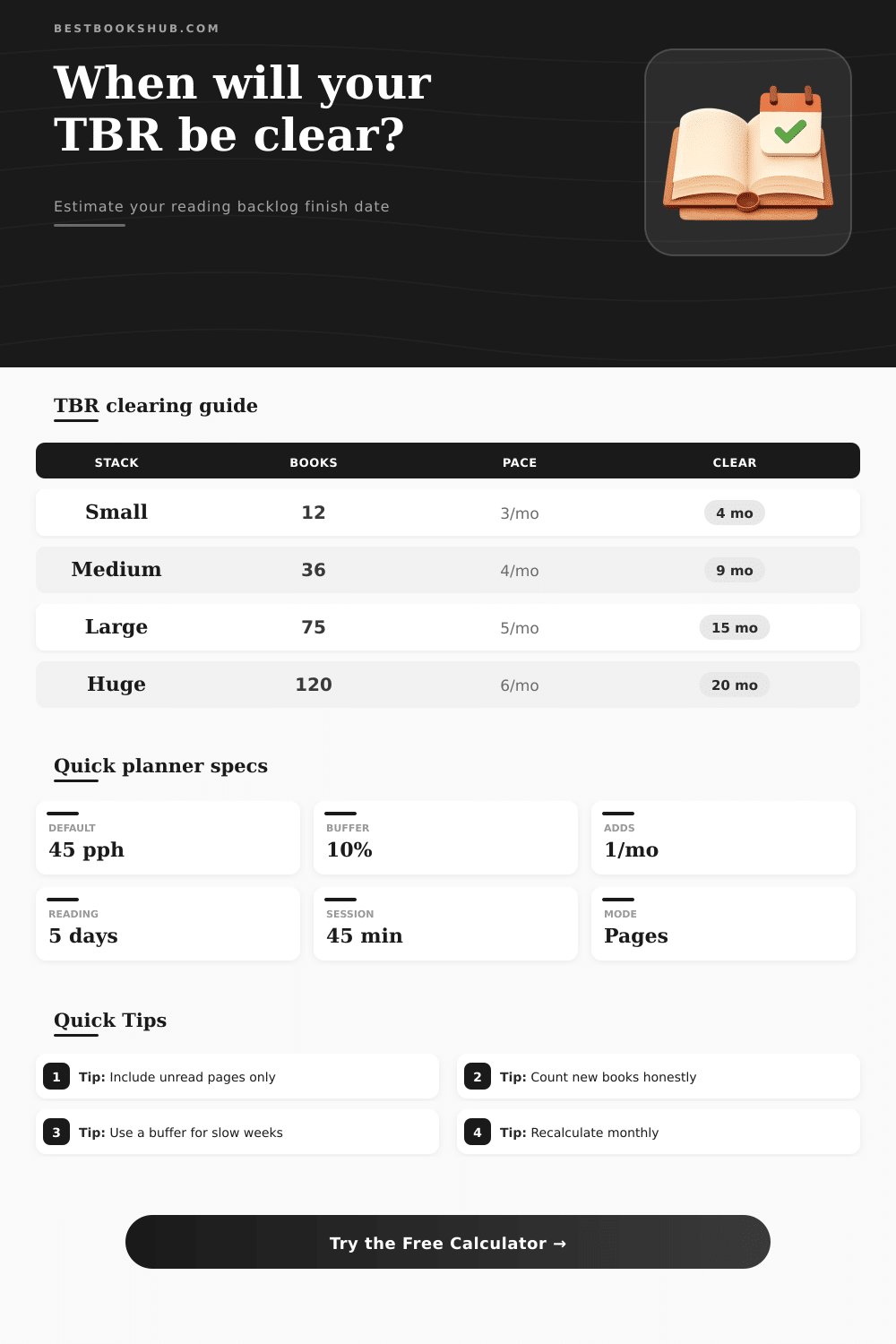
| TBR size | Typical page load | Clear pace | Planning signal |
|---|---|---|---|
| Small stack | 8 to 20 books | 2 to 4 months | Works well with a simple monthly check-in. |
| Medium shelf | 21 to 50 books | 6 to 14 months | New additions can shift the date quickly. |
| Large backlog | 51 to 100 books | 12 to 28 months | Track net books per month, not just pages. |
| Collector TBR | 100+ books | 2+ years | Use category goals so the plan stays readable. |
| Reading material | Pace factor | Common page range | Clear-date note |
|---|---|---|---|
| Light fiction or memoir | 1.20x | 240 to 360 pages | Often clears faster than the raw page count suggests. |
| Standard novels | 1.00x | 280 to 420 pages | Good default for mixed paperback and hardcover stacks. |
| Literary or translated fiction | 0.85x | 240 to 450 pages | Use when sentences invite rereading or slower attention. |
| Dense nonfiction | 0.70x | 300 to 520 pages | Add review load when chapters need notes. |
| Academic or technical reading | 0.55x | 120 to 600 pages | Best planned by sessions and buffer, not speed alone. |
| Graphic novels or comics | 1.35x | 120 to 240 pages | Pages move fast, but series stacks can grow quickly. |
| Audiobook-heavy stack | 0.75x | 8 to 12 hours | Use known listening hours when available. |
| Monthly additions | Reading pace | Net clearing | Backlog result |
|---|---|---|---|
| 0 books/month | 3 books/month | 3 books/month | A 36-book TBR clears in about one year. |
| 1 book/month | 4 books/month | 3 books/month | The same 36-book TBR still takes about one year. |
| 3 books/month | 4 books/month | 1 book/month | A medium backlog becomes a multi-year project. |
| 5 books/month | 4 books/month | -1 book/month | The TBR grows unless buying, borrowing, or holds slow down. |
| Starting stack | 2 books/month net | 4 books/month net | 6 books/month net |
|---|---|---|---|
| 12 books | 6 months | 3 months | 2 months |
| 36 books | 18 months | 9 months | 6 months |
| 72 books | 36 months | 18 months | 12 months |
| 120 books | 60 months | 30 months | 20 months |
DISCLOSURE: This post may contain affiliate links, meaning when you click the links and make a purchase, I receive a commission. As an Amazon Associate I earn from qualifying purchases.
The dilemma is that when you purchase favorite book, you’re excited, but you’re also a bit nervous because this book now has to shares space with an ever-growing mountain of books beside your bed. And, honestly, it runs counter to your desire to read all the things: You want to keep up with momentum, but how do you get rid of that mess?
It’s a problem for today’s reader: We have so much to read and we don’t know how long it’ll take to get to it. How many people estimate (vaguely) that they’ll get through their backlist within six months or, heck, next year? Without firm date, what you have is a way to create low-grade stress over a perfectly reasonable habit!
How to Read Your Pile of Books Without Stress
Your real problem isn’t typically how fast you read. Typically it’s what you do about the things that slow you down. We likes to estimate our rate of progress during ideal situations, such as when we are feeling perfectly focused, energetic, and have plenty of time to devote to reading. Unfortunately, real life doesn’t always cooperate with those assumptions. You get busy at work. Or maybe you’re taking a vacation? Or maybe you just had an exhausting day and you don’t want to wrestle with complicated sentence structures? A good plan should accommodated this kind of friction.
Plug in your daily habits and the number of books you haven’t read yet into the calculator above and let it crunch numbers for you. This will save you from underestimating how slowly book backlogs melt away as life inevitably interferes.
What’s getting added to your pile every month? This is silent killer of reading goals. You can be enthusiastic about buying a bunch of books a month and feel good about your productivity, but if you buy more than you finish, it doesn’t matter: Your stack will grow anyway. What matters is net progress. Finishing books may make you feel productive, but if your addition rate is higher then your clearing rate, you are not making progress.
A few things become clear from the reference table on the page: Small differences in monthly additions has dramatic shifts in your projected finish date. The math is harsh, and it requires you to be honest with yourself. Even then, there’s a lot of variation within these categories. Light fiction reads faster than heavier fiction with an equivalent number of pages. So does academic writing compared to lighter non-fiction. While an average novel might take 45 pages per hour, a technical manual could halve that speed due to note-taking and rereading difficult passages. If you don’t account for that difference in density, you’re setting yourself up for over-optimism that will evaporate as soon as you encounter a meaty section. Your “average” reading speed should be set for whatever is actualy on your bookshelf. Don’t use a one-size-fits-all approach.
Time is another common blindspot. Readers often tell me they make the effort to read every day… Yet they only get to sit down for 15 minutes at a stretch, until something distracts their attention. Fifteen minutes, three days per week is not much more than one or two chapters, which is enough to really stall your progress versus committing to half an hour each session. Here, it’s consistency over intensity; forming a short-but-steady habit will clear those backlogs sooner then occasional marathons of reading, and help build momentum. The tool visualizes that for you: convert your minutes into concrete rate-per-month.
But that’s just it. That’s adding a buffer for slow weeks. That isn’t being pessimistic; that’s realistic planning. Life happens. And expecting yourself to work at your peak level every single month is setting yourself up for failure because there will be a week (or two) where you won’t be at your peak. Ten percent gives you wiggle room while still keeping you on track. It makes your schedule resilient. It is able to absorb some shocks without falling apart. And this little tweak can make all the difference between quitting out of frustration or powering forward during a busy season.
And really, that’s the point of clearing a backlog: it’s not about doing it faster, but adjusting your expectations. It’s not about reading as fast as physically possible for you as a human being. It’s about finding habits that work within the limits of reality. If you have a clear goal somewhere out there on the horizon, then you can turn that mountain into a path. You will no longer feel stressed about making progress. Instead, you’ll feel a sense of steadiness, which removes some of the pressure.
You won’t view your TBR as a monument to all the books you haven’t gotten around to yet. Instead, you’ll view it as a string of little goals you’re able to achieve one by one. And that change of perspective is more valuable than any quick fix.