📖 Multi-factor reading difficulty lab
Text difficulty score calculator
Paste a passage to score sentence complexity, syllable load, rare word share, jargon density, paragraph length, and audience-target fit with one composite difficulty model.
Load a realistic sample, then adjust audience, jargon rules, and scoring weights to see how the composite score reacts.
DISCLOSURE: This post may contain affiliate links, meaning when you click the links and make a purchase, I receive a commission. As an Amazon Associate I earn from qualifying purchases.
The composite model normalizes six difficulty factors to 0-100 and reports which factor is doing the most work.
Results will identify whether sentence shape, word load, jargon, paragraph blocks, or audience mismatch is the strongest difficulty source.
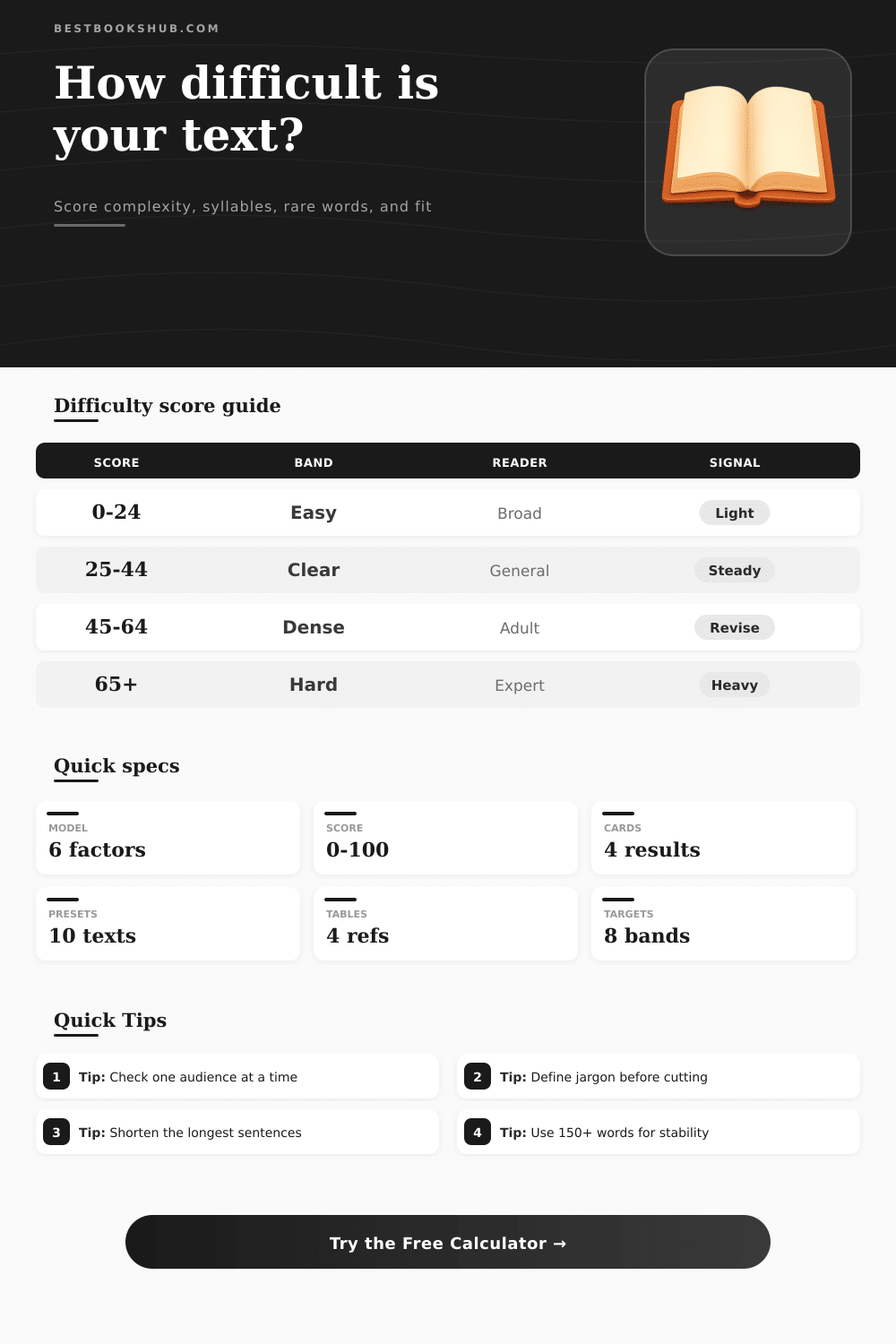
| Composite score | Difficulty label | Typical reader fit | Editing interpretation |
|---|---|---|---|
| 0 to 24 | Light difficulty | Early readers, quick help copy, highly accessible summaries | Check that ideas are not oversimplified for older readers. |
| 25 to 44 | Clear difficulty | Middle grade, young adult, general web and book content | Usually approachable if the topic is familiar. |
| 45 to 64 | Moderate density | Adult nonfiction, reviews, professional explanations | Review the largest driver before changing voice or accuracy. |
| 65 to 79 | High difficulty | Academic, legal, scientific, technical, or specialist prose | Definitions, sentence breaks, and paragraphing can reduce load. |
| 80 to 100 | Extreme difficulty | Narrow expert audience or very compressed reference text | Use only when precision outweighs broad comprehension. |
| Factor | Raw signal | Higher means | Useful revision lever |
|---|---|---|---|
| Sentence complexity | Words per sentence, clause marks, sentence variation | More syntax load and more relationships per sentence | Split chains, reduce stacked clauses, vary rhythm. |
| Syllable load | Estimated syllables per word and polysyllable share | More effort to decode vocabulary aloud or silently | Replace long words when precision is not needed. |
| Rare word share | Words outside a compact common-word screen | More unfamiliar or less frequent vocabulary | Define terms, use familiar synonyms, or repeat labels. |
| Jargon density | Domain terms from built-in and custom lists | More audience-specific language | Keep required terms but add explanations nearby. |
| Paragraph length | Average and longest paragraph in words | Larger visual and memory blocks | Break paragraphs at topic shifts or examples. |
| Audience gap | Composite score versus target range | Text is above the selected audience expectation | Change target or revise the strongest factor first. |
| Profile | Example terms counted | Best use | Scoring caution |
|---|---|---|---|
| Literary analysis | motif, allegory, protagonist, subtext | Book reviews, essays, classroom notes | Literary terms may be expected for advanced readers. |
| Science and research | hypothesis, methodology, empirical, variable | Abstracts, lab summaries, science passages | Do not remove precise terms without replacing meaning. |
| Technical documentation | interface, protocol, configuration, latency | Manuals, help pages, engineering notes | Jargon is useful when the audience shares it. |
| Legal or policy | liability, compliance, pursuant, jurisdiction | Policies, notices, contracts, forms | Sentence length often matters as much as vocabulary. |
| Medical or health | diagnosis, contraindication, dosage, symptom | Patient copy, study summaries, health forms | Define terms rather than guessing simpler replacements. |
| Preset | Expected score pattern | Main driver to watch | Audience check |
|---|---|---|---|
| Early Reader | Very low score if sentences stay short | Rare words from names and story objects | Should fit early or middle readers. |
| Book Review | Moderate score with literary vocabulary | Jargon and sentence length | Often fits general adult or YA readers. |
| Textbook Page | Moderate to high score | Definitions, rare words, paragraph length | Use middle, YA, or professional targets by course. |
| Academic Abstract | High score from compression | Syllable load and rare terms | Usually above general adult target. |
| Policy Notice | High score from clauses and legal terms | Sentence complexity and jargon density | Legal target may still show a large load. |
A text difficulty score calculator are a tool that will measure how hard a text is to read. A text difficulty score calculator will provide data that will help a writer to understand the reading level of their texts. Many writers may feel that their text is heavy or difficultly to read.
However, it isnt uncommon for a writer to struggle to provide specific reasons as to why their text can be difficult to read. A text difficulty score calculator will identify the specific reason why a writers text may be difficult to read by evaluating six different factors that relates to text difficulty. The first factor that a text difficulty score calculator can evaluate is sentence complexity.
How a Text Difficulty Score Calculator Helps Writers
Sentence complexity looks at the length of the sentences that are written by measuring the number of word that are written within each sentence. Complex sentences are challenging to read because readers must remember the beginning of the sentence when they are reading the end of the sentence. The second factor that a text difficulty score calculator can evaluate is the syllable load within each word.
Syllable load look at the number of syllables within each word to determine the difficulty that readers may have in decoding those words. The third factor is the rare word share within the text. This evaluates the number of word within the text that are not part of a common list of words.
The fourth factor that can be evaluated is jargon density. Jargon density measures the number of instance of jargon within a text. Terms that is specific to a particular domain can often be challenging for readers of all knowledge levels to understand.
The fifth factor is the length of each paragraph within a text. The longer the paragraph, the more challenging it may be for a reader to take a break in reading dense block of text. Finally, the last factor that can be measured is the audience gap.
The audience gap calculates the difficulty score of a text in relation to the specific target audience for which the text is written. A writer can use each of these factors as means of making decisions regarding their text. Text difficulty scores allow a writer to make adjustments to their text so that a specific audience can read it.
For instance, a writer who produces legal documents may wish to target a legal audience for their text. Legal audiences can read higher levels of sentence complexity and contain higher levels of jargon then, say, a general adult audience. The writer may need to adjust the text for a specific audience so that that audience can understand it.
A text difficulty score calculator allow writers to test these different outcomes before having to rewrite their text altogether. The results from a text difficulty score calculator will be most helpful if the text writer can determine which factor is the largest contributor to the difficulty of the text. If the complexity of the sentences within the text is the largest contributor to the difficulty of the text, the writer can focus on breaking up long sentences into shorter sentences within the text.
If the words that are found within the text that are rare for common text would be the largest contributor to the difficulty of the text, then adding definition for those words would be one means of lowering the difficulty score that is calculated for the text. A text difficulty score calculator will not replace the writers judgment, but it will remove the guesswork that a writer may have in regard to the difficulty of their text. A writer may want to lower the difficulty score of their text, but they may assume that this will result in less complex ideas within the text.
A lower difficulty score does not necessarily mean that the idea within the text have to be simplified. For example, a writer can break a technical manual into smaller paragraph without changing the idea behind the text. The same can be said for a novel that maintains its voice but spaces out the use of rare words.
The text difficulty score allows writers to understand the difference between these outcomes. A writer may make many mistake when attempting to lower the difficulty of their text. One such mistake may be to treat every high difficulty score within a text as a problem.
There are situations in which high scores are expected for the audience that is to read the text. For instance, academic abstracts will have high difficulty score because they contain concepts that only specialist in the field understand. A writer must ensure that the difficulty score of the text match the expectations of the audience that will read the text.
Another mistake that a writer may make is to only change the vocabulary within their text but to leave the length of sentences alone. This change alone will not necessarily have a positive impact on the difficulty score of the text. Long sentences will always require a reader to hold information in their short-term memory.
A writer must adjust the length of the sentences in addition to changing the vocabulary within the text. Finally, another recommendation for writers is to use a text difficulty score calculator to compare samples of text that are similar to one another. The three sentence notice for a contract is different than a twelve paragraph chapter section in a novel.
Writers should ensure that any comparison that they make are between passages that are comparable to one another. Using a text difficulty score calculator allows writers to become accustomed to asking the question of what creates the difficulty in their text. This question will allow writers to make specific adjustment to the text that will help the reader.