📚 Chapter study timer
Textbook chapter time calculator
Estimate how long a textbook chapter will take with reading speed, page density, difficulty, annotation depth, rereading, review passes, breaks, and deadline pacing.
Preview skim
Use for headings, summaries, diagrams, and vocabulary lists before a lecture. Fast pace, light notes, and little review time.
Class preparation
DISCLOSURE: This post may contain affiliate links, meaning when you click the links and make a purchase, I receive a commission. As an Amazon Associate I earn from qualifying purchases.
Use for standard chapter reading with margin notes. This is the default calculator profile for most weekly assignments.
Problem-heavy study
Use for math, science, law, or technical chapters where examples and definitions need slower rereading.
Exam consolidation
Use when the chapter has already been read and the main work is recall, outline repair, and targeted rereading.
| Reading mode | Typical pace | Best use | Calculator setting |
|---|---|---|---|
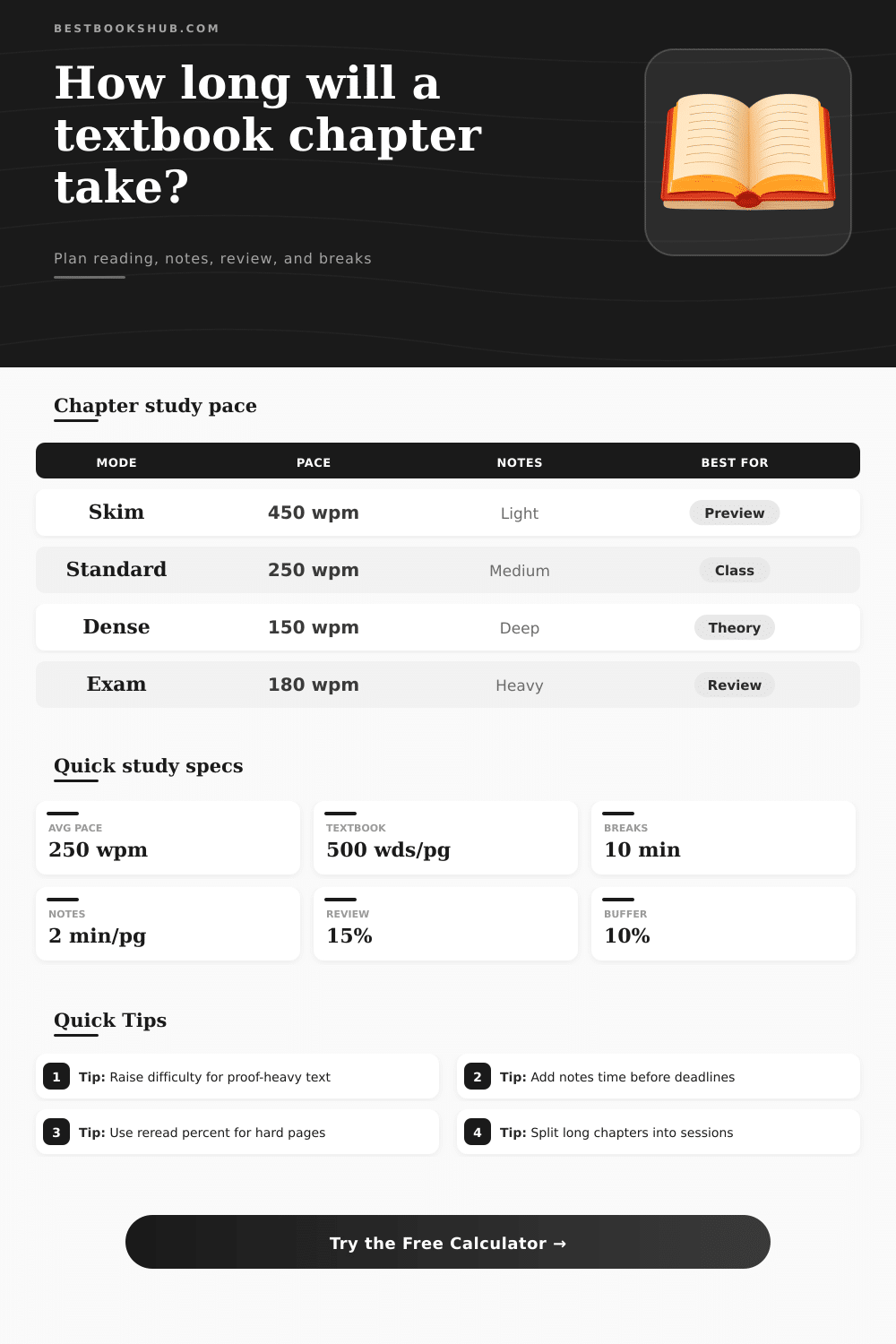
| Preview skim | 400-500 wpm | Headings, summaries, figures, and quick refreshes | Skim or preview - 450 wpm |
| Comfortable textbook read | 220-280 wpm | Weekly chapters with familiar vocabulary | Comfortable study - 250 wpm |
| Careful textbook read | 140-200 wpm | Definitions, formulas, unfamiliar terminology | Careful reader or textbook average |
| Exam review read | 170-230 wpm | Known material with active recall checks | Textbook average plus review pass |
| Textbook format | Words per page | What changes the time | Good starting value |
|---|---|---|---|
| Large-format science text | 350-500 | Diagrams reduce word count but increase interpretation time | 450 words/page |
| Standard college textbook | 450-650 | Dense paragraphs and sidebars add reading load | 500 words/page |
| Humanities or theory text | 550-750 | Long paragraphs and argument tracking slow the pace | 650 words/page |
| Casebook or primary source packet | 650-900 | Small type and citation notes raise the word count | 750 words/page |
| Difficulty setting | Multiplier | Use when | Common subjects |
|---|---|---|---|
| Light narrative | 0.85x | The reading is story-like or mostly review | Literature, history overview |
| Standard textbook | 1.00x | Most paragraphs can be followed in one pass | Intro psychology, business |
| Concept dense | 1.20x | Terms, models, and examples need pausing | Biology, economics |
| Technical or proof-heavy | 1.45x | Formulas, proofs, or cases require verification | Math, law, engineering |
| Very dense with diagrams | 1.70x | Figures, anatomy plates, or code examples take separate study | Medicine, advanced science |
| Study method | Added time | Best for | Calculator input |
|---|---|---|---|
| Highlight only | 0.75 min/page | Quick preview or known material | Highlight only |
| Margin notes | 1.5 min/page | Normal class preparation | Margin notes |
| Outline notes | 2.5 min/page | Chapter summaries and seminar prep | Outline notes |
| Detailed Cornell notes | 4 min/page | Exam-heavy or concept-dense courses | Detailed Cornell notes |
| Quiz-ready review | 20% extra | Recall checks after first reading | Review passes dropdown |
| Assignment type | Typical pages | Suggested depth | Planning note |
|---|---|---|---|
| Short weekly chapter | 12-18 pages | Margin notes plus quick recall | Often fits in one focused session |
| Standard textbook chapter | 20-35 pages | Margin or outline notes | Split across two sessions if dense |
| Casebook reading set | 25-45 pages | Outline notes and rereading | Plan extra time for rule extraction |
| Exam catch-up block | 40-70 pages | Review pass plus selective rereading | Use daily page targets to avoid cramming |
If a chapter has proofs, diagrams, cases, or unfamiliar vocabulary, the reread percentage is usually more accurate than simply lowering your reading speed.
The first pass tells you how long it takes to get through the chapter. Notes, recall, and breaks tell you whether the assignment fits into one realistic block.
Look at the stack: Forty pages of cellular biology, due in three days, and you’re dreading it. What’s the deal? Will it take you twenty hours or two? The length isn’t the issue. Reading becomes studying only once those invisible variables kicks in. These include stopping to think and pausing to take notes. You might also return to diagrams to reread them or pause for a break when your brain overheats.
Students underestimate all this downtime by roughly half, hence the constant surprise about how close it is to library closing time. And if you enter your deadline and chapter length into the calculator, it figures out math for you, so you don’t need to guess at how long it’ll take to work on something.
Why Studying Takes So Much Time
But more important then the end result is what these numbers mean. Why is there a difference between skimming, say, for a lecture preview versus studying for an exam? Skimming means extracting argument and structure with almost zero mental energy. Studying is different; you’re pulling out definitions, following cause and effect and building mental models. That’s why your pace changes when you study for an exam so you don’t lose the plot.
People get tripped up by subject density: A law casebook is different than a textbook of philosophy; it’s different from a history chapter that has a good narrative flow. The subject itself create friction because you have to stop every paragraph to make sure the logic makes sense or to translate some jargon. The difficulty multiplier takes this into account, so your actual reading speed will fall as a result. Ignoring this causes panic when the pages don’t turn away on command. It’s not because you’re lazy; you’re slow because it requires more thinking.
These notes also add weight to your timeline; while they’re fast, they are not very effective at helping you retain information deep. Outlining and taking detailed Cornell notes is much slower per-page, but ultimately pay off when review week rolls around. Because there’s no such thing as a free lunch with study planning, you have to decide if you’d rather have speed now or understanding later.
Adding an additional 20% time to let you double-check what you think you remember avoids the illusion of competence created by rereading passively. It forces you to actively test yourself, which might take a few minutes but would of saved you hours come final exam day.
It’s important to note here that “breaks” aren’t downtime; they’re part of the job. Your brain solidifies what you’ve learned during break time. Think of it like refilling your mental energy every hour, which prevents you from getting through just one more page and then realizing you can’t remember anything on that page when you look back. You’ll be staring at the same sentence for the next couple of hours and won’t understand a thing.
The session length input lets you take that into account as you fit this reality in your calendar: Okay, I’ll have 45 minutes until dinner, so I’m going to get this many pages read. Now you walk away knowing where you stopped. Not with half-hearted efforts abandoned mid-stride.
Planning makes action possible: Eight pages a day sounds like less work than a pile of unread pages on Friday night. It’s easier to tweak the inputs (i.e., how many pages per day) until the outputs (how long to read) feel honest. A dozen hours for a thorny chapter? Believe it… And plan ahead to find the time in your schedule to spend those dozen hour.
Because finishing the chapter is only half the battle: you want to understand it so well that you won’t be forced to reread it at the last minute. That sense of clarity will transform anxietty into control.