📖 Chapter timing lab
Time per chapter calculator
Estimate average and longest chapter time from page density, words per minute, notes, rereads, chapter variation, and available reading sessions.
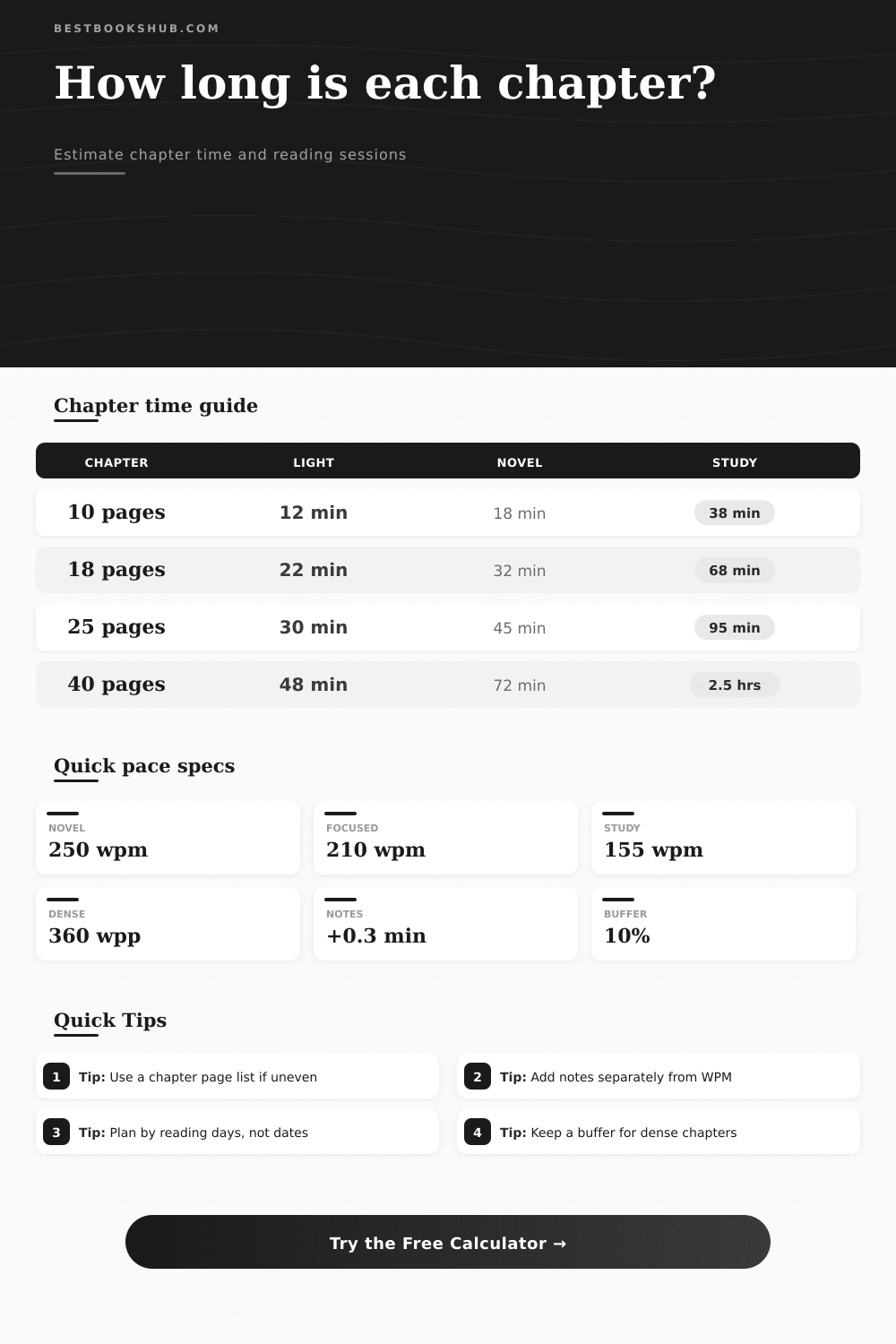
| Page type | Words per page | Typical chapter | At 250 WPM | Best use |
|---|---|---|---|---|
| Large print or airy layout | 200 to 240 | 12 to 20 pages | 11 to 19 minutes | Light fiction, rereads, and accessible editions |
| Trade fiction | 250 to 300 | 15 to 25 pages | 17 to 30 minutes | Novels, memoirs, and book club planning |
| Narrative nonfiction | 300 to 350 | 18 to 28 pages | 24 to 39 minutes | History, essays, and idea-driven chapters |
| Dense classic | 330 to 420 | 12 to 22 pages | 20 to 37 minutes | Older prose, long sentences, and compact editions |
| Textbook | 450 to 650 | 20 to 40 pages | 48 to 104 minutes | Courses, exams, diagrams, and review questions |
| Graphic novel or manga | 50 to 140 | 20 to 45 pages | 4 to 25 minutes | Visual reading with panel scanning time |
| Reading mode | Typical WPM | 18-page trade chapter | Extra chapter load | When to use |
|---|---|---|---|---|
| Skim or survey | 400 to 600 | 8 to 12 minutes | Low retention | Previewing headings or review material |
| Casual reading | 230 to 280 | 18 to 22 minutes | Minimal notes | Fiction, memoir, and relaxed nonfiction |
| Focused nonfiction | 180 to 230 | 22 to 28 minutes | Concept pauses | Argument-heavy books and discussion prep |
| Study reading | 120 to 180 | 32 to 45 minutes | Notes and rereads | Textbooks, tests, and marked-up reading |
| Proofread or close read | 90 to 140 | 41 to 60 minutes | Line-level attention | Manuscripts, theses, and detailed review |
| Session length | At 20 min/chapter | At 35 min/chapter | At 60 min/chapter | Best fit |
|---|---|---|---|---|
| 20 minutes | 1 chapter | Half chapter | Short section | Daily maintenance reading |
| 45 minutes | 2 chapters | 1 chapter | Most of chapter | Weeknight reading block |
| 60 minutes | 3 chapters | 1 to 2 chapters | 1 chapter | Book club or course plan |
| 90 minutes | 4 chapters | 2 to 3 chapters | 1 to 2 chapters | Focused weekend session |
| 120 minutes | 6 chapters | 3 chapters | 2 chapters | Deadline sprint or exam block |
| Preset | Chapter pattern | Reading setup | Expected chapter time | Planning note |
|---|---|---|---|---|
| Evening Novel | 18 pages x 24 | Trade fiction, casual pace | 25 to 30 minutes | Good for one or two chapters after work |
| Book Club Week | 16 uneven chapters | Focused pace, discussion retention | 30 to 45 minutes | Use daily targets to avoid a late-week pileup |
| Dense Classic | Short but uneven chapters | Dense prose, rereads, buffer | 35 to 55 minutes | Longest chapter matters more than average length |
| Textbook Unit | 5 long chapters | Study pace, notes, breaks | 90+ minutes | Split long chapters across sessions |
| Graphic Novel | Large page count chapters | Low word density, visual scan | 15 to 35 minutes | Panel detail changes speed more than page count |
DISCLOSURE: This post may contain affiliate links, meaning when you click the links and make a purchase, I receive a commission. As an Amazon Associate I earn from qualifying purchases.
If you pick up a book with a deadline in mind (say, two weeks from now), and aren’t sure you can finish it, then you’re going to be panicked. Most people estimate how long it will take by counting number of pages. That’s a terribel way to do it. Why? Because page counts vary like crazy. How much space between paragraphs? What font size?
It’s not the paper that limits you, it’s the speed at which you process things, and amount of attention you have. The number of pages doesn’t matter; instead it’s about calculating time-per-chapter. It change the metric from something fixed (the length of a book) into something variable (your thinking power). Estimating time-per-chapter is actualy an act of planning your brain power.
Why You Should Plan by Chapter Instead of Page Count
For example, a light novel chapter with 20 pages might only require half the time that a dense text book chapter with 20 pages requires. Once you input the page density along with your reading speed, the calculator do the math for you. You do not need to use conversions or coefficients.
The biggest error that users of this type of software make is that they think that their reading speed is static. It’s not. Your word-per-minute count will vary widely depending on what you’re reading. For instance, you could read three hundred words per minute in a dialogue-heavy novel. Then, you might turn to technical nonfiction and watch yourself crawl to a halt.
The tool includes these variations, allowing you to account for both the difficulty of text as well as the reason behind your reading. Are you reading for study purposes? Then you’ll want to slow way down so that you have time to retain what you’ve read. That’s where most folks go astray. They determine their reading schedule according to how quickly they can read words rather than how long it takes to understand them.
Notes and rereading are silent time killers. Rereading and highlighting sentences adds up faster then you think. Sure, you’re moving through the pages at what feels like a consistent speed, but those moments spent re-reading the confusing paragraph or highlighting a sentence you want to remember add up. Noting the minutes spent per chapter helps show this hidden expense.
They is small, but still important, because forgetting about these interruptions means optimistic schedules are doomed to fail. An additional three minutes of notes per chapter may not feel like much. But across two dozen chapters? That’s another hour you’ve worked that you haven’t accounted for.
Then there’s variation: Novel chapters are usually around the same size. But non-fiction chapters (e.g., textbook chapters, essay collections) can vary widely in length. When a reading assignment has widely differing lengths, you may want to use an average; but that’s going to mask the outliers. If it’s uneven, type out a list of page numbers into the calculator, which lets you see at a glance what’ll be a heavy day and what’ll be a light day. It saves you from Friday night realization that you’re halfway through the book.
Second, long stretches aren’t negotiable either. Reading for two hours straight leads to diminishing returns. Even though your eyes may be scanning the page, your brain isn’t actualy absorbing it anymore. Taking brief breaks (every hour) keeps your brain firing on all cylinders. This is why the session planning guide break up reading time so you don’t spend four hours just staring at a giant block of text.
Attention is finite for humans. In the end, we don’t want to just get through the book, we want to get through the book having understood the material well enough to feel like it’s been worthwhile. When you rush through things, you understand them at a shallow level, and then you’ll probably need to go back and read it again. If you take the time to map out each chapter carefully, however, you create a doable pace and rhythm that prevents burnout and cramming on deadline.
You should of planned better. Know how long you can realistically work each day. Know what you are capable of doing in an hour or two of focused time at night, etc. Then create your schedule to match. Don’t expect to suddenly get more free hours next week. Adjust your expectation accordingly for different types of texts How much note-taking will you really do? How many notes? Be real here. Then use those figures as a baseline and go from there.
The key is knowing what’s really getting counted. Reading doesn’t count. Interacting with the content does. Breaking the task into bite-sized pieces like chapters helps translate this giant pile of papers into series of smaller hills you can climb. Take the book off the shelf, glance at your calendar, dive in and read. No more wondering if you’ll ever reach bottom of the mountain.