📖 unread shelf audit
Unread Book Cost Calculator
Estimate the money, pages, shelf time, and recoverable value tied up in unread books, then compare the reading pace needed to clear the backlog.
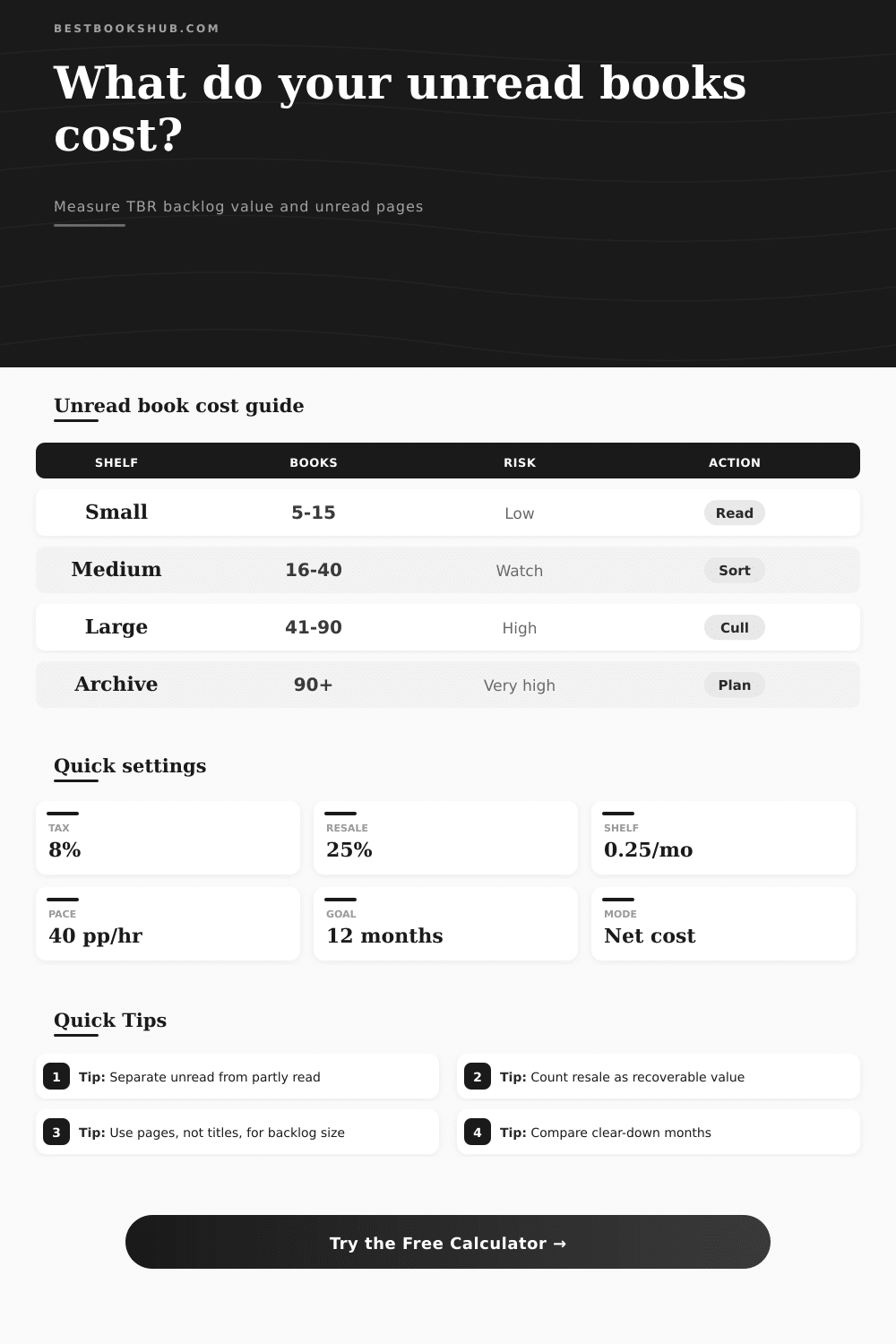
| Backlog size | Typical unread pages | Cost signal | Best calculator action |
|---|---|---|---|
| 5 to 15 unread books | 1,500 to 5,000 pages | Usually manageable | Set a small monthly clear-down target. |
| 16 to 40 unread books | 5,000 to 14,000 pages | Worth reviewing | Separate priority reads from low-interest books. |
| 41 to 90 unread books | 14,000 to 32,000 pages | Large cash and shelf drag | Use resale and donation inputs honestly. |
| 90 or more unread books | 32,000+ pages | Archive-level backlog | Model a cull plus a slower buying pace. |
| Book format | Common paid amount | Recovery behavior | Unread cost note |
|---|---|---|---|
| Used paperback | 4 to 10 | Low resale, easy donation | Small per-title cost can become large in quantity. |
| New paperback | 12 to 20 | Modest resale if clean | Completion rate matters more than shelf value. |
| Hardcover | 22 to 35 | Better resale when recent | A small hardcover TBR can hold a lot of cash. |
| Ebook | 2 to 15 | Usually no resale | Discount purchases still need reading capacity. |
| Textbook or research | 40 to 180 | Time-sensitive resale | Old editions can lose recoverable value quickly. |
| Reading pace | Pages per week | Books per month | What it means for the backlog |
|---|---|---|---|
| 3 hours at 35 pp/hr | 105 pages | About 1.3 books | Good for a small stack, slow for a deep shelf. |
| 5 hours at 40 pp/hr | 200 pages | About 2.5 books | Solid pace if new buying stays restrained. |
| 8 hours at 45 pp/hr | 360 pages | About 4.5 books | Can reverse a medium backlog. |
| 12 hours at 50 pp/hr | 600 pages | About 7.5 books | Fast enough for a planned clear-down year. |
| Decision signal | Calculator field to adjust | Useful threshold | Result to watch |
|---|---|---|---|
| Buying faster than reading | New unread books added monthly | Above monthly completions | Clear-down time becomes infinite. |
| Low interest shelf | Completion rate and stale penalty | Below 65% completion | Value at risk rises. |
| Worth selling | Sellable share and resale value | Credit above shelf drag | Recoverable credit grows. |
| Worth reading now | Avoided future purchase value | Above page cost | Rescue value improves. |
DISCLOSURE: This post may contain affiliate links, meaning when you click the links and make a purchase, I receive a commission. As an Amazon Associate I earn from qualifying purchases.
You feel shelf guilt when you reach for a familiar book, only to remember that you haven’t read this particular volume since last winter. Sure, there it is, perfectly aligned on the shelf, but the issue isn’t simply physical clutter; it’s also the fact that all these stacked up story are locked-up capital in paper form. Books are an experience, most readers believe, yet in truth, they’re debts. Until you price out your unread inventory.
To do all this math for you, just plug in your estimated resale potential and backlog size into calculator above. Now you don’t need to guess at opportunity costs or depreciation curves. You’ll be forced to distinguish between what you’ve used and what you still own. The trick, looking back on the inputs here, is knowing what you’re really measuring; and that’s where the tool come in.
How to Clean Up Your Book Collection
By accounting for platform fees, shipping, and taxes (which tend to bloat the original purchase price), it separates the original purchase price from the net value. It also takes into account a stale penalty for books that sits around too long. Reflecting the fact that inventory becomes less relevant over time within any serious collection. Add in the number of books you’ve already read vs. Total books; you may be shocked at how fast the tally piles up.
Once you invest additional time finishing a book, it’s no longer 50% as valuable, a half-read book isn’t half-off! The calculator accounts for completion rate and reading speed (a thick non-fiction book takes longer than a breezy thriller) to help you understand why backlog duration depend on speed. If you buy faster than you read, the backlog will stay out of control and cleaning it up will drag on forever. People make this mistake by focusing only on acquiring new books without taking into account the drag off what’s already on their shelves.
This is spelled out in the table of references on the page: it classifies the piles into something you can deal with as manageable stacks vs. There is an archive level backlog. The former needs modest changes to your normal workflow, while the latter require a planned cleanup. Usually that’s in terms of recoverable credit.
Niche genre titles and older editions tend to rapidy lose resale value. Donating them will give you a small return, though rarely enough to cover original purchase price. It comes down to which is more valuable, the amount of money you could of get back, or the amount of space taken up by those books. Even if it’s not physical space, shelf space has a cost (even if it’s merely mental energy). For most people, their emotional connection with books colors their perception of how useful those books really are, as many readers holds onto books out of obligation.
There’s a place in the tool for avoided future purchase value that allows you to put a number on the value of simply consuming what you have. For example: you bought a book two years ago and then read it. You avoid spending the money now on whatever you would have purchased instead. That’s real savings (it’s turning a sunk cost into an active asset).
To get caught up, you need to assess how much you can actualy read. It sounds obvious but the tool has some presets to model various situations: everything from a catch-up weekend to a serious study pile. Each scenario shift the number of hours per week required to keep on top of it. Keeping a steady pace requires culling what you haven’t processed yet while still making room for the stuff you want to add. This creates a deficit that will even out over time. At that point, you won’t buy the things you don’t have time for.
This isn’t about having an empty bookshelf… It’s about having a bookshelf that actually works. When there are more unread books than time to read, every book on the shelf becomes a distraction. When you quantify the time and money spent, you remove emotions from the equation. The numbers reveal which books deserves space on your shelf and which ones aren’t worth the real estate.
When you realize the invisible value inside a book, you know what to do. Either read them or let them go. Donate it. But don’t pay rent to ghosts either way.