🎓 Unweighted GPA Calculator
Calculate your cumulative GPA on a standard 4.0 scale — enter grades and credit hours for each course
| Course Name | Letter Grade | Credit Hours | Remove |
|---|
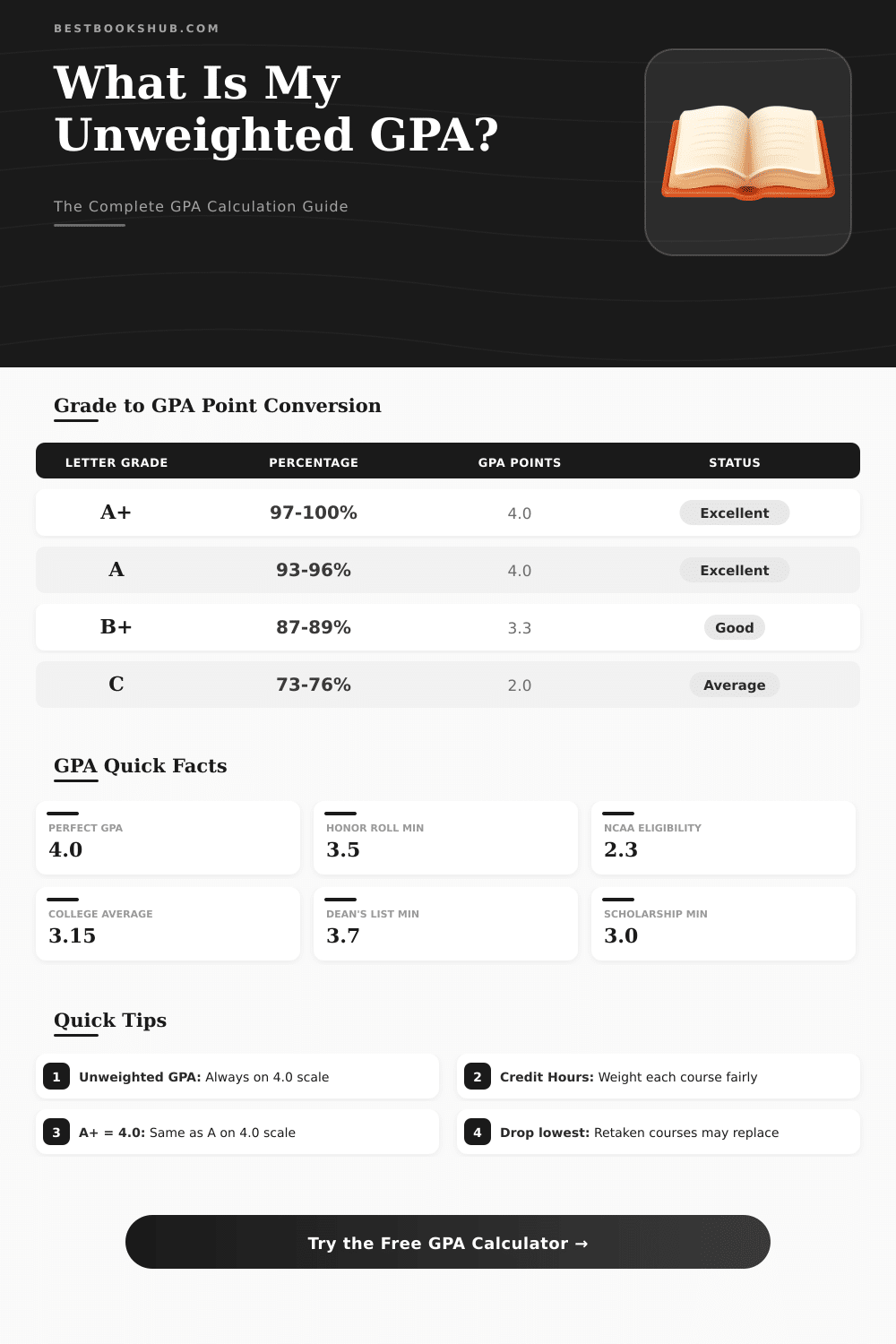
| Letter Grade | Percentage Range | Standard GPA | Plus/Minus GPA | Common Standing |
|---|---|---|---|---|
| A+ | 97 – 100% | 4.0 | 4.0 | Exceptional |
| A | 93 – 96% | 4.0 | 4.0 | Excellent |
| A- | 90 – 92% | 4.0 | 3.7 | Excellent |
| B+ | 87 – 89% | 3.0 | 3.3 | Above Average |
| B | 83 – 86% | 3.0 | 3.0 | Good |
| B- | 80 – 82% | 3.0 | 2.7 | Good |
| C+ | 77 – 79% | 2.0 | 2.3 | Average |
| C | 73 – 76% | 2.0 | 2.0 | Average |
| C- | 70 – 72% | 2.0 | 1.7 | Below Average |
| D+ | 67 – 69% | 1.0 | 1.3 | Poor |
| D | 63 – 66% | 1.0 | 1.0 | Poor |
| D- | 60 – 62% | 1.0 | 0.7 | Poor |
| F | 0 – 59% | 0.0 | 0.0 | Failing |
| GPA Range | Letter Grade Equiv. | Academic Standing | Typical Recognition |
|---|---|---|---|
| 3.9 – 4.0 | A / A+ | Excellent | Valedictorian, Summa Cum Laude |
| 3.7 – 3.89 | A- | Excellent | Magna Cum Laude, Dean's List |
| 3.5 – 3.69 | B+ / A- | Very Good | Dean's List, Cum Laude |
| 3.0 – 3.49 | B | Good | Honor Roll (many schools) |
| 2.5 – 2.99 | C+ | Satisfactory | Good Academic Standing |
| 2.3 – 2.49 | C+ | Satisfactory | NCAA Eligibility Minimum |
| 2.0 – 2.29 | C | Minimum | Graduation Requirement (many schools) |
| Below 2.0 | C- | Probation | Academic Probation Risk |
| Opportunity | Min. GPA (Typical) | Competitive GPA | Notes |
|---|---|---|---|
| General College Admission | 2.0 | 3.5+ | Varies by institution |
| Ivy League / Top Schools | 3.9 | 4.0 | Unweighted preferred |
| Merit Scholarships | 3.0 | 3.7+ | Many require 3.5+ |
| NCAA Division I Athletics | 2.3 | 3.0+ | Core course GPA |
| Honors Program | 3.5 | 3.8+ | School specific |
| Graduate School (General) | 3.0 | 3.5+ | Depends on program |
| Medical School | 3.5 | 3.7+ | Science GPA also reviewed |
| Law School (Top 14) | 3.7 | 3.9+ | LSAT also critical |
Unweighted GPA is the most common way to measure academic success in high school. It uses a scale of 0 to 4.0 and ignores the difficulty of the courses. That means an A in an AP or IB course and an A in a simple course both value 4.0 It is a simple method to see the results of a student without looking at how difficult the chosen courses were.
DISCLOSURE: This post may contain affiliate links, meaning when you click the links and make a purchase, I receive a commission. As an Amazon Associate I earn from qualifying purchases.
The grading system is very clear. A is 4 points, B is 3, C is 2, D is 1 and F is 0. If the school does not use plus or minus grades, you do not need to care if for instance 93 percent becomes 3.7.
What Is Unweighted GPA and How It Works
To calculate unweighted GPA, you add the points of every course. Then that amount is divided by the number of courses. The result you usually round to one or two decimals.
Because advanced classes weigh the same as basic, this GPA can never go above 4.0.
In this system, a standard course gives the same GPA as an advanced class. So a student who gets only A’s in easy courses can have a higher total GPA than someone who studied in hard classes. That might seem a bit unfer, but that is how the system works.
Weighted GPA works differently. It gives extra points for hard studies like AP or honors courses, commonly using a scale to 5.0. For instance, an A in an AP class can become 5.0, while an A in a regular class stays 4.0.
Many schools also have mid-level honors classes, where the maximum is 4.5. While unweighted GPA ignores the type of class, weighted GPA considers it.
Universities commonly prefer to decide whether a course was difficult or not. Most admissions officers standardize the results, either by unweighting or using their own weighting system. They look at the unweighted GPA and the chosen courses to count a new value, so they can compare candidates from various schools.
Weighted GPA are almost useless if you do not know the rules of the particular high school.
Although a high unweighted GPA is important, universities also look at other things, like the total of won credits, the trend of the grades and the success in difficult courses. High GPA also helps to get financial support, because many scholarship programs use it to decide. Students can use a GPA calculator or read the policies of the school to understand how peers will interpret their grades.
In the Common App or Coalition App, reporting the unweighted GPA is a good strategy.
When unweighted GPA falls under 4.0, it is mathematically impossible to raise the average back to 4.0. It can get close, but it will never reach the maximumagain.