📖 Vocabulary rate lab
Vocabulary acquisition rate calculator
Estimate how quickly new words move from exposure to usable memory, then compare retained words per hour, week, and study window.
Choose a source mode, then add candidate flow, study time, retrieval quality, exposures, backlog, and target size. The rate is the estimated usable vocabulary gain after forgetting and review limits.
| Source type | Candidate words per 1,000 | Typical capture | Acquisition pattern |
|---|---|---|---|
| General fiction | 8-22 | 20-40% | Rich context, moderate repetition, lower urgency. |
| Classics or literary essays | 18-45 | 30-55% | Older diction and denser phrasing slow the rate. |
| Academic nonfiction | 30-75 | 45-70% | Terminology clusters need review and definitions. |
| Language learner text | 40-110 | 60-85% | Many candidates, but graded repetition helps retention. |
| Assigned vocabulary list | Direct list | 80-95% | Fast capture, weaker context unless examples are added. |
| Review style | Seconds per rep | 20-minute capacity | Best fit |
|---|---|---|---|
| Fast recognition | 8-14 | 86-150 reps | Familiar roots and simple definitions. |
| Normal flashcards | 15-22 | 55-80 reps | Most vocabulary cards and notebooks. |
| Definition recall | 22-35 | 34-55 reps | Academic terms and precise meanings. |
| Production practice | 35-60 | 20-34 reps | Using words in sentences or speech. |
| Factor | Low setting | High setting | What it changes |
|---|---|---|---|
| Meaningful exposures | 1 context | 6+ contexts | Higher exposures make each card less fragile. |
| Recall accuracy | 45-60% | 84-92% | Better retrieval converts reviews into retained words. |
| First review delay | After 1 week | Same day | Early review reduces the first forgetting drop. |
| Difficulty mix | New forms | Familiar roots | Harder words need more examples and reps. |
DISCLOSURE: This post may contain affiliate links, meaning when you click the links and make a purchase, I receive a commission. As an Amazon Associate I earn from qualifying purchases.
If review capacity is below the repetition need, adding more candidate words usually increases backlog before it increases usable vocabulary.
The model estimates retained vocabulary, so compare weeks with similar difficulty instead of treating every word list as equal.
Retention: You can read a hundred pages of fiction in an afternoon and still not know ten new words by tomorrow. The reason? Exposure is easy; retention are difficult. Once you input your reading habits and review discipline, the calculator above do the math for you, so there’s no need to guess whether or not it’s working.
Most people assume that volume equal progress, but thats not how brain functions. It requires both meaningful context and spaced repetition. Collecting debt won’t make you smarter. The quantity of input do not equal quality. This is why knowing whether your sources are mostly casual reading or study material matters more than total hours spent. Because books are just different. Fiction will rarely dump a truckload of terms on you like an academic text would. A novel may give you five in a chapter, but a dense paper might drop fifty on you in two pages.
Why Reading More Doesn’t Mean Learning More
If you treat your textbooks as beach reads, you’ll miss all the clues telling you which words to capture. On the other hand, if you try forcing yourself to list words from casual reading, you’ll burn out during review time without having learned anything worthwhile.
This is where the calculator comes into play: It can help you identify what’s causing your bottleneck, and most often it’s not the flow of incoming new words. It’s your capacity. You may be able to learn two-hundred words a week, but if all you can squeeze in is twenty minutes a day on flashcards, there’s a limit to what your brain can review. Even if you only spend a few seconds on each word, you simply cannot maintain this pace without forgetting some of your older word.
What does that mean? Seconds per card sound like nothing. But once you reach three hundred cards, you realize that eight seconds per card mean an hour of work before lunchtime. This is why we have the concept of “study efficiency”, the metric that tells you how many usable words you get per hour of focused attention. If the metric are low, you know that your backlog is eating your time. You’re spending more energy keeping old words alive than acquiring new ones.
Memory glues itself onto context, which is why a word presented within a sentence full of vivid imagery will be retained more effective than the exact same word listed by itself. Seeing a word three different times in different ways are more valuable then seeing it ten times with the same meaning, which is why the calculator considers meaningful exposures. People miss that point whenever they obsess over how many times something has been encountered rather than how well it’s been associated.
Because technical terms tend to be difficult, the math adjust for the mix of difficulty levels, making harder words require more reps. Abstract concepts takes longer to master than easy nouns do; the tool recognizes that difference and doesn’t assume that all vocab is created equal.
Consistency matters more then perfection. The algorithm penalizes delayed or irregular reviews. Science supports this, as your brain won’t file it away unless it knows you care about the info. If you wait a week for your first review, you will probably forget. This leads to an early consolidation and a steep drop-off at the beginning of the curve. It is wasted effort. This isn’t about perfection, but rather timing: Check in within two days, keep the retention factors healthy, and let a steady rhythm beat a heroic cram session followed by silence.
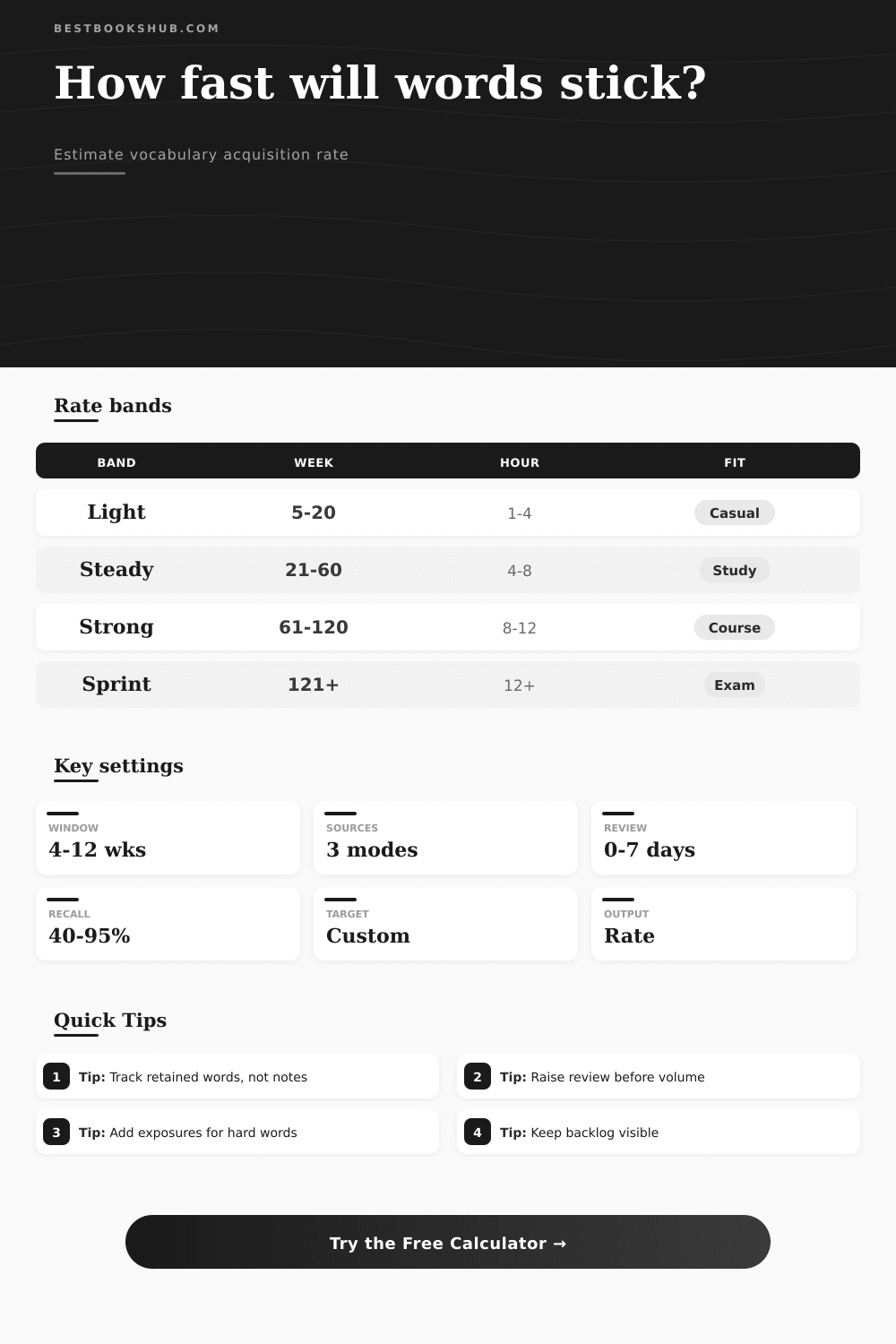
High velocity causes high friction. Go fast if you have a deadline and a backup plan but don’t go sprinting after the band unless you’re trying to catch up. Most sustainable growth occur on the light and steady bands that let you digest the stuff. Crank the pedal to eleven later after building the habit. Breaking the review chain is more difficult than starting slowly, and the estimates will help you get real about what’s realistic.
You should of believe the tool when it tells you it’ll take twelve weeks to reach your goal. Chasing a four week timeline typically results in burnout and abandoned lists. Learning vocab isn’t a matter of filling up a bucket; it’s like gardening. There are seeds (vocab). They require watering (regular reviews) and weeding (removing the weeds before they kill the root).
How much do you water each word? Does the rate feel sluggish? Check your review schedule. More often than not, the solution is not to “read faster” but to “remember better.” When the math guides our pace and we respect the repetition, it keeps the backlog in view. That’s how we stop guessing and start growing.