📚 Series pace lab
Volumes Per Month Calculator
Calculate how many volumes to read each month, plus daily pages, monthly hours, finish date, and deadline pressure for manga, comics, novels, and study sets.
Count unread volumes only, or enter total volumes and volumes already finished. The calculator converts the stack into a monthly pace, reading-day target, hours, and deadline fit.
| Volumes per month | 180-page manga | 320-page novel | Best fit |
|---|---|---|---|
| 1 volume/month | 180 pages/month | 320 pages/month | Low-pressure reread or side series. |
| 2 volumes/month | 360 pages/month | 640 pages/month | Casual but consistent reader. |
| 4 volumes/month | 720 pages/month | 1,280 pages/month | Weekly volume habit or book challenge. |
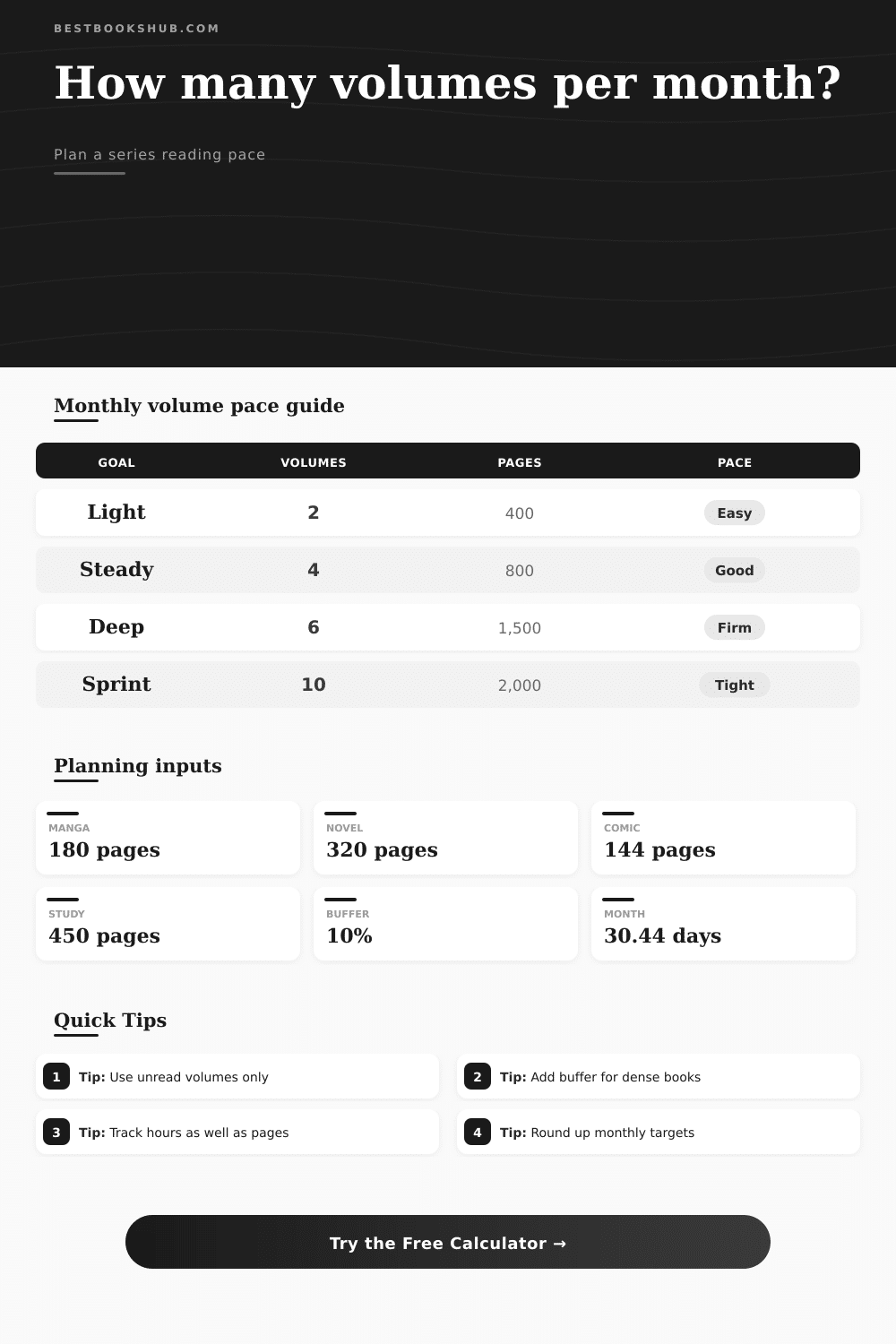
| 6 volumes/month | 1,080 pages/month | 1,920 pages/month | Focused series push with steady sessions. |
| 10 volumes/month | 1,800 pages/month | 3,200 pages/month | Short sprint, visual reading, or open schedule. |
| Format | Common speed | Density factor | Planning note |
|---|---|---|---|
| Manga or panel-led comic | 60 to 100 pages/hour | 0.75x to 1.00x | Visual pacing varies by dialogue and action density. |
| Graphic novel | 35 to 70 pages/hour | 0.90x to 1.20x | Literary or experimental pages often need a slower pass. |
| Light novel | 35 to 55 pages/hour | 1.00x to 1.20x | Use prose pace when chapters are text-heavy. |
| Trade novel volume | 25 to 45 pages/hour | 1.00x to 1.45x | Dense style, small type, and notes slow the target. |
| Academic volume | 10 to 25 pages/hour | 1.45x to 1.70x | Annotation and citations can double clock time. |
| Series plan | Unread volumes | Target window | Monthly target |
|---|---|---|---|
| Short manga run | 12 volumes | 3 months | 4 volumes/month before buffer. |
| Long manga catch-up | 48 volumes | 12 months | 4 volumes/month before buffer. |
| Comic event arc | 8 trades | 2 months | 4 trades/month before buffer. |
| Book club stack | 6 novels | 6 months | 1 novel/month before buffer. |
| Graduate reading list | 10 volumes | 5 months | 2 volumes/month before buffer. |
| Monthly pages | 3 days/week | 5 days/week | 7 days/week |
|---|---|---|---|
| 360 pages/month | 28 pages/day | 17 pages/day | 12 pages/day |
| 720 pages/month | 55 pages/day | 33 pages/day | 24 pages/day |
| 1,080 pages/month | 83 pages/day | 50 pages/day | 36 pages/day |
| 1,500 pages/month | 115 pages/day | 69 pages/day | 49 pages/day |
| 2,000 pages/month | 153 pages/day | 92 pages/day | 66 pages/day |
DISCLOSURE: This post may contain affiliate links, meaning when you click the links and make a purchase, I receive a commission. As an Amazon Associate I earn from qualifying purchases.
A decimal monthly pace is useful for math, but a real plan usually needs whole volumes assigned to each month.
Ten manga volumes and ten academic volumes are not equal effort, so the calculator keeps page load and hour load separate.
Most reading plans start off like this: a pile of books sitting on the shelf and an idea that maybe you’ll read them all before summer rolls around. What’s wrong with that? Nothing! Except… Volume doesn’t matter. A fantasy novel may have four-hundred densely-packed paragraphs, where a tank manga has only a few pages worth of sparse panels. Volume isn’t equal; it’s deceiving.
It’s time to turn that stack into a manageable pace. A pace suited for your real world, not just your idealized version. To get started with it, use the calculator above. It’ll do the rest of the math for you. It’ll do the rest of the math for you.
How to Make a Realistic Reading Plan
Choose your format first. This is way more important than most people think. Because yes, page count is only half the equation. The other half is density. Text are denser than visual storytelling. Sure, some novels has super long sentences, but you can scan a manga page in seconds. In a novel, however, you’re parsing out each word. That’s why the tool has density multipliers. Set it higher if you’re planning to read annotated editions or something realy academic. It takes into account how much time you’re spending looking things up or rereading complex sentences. If you don’t adjust for this, you may find yourself thinking your schedule looks fine on paper, but in reality it’s impossible.
The other variable is time. How long do you want this to take? Are you looking at months or a firm end-date? End-dates add clarity, but they also adds pressure. Choose one and let’s go from there. Then the system calculates how much time you should of dedicate each week. It calculates not just how many pages. But what load of hours in a week will get it done.
That’s the piece where most systems fall apart. We say “I’m gonna read four books a month” with no idea what that looks like. Nearly an hour a day of focused reading, every day of the week. Before you begin, the calculator shows that tradeoff.
But don’t dismiss the buffer setting. Life occurs. Work gets in the way. You get sick. You binge a new television show instead of reading a book. Extra time isn’t pessimistic; it’s realistic. Successful readers adds some slacker time to their schedule, because then they aren’t beating themselves up if they miss a day.
The pace chart below shows how your easy or sprint paces turns into the amount you should aim for each day. Two books a month at a light pace might be twenty pages per day. Even tired evenings can hit that target. If you go deep, six volumes requires nearly fifty pages daily. That takes commitment and unbroken focus.
And also think about how often you like to read. Do you want a single long weekend marathon, or would you rather break up your reading into five shorter sessions? You can use this tool to change your minutes per session and days per week. That will help you match your energy levels. For example, if you only have time to read during the weekends, then your weekly commitment will remain the same, while your daily target will increase significantly.
As long as the numbers reflect your reality, there’s no right or wrong way to do it. And lastly, consistency wins out over intensity. It doesn’t matter if you finish a series, provided you enjoy it along the way. If you feel like you need to read three hours on an average workday to match your preferred speed, then step back and change things up. Round down on the session duration on the weekend or drop target month altogether. The point is to knock out the stack while not hating every second of the process.
A reading plan isn’t about limiting yourself; it’s about allowing yourself permission to switch off and forget about all the books once they’re put away for the night. You’ve got your pace. You’ve got your plan. Just sit back, relax, and read.