Vowel Counter
Count every vowel A, E, I, O, U with a detailed frequency breakdown
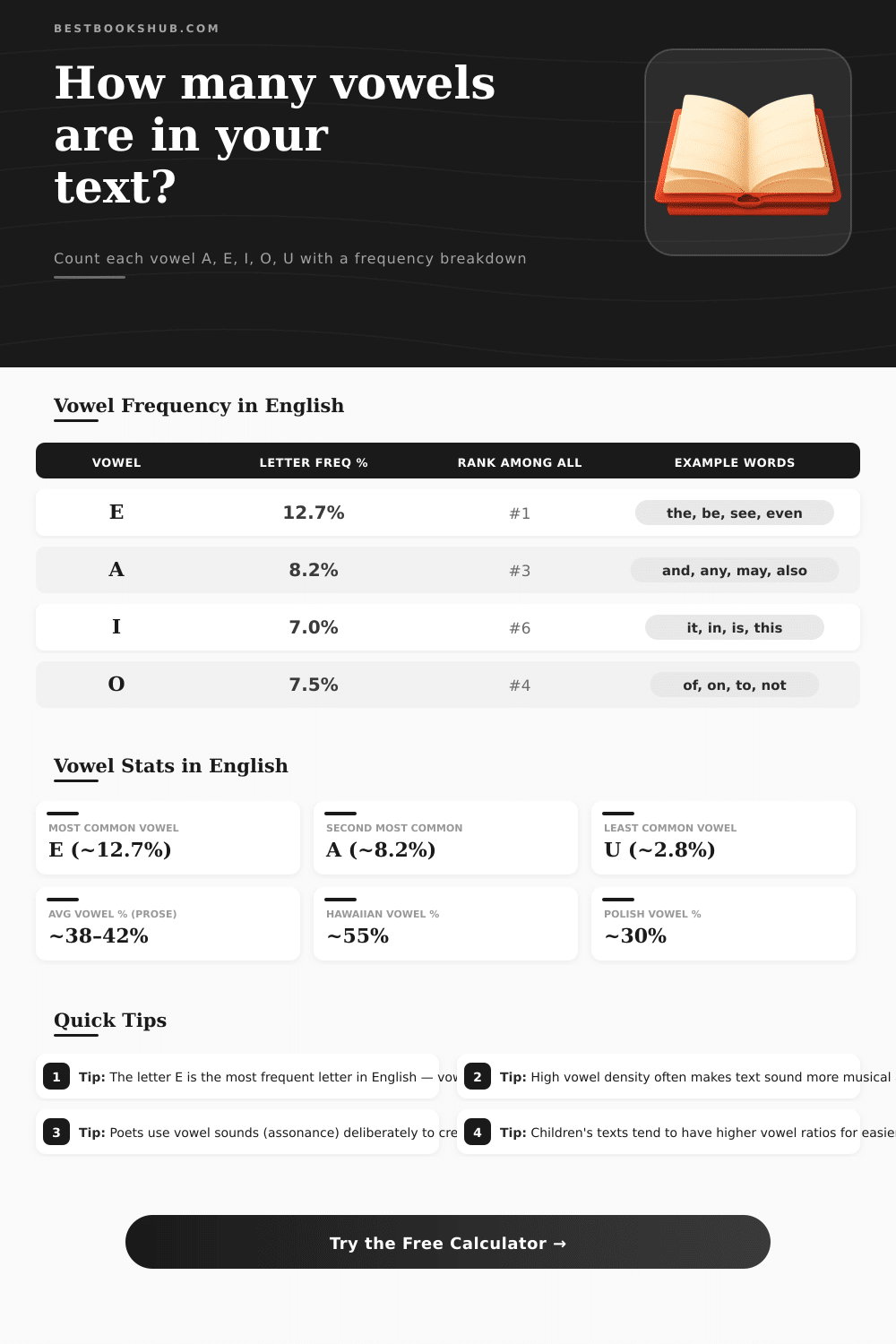
| Vowel | Freq % (All Letters) | Freq % (Vowels Only) | Common Words |
|---|---|---|---|
| E | ~12.7% | ~38% | the, be, see, even, here |
| A | ~8.2% | ~25% | and, any, may, also, can |
| O | ~7.5% | ~23% | of, on, to, not, so, do |
| I | ~7.0% | ~21% | it, in, is, this, will |
| U | ~2.8% | ~8% | up, use, but, our, out |
| Genre | Approx. Vowel % | Notes |
|---|---|---|
| Children's Books | ~42–45% | Simple words, high vowel ratio |
| Literary Fiction | ~40–42% | Standard English prose range |
| News / Journalism | ~38–41% | Concise, efficient language |
| Academic Writing | ~36–39% | Complex terminology lowers ratio |
| Poetry (lyric) | ~42–48% | Often uses assonance intentionally |
| Technical Writing | ~35–38% | Abbreviations and jargon reduce vowels |
| Language | Vowel % of Letters | Notes |
|---|---|---|
| English | ~38–42% | Mixed Germanic/Romance |
| Spanish | ~45–47% | Vowel-rich Romance language |
| Italian | ~46–48% | Very vowel-heavy |
| Hawaiian | ~55–60% | Extremely vowel-dominant |
| Polish | ~30–33% | Many consonant clusters |
| Arabic (romanized) | ~25–30% | Consonant-heavy structure |
A vowel counter is a free online tool that quickly scans any text and counts how many vowels, A, E, I, O and U; appear. This tool is useful for writers, students, teachers, linguists and anyone that works with words. There are also free online tools that count the number of characters, words, sentences, vowels, consonants and even prepositions in text.
DISCLOSURE: This post may contain affiliate links, meaning when you click the links and make a purchase, I receive a commission. As an Amazon Associate I earn from qualifying purchases.
No registration is required.
How to Count Vowels Online and with Code
To use an online vowel counter, simply type or paste text in the marked box to count vowels online. The results update immediately, showing the numbers of A, E, I, O and U as you type. The consonant and vowel counts above the text box automatically will show according to your input.
Under the box you see the count of every separate consonant, for instance B, C, D, F and so on. Later appear also the letter and word count. To start fresh click the button to erase the text and remove the entered content.
Beyond the online tools, counting vowels is a common programming exercise. In Python you can do that in a string step by step. Start by setting a count variable to 0.
Later use a for loop to go across the characters in the string. With an if statement check if the character is a vowel or not, and increase the counter if it is a vowel. In Python the for loop works as a “for each” loop.
Unlike other loops, it goes over all elements, instead of keeping a separate counter, loop variable or checking a condition after each pass.
In the classic version you set the counter to 0, go across every character, check whether it is in “aeiouAEIOU“, and increase the counter by 1. A shorter solution uses a list insight to filter the vowels and print the length. Another approach uses the built-in count method of the string to count each vowel separately, and later adds up the totals.
In JavaScript the logic stays similar. You loop threw the input string and check every character as a vowel by means of includes(). The counter grows for every match.
The includes method returns true if the character is in the vowels string, so the counter goes up. For instance, “bootcamp” returns 3 vowels, “apple” returns 2 and “pizza” returns 2.
A common mistake is comparing the whole input string instead of a single character. Unless the input is only one single vowel, that comparison never will be true. Another common bug is always getting a count of 1, regardless of how many vowels actually are there.
Adding print statements in the loop can help spot such issues. Also problems can come up when words are separated by a space, one word works fine, but after that the counting stops.
For a quick example, the string “geeks for geeks” has 5 vowels and 8 consonants. The full alphabet string has 5 vowels and 21 consonants. The considered vowels are A, E, I, O and U, notY.