📖 Serialized story planner
Wattpad reading time calculator
Estimate how long a Wattpad chapter, part list, completed novel, or binge session will take after adjusting for reading pace, comments, votes, ads, rereads, and breaks.
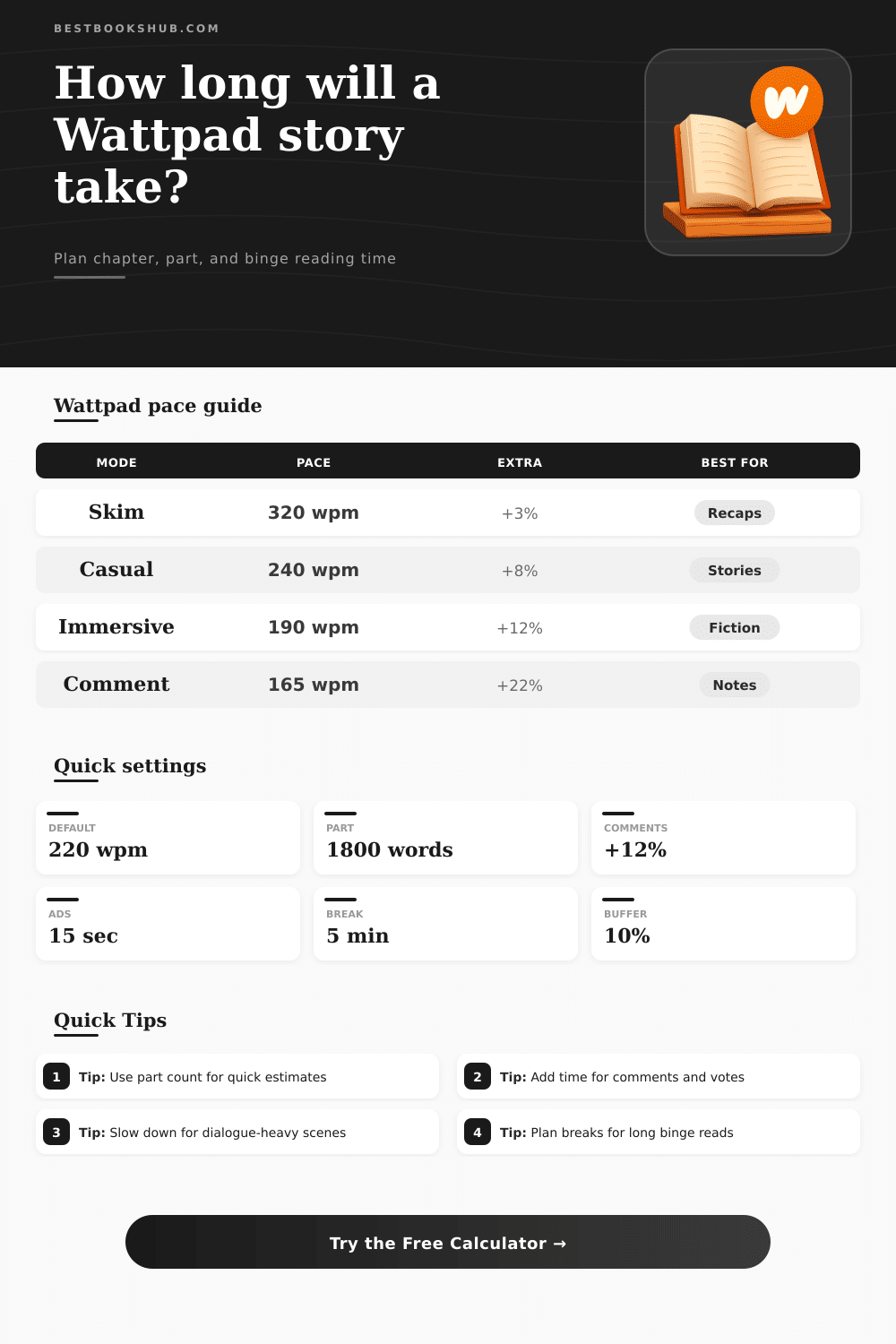
| Reading mode | Base pace | Best match | Time effect |
|---|---|---|---|
| Skim or recap check | 320 wpm | Previously read chapters, summaries, quick checks | Fastest |
| Casual story read | 240 wpm | Light fiction, familiar fandom, easy prose | Baseline |
| Immersive fiction read | 200 wpm | New plot, emotional scenes, careful reading | Moderate |
| Comment-as-you-go read | 175 wpm | Voting, reacting, and reading inline comments | Slower |
| Draft or beta read | 145 wpm | Writer notes, typo spotting, continuity checks | Slowest |
| Story size | Words | Parts | Casual reading time |
|---|---|---|---|
| Single Wattpad part | 1,500-3,000 | 1 | 7-14 minutes |
| Short story arc | 10,000-18,000 | 5-9 | 45-90 minutes |
| Novella-length story | 25,000-45,000 | 12-22 | 2-4 hours |
| Completed web novel | 60,000-90,000 | 25-45 | 5-8 hours |
| Long serial binge | 120,000+ | 50+ | 10+ hours |
| Adjustment | Typical range | Why it matters | Calculator use |
|---|---|---|---|
| Comments and votes | 0-25% | Interactive reading adds stops between scenes | Comment selector |
| Reread rate | 0-20% | Plot twists, dialogue tags, and names cause backtracking | Reread input |
| Ad or transition delay | 0-45 sec | Short waits add up across many parts | Delay selector |
| Device focus | -5% to +18% | Phone, commute, and late-night reading change pace | Focus selector |
| Break schedule | 5-10 min | Long binge sessions need realistic pauses | Break inputs |
DISCLOSURE: This post may contain affiliate links, meaning when you click the links and make a purchase, I receive a commission. As an Amazon Associate I earn from qualifying purchases.
When you start reading a new Wattpad series, you have no idea how much time it will take. Every reader takes a gamble. Will this be an afternoon read, a quick distraction while eating lunch? Or will it be a full weekend journey?
In many ways, that depends on what we think of when we imagine “reading” in a serialized environment. If we use traditional word count assumptions, we’re imagining something consumed silently and uninterrupted, yet few readers reads online this way today. We hit “pause” for advertisements; we click through to comment threads; we get distracted by our own responses to plot twists. Most estimates miss the space between text and real-time experience.
Why Reading Time Is Hard to Predict
There are still some unknowns, hidden variables, but the calculator above do the math for you based off your preferences and story length. And it begins with the first order: the volume (either the precise word count or the number of chapters). From there, however, it doesn’t stop with straight-up division. That’s where the value is. It models how our attention is limited and becomes broken because of how the platform is designed.
Selecting a reading mode isn’t just choosing the desired speed; it’s recognizing one’s own mental state and purpose. Recaps gets skimmed. Immersive reading happens when we care about the prose. And these modes modify the underlying words per minute to better reflect reality different than perfect conditions.
I think what people miss is that comments also contributes a lot of weight to overall time spent. Inline reactions generate a dialogue that naturaly slows you down as they convert passive consumption into an interactive social experience. The tool factors this in with overhead percentages based on level of engagement (light vs. Deep). So if you’re not only reading but replying and voting; you’ll find your actual reading speed drop considerably. It’s not a penalty, though: that’s simply how human attention behaves when spread across multiple direction at once.
And then there’s the unseen impact of technical friction: ads between segments, click-to-transition, etc. Small delays here add up to actual minutes when you’re working through a fifty-part saga. Use the calculator to estimate how much time each chapter “costs” in terms of delay. A few seconds may not feel like much at once, but they will add up into another couple of hours (or more) on your long arc. If you ignore it, you’ll plan optimistically and never see reality when it comes crashing against the reading experience.
The environment/device also matters. There’s a big difference between reading something on a device while commuting vs. You might also be reading it at home on a bigger device. The more distractions you have, such as standing in line or waiting for a bus, the more focus settings will adjust your speed to match those distractions. Your reading speed depend on the context and screen size as much as your retention.
Faster doesn’t always mean you remember more. Slower can sometimes be a good thing. Often, the reason we pick up fiction in the first place is to connect deeply with it. It also makes the time you break up into doable pieces. Long reading sprees need rest periods to maintain quality, which is why you want to pause every now and then to refresh.
The tool will let you set those pauses based on what works best with your day (how intense you want to go) and when it fits best (what nights are off limits?). It takes your total hours and turns them into a doable schedule, such as: “I’m going to read this much each night until I’ve finished,” so that I can live my life away from screens.
That’s why I like how the page does this with a reference table… It lays it all out neatly and compares various paces against types of stories. A conversation in a fast-paced fanfic needs less time then dense prose from a mystery novel. Match your expectation for pacing to the style of the content. This will help you avoid burning yourself out. You won’t be trying to breeze past details that need care or rush through things that require time.
A reading session isn’t about cold hard numbers as much as it’s about controlling energy. You only have so much attention to give during any given day, and using it efficiently ensures that you’ll finish strong instead of going hard at the start then petering out by 6pm. The tool creates the framework; your habits flesh it out.
By getting good at estimating, you turn an abstract plan into something concrete… A commitment you’re making to yourself. Before you load the first page, you know precisely what you signed up for, which makes every second spent reading feel like a reward instead of a theft from some other part of your life. You should of known it would take time.