🎓 Weighted Average Grade Calculator
Calculate your final grade by entering each assignment, exam, or category with its weight and score.
| Component Name | Weight (%) | Score | Category | Remove |
|---|
| Letter Grade | Percentage Range | GPA (4.0 Scale) | Quality Points |
|---|---|---|---|
| A+ | 97–100% | 4.0 | Excellent |
| A | 93–96% | 4.0 | Excellent |
| A– | 90–92% | 3.7 | Excellent |
| B+ | 87–89% | 3.3 | Above Average |
| B | 83–86% | 3.0 | Above Average |
| B– | 80–82% | 2.7 | Above Average |
| C+ | 77–79% | 2.3 | Average |
| C | 73–76% | 2.0 | Average |
| C– | 70–72% | 1.7 | Average |
| D+ | 67–69% | 1.3 | Below Average |
| D | 63–66% | 1.0 | Below Average |
| D– | 60–62% | 0.7 | Below Average |
| F | 0–59% | 0.0 | Failing |
| Course Type | Homework | Midterm | Final Exam | Other |
|---|---|---|---|---|
| High School Core | 30% | 25% | 30% | 15% (quizzes) |
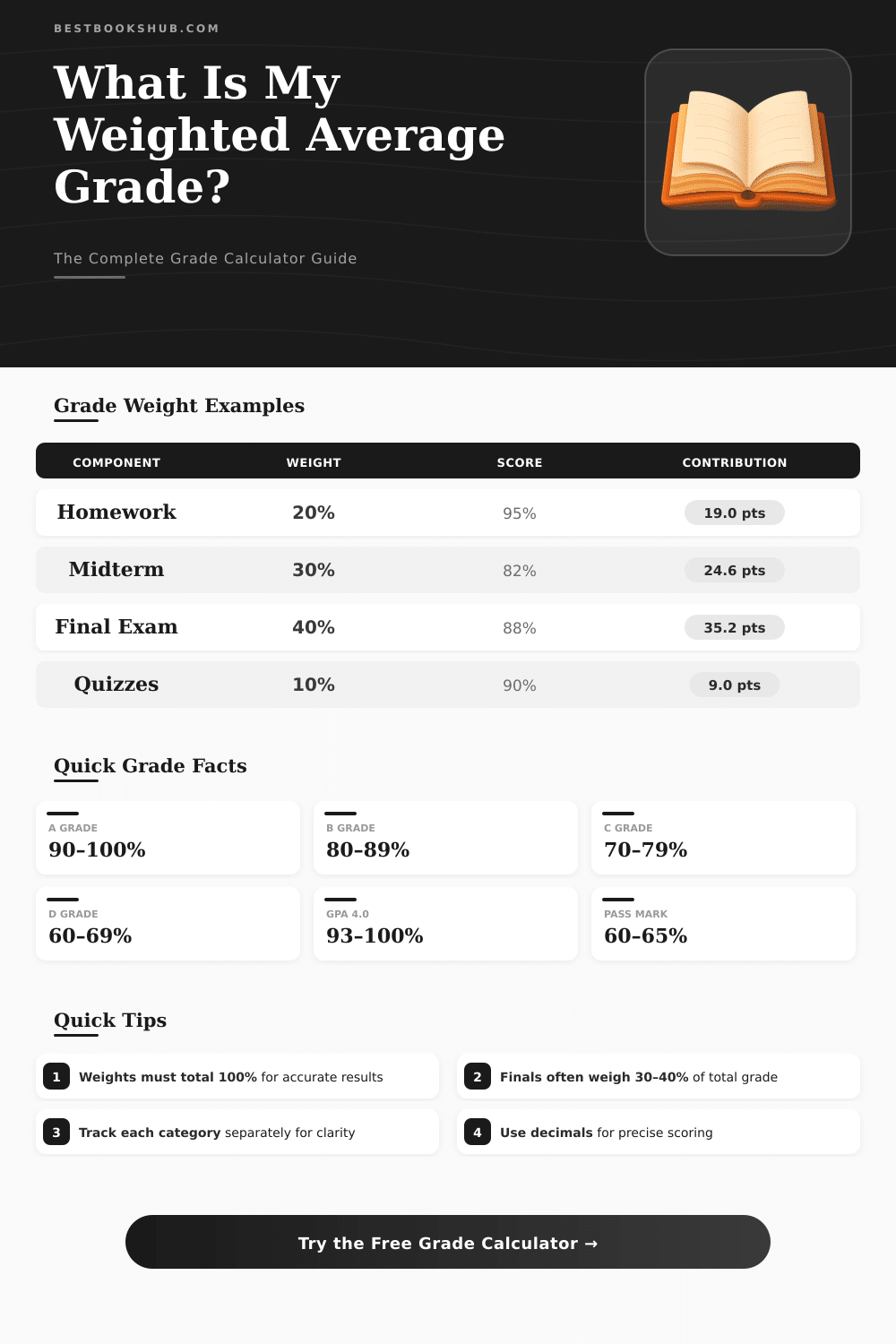
| College STEM | 20% | 30% | 40% | 10% (labs) |
| College Humanities | 20% | 20% | 30% | 30% (papers) |
| Graduate Course | 15% | 20% | 35% | 30% (research) |
| Lab Science | 15% | 25% | 30% | 30% (lab reports) |
| Online Course | 35% | 20% | 25% | 20% (discussion) |
| Project-Based | 10% | 15% | 15% | 60% (projects) |
| Component | Typical Weight | Score Example | Weighted Points |
|---|---|---|---|
| Homework / Assignments | 20–30% | 88% | 17.6–26.4 pts |
| Quizzes | 10–15% | 92% | 9.2–13.8 pts |
| Midterm Exam | 25–30% | 78% | 19.5–23.4 pts |
| Final Exam | 30–40% | 85% | 25.5–34.0 pts |
| Lab Reports | 10–20% | 90% | 9.0–18.0 pts |
| Term Paper / Essay | 15–30% | 82% | 12.3–24.6 pts |
| Class Participation | 5–10% | 95% | 4.75–9.5 pts |
| Group Project | 15–25% | 87% | 13.05–21.75 pts |
Weighted average for grades is only to ensure that some assignments or tests matter more than others when you count your final result. In ordinary average, you simply would add up all your grades and divide by the number of assignments, quite simple stuff. But with weighted system, every grade is multiplied by its weight first, so some scores have stronger impact on the final result
DISCLOSURE: This post may contain affiliate links, meaning when you click the links and make a purchase, I receive a commission. As an Amazon Associate I earn from qualifying purchases.
The actual formula is not too complex. You multiply every grade by its weight, add all those results together, and later divide that by the total of all weights. Other said, your weighted average is the sum of every score multiplied by its weight, divided by the sum of the weights.
How to Calculate Your Weighted Grade
Before you multiply something, remember to convert every percentage to decimal.
For instance, class could be shared like this: Lab counts for 25% of your grade, homework 5%, and quizzes together 10%. Later is Exam 1 at 20%, Exam 2 at 20% and your Final Exam also at 20%. Every category represents its own part of your total grade.
To find what percentage you got in every category, you would divide the points that you won by the total possible points.
Here it becomes interesting. If you receive 100% in everything, the weights add up to 100%. But assume that you had perfect grades in everything except one test that values 25% of your grade, where you got 90%.
That would bring your final grade down to approximately 97.5%.
And what happens if you yet did not do all your exams? You simply would divide by the percentages of the work that already is ready. Therefore, if exams yet will come and you only completed 60% of the available work, you would use that 60% as your denominator.
The good aspect of weighted categories is consistency, each test in the same category has the same weight as each other. Like this, your homework grades can not artificially affect your grade too a lot. That urges students genuinely focus on show what they know during exams, because failure in one alone test will not destroy your whole result, because it is only one bit of bigger cake.
Before this method, schools mostly used simple point totals, what was easier for students follow. There were no moments wondering why perfect marks in one lab barely altered your final grade. Even so, weighted systems became useful when it was hard to give to every task exactly the same number of points.
Weighted GPA operate entirely otherwise. Unweighted GPA follows the 4.0 scale for every class, independently of how much difficult it is. That means that A is 4, B is 3, and so on.
Weighted GPA add bonus, commonly extra 0.5 for Honors classes or extra 1.0 for AP and IB courses… Before averaging everything. In those advanced classes with weighted scales, A jump to 5, B become 4 and C is 3.
Here the surprise: most colleges and universities in United States do not indeed use weighted grades for themselves, even if high schools do that.
Exist tools that take both numerical and letter grades to calculate your course result by means of weighted average. Grade sheet generators can do these weighted calculations and allow you to set the categories using points, percentages or letter grades.