📖 German nonfiction readability lab
Wiener Sachtextformel Calculator
Paste a German nonfiction passage to estimate school grade level with Wiener Sachtextformel variants 1-4, sentence length, long words, polysyllabic words, monosyllables, and sample reliability.
Load realistic Sachtext samples from school, science, administration, news, museum, health, and technical writing. Each preset fills the controls and recalculates.
| Variant | Formula | Best fit | What changes |
|---|---|---|---|
| WSTF 1 | 0.1935 MS + 0.1672 SL + 0.1297 IW - 0.0327 ES - 0.875 | General nonfiction | Uses all four classic predictors, including monosyllables as an easing factor. |
| WSTF 2 | 0.2007 MS + 0.1682 SL + 0.1373 IW - 2.779 | Texts where ES is unstable | Drops monosyllables and leans on complex words plus sentence length. |
| WSTF 3 | 0.2963 MS + 0.1905 SL - 1.1144 | Short samples | Compact two-factor version using polysyllabic words and sentence length. |
| WSTF 4 | 0.2744 MS + 0.2656 SL - 1.693 | Sentence-heavy texts | Gives sentence length more influence than variant 3. |
| WSTF score | Likely school level | Reader signal | Revision priority |
|---|---|---|---|
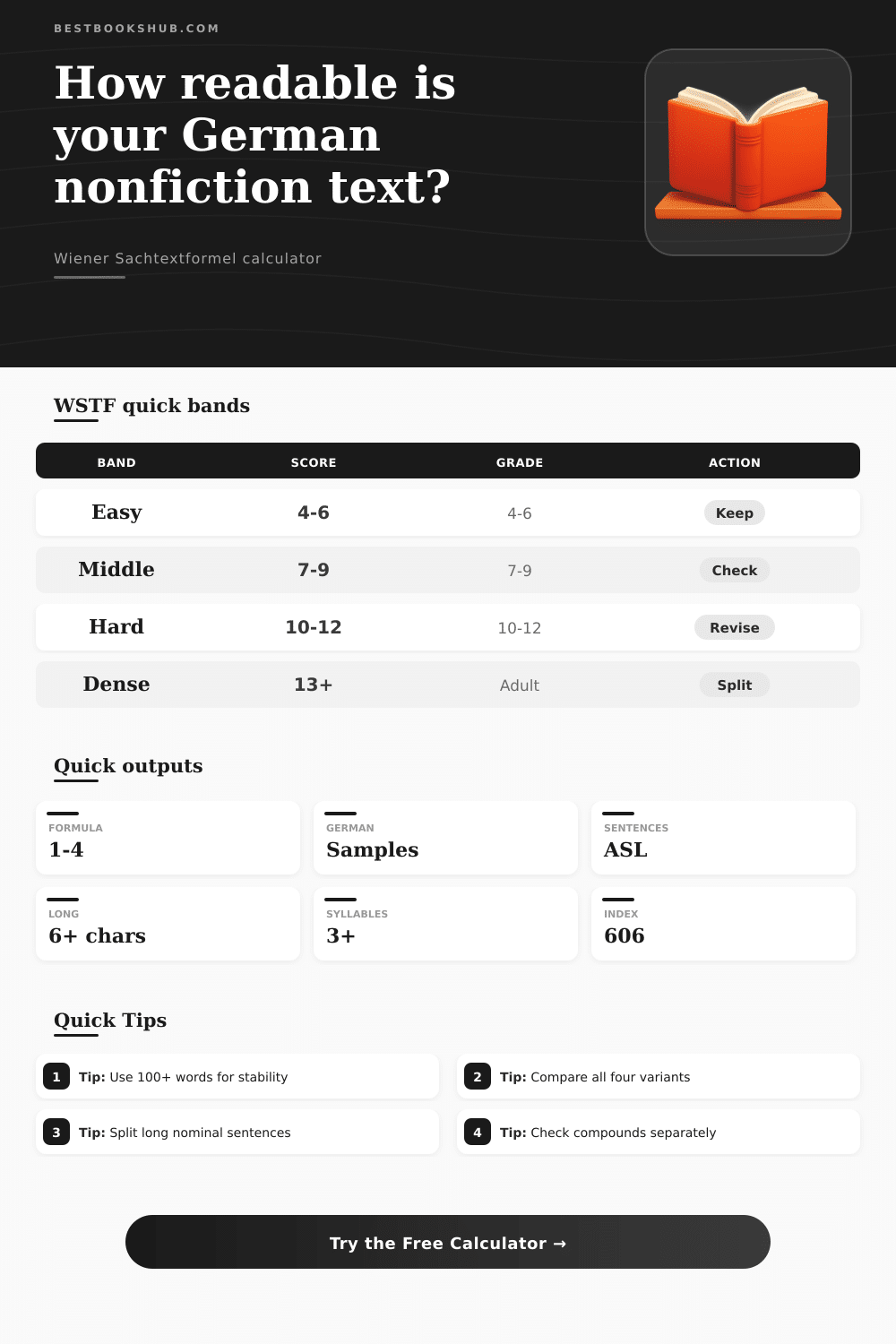
| 4.0-6.0 | Grades 4-6 | Easy informational text for younger readers | Keep definitions short and preserve clear examples. |
| 6.1-8.5 | Grades 6-8 | Accessible school or public nonfiction | Watch noun clusters and paragraph load. |
| 8.6-10.5 | Grades 9-10 | Moderate upper-secondary difficulty | Split long sentences and explain terms early. |
| 10.6-12.5 | Grades 11-12 | Advanced school or adult nonfiction | Reduce stacked compounds and embedded clauses. |
| 12.6+ | Adult or college | Dense specialist prose | Revise sentence architecture before vocabulary. |
| Metric | Light | Moderate | Dense |
|---|---|---|---|
| Average sentence length (SL) | Under 12 words | 12-20 words | Over 20 words |
| Polysyllabic words (MS) | Under 12% | 12-22% | Over 22% |
| Long words (IW) | Under 22% | 22-36% | Over 36% |
| Monosyllables (ES) | Over 45% | 30-45% | Under 30% |
| # | Sentence preview | Words | Long | 3+ syll. | Pressure | Edit cue |
|---|---|---|---|---|---|---|
| Paste text or choose a preset to see the highest-pressure sentences. | ||||||
DISCLOSURE: This post may contain affiliate links, meaning when you click the links and make a purchase, I receive a commission. As an Amazon Associate I earn from qualifying purchases.
Wiener Sachtextformel is a readability calculator for German nonfiction. This tool help to determine the difficulty of your writing. By inputting text, you recieve an estimate of reading grade (school level), and then you’re able to check average sentence length, percentage of words >6 characters, share of words with 3+ syllables, and proportion of monosyllabic words.
The Wiener Sachtextformel has served German communicators, editors, and other writers of nonfiction for decades. It’s a measure of perceived accessibility to the target reader. The formula turn concrete features such as sentence length into an estimated school-level grade. While imperfect, it offers you an objective anchor once your own eyes becomes too accustomed to draft. This is where calculator on the page comes in.
What Is the Wiener Sachtextformel?
Just paste a passage of German nonfiction and you’ll be presented with four versions of the Wiener Sachtextformel plus relevant stats: You get average length of all the sentences, including what percentage of words are greater than six letters long. There’s the share of words with three or more syllables, and the proportion of monosyllabic words. Each metric tell us something else.
Monosyllabicity helps as an indicator, as short words from everyday speech provide the reader with some respite. Lots of words over six characters tend to indicates compound nouns that bundle multiple ideas into one unwieldy word. And long sentences is a red flag for heavy use of nouns found in German administrative texts.
Variants balance emphasis in interesting ways. Simple-word subtraction removes the easing effects. A variant leave out monosyllables completely. Technical labels, abbreviations, and even names can change how much they contributes. Both compact forms favor many-syllable weight plus rhythmic push and pull of sentences. When you have a short sample, this makes sense.
So which to pick? It’s not so much a question of picking “the right” number as it is of recognizing which linguistic pressure is most dominant for your text. A dense nominal chain in a climate report might spike the one with most sentence weight. A well-edited health leaflet will stay calm by any measure.
I’d like to point out German compounds. They’re very effective, accurate, and sometimes necessary. But they increases the number of syllables and long words simultaneously. You can play with various solutions here: How to treat compound words? Or use some mild statistical tweak. It’s never terribly dramatic, but nudges scores by up to a half-grade. That extra effort is all it takes to push a sentence from “check” to “revise.”
That tiny push involve deciding whether to keep a tech word or just include an explanatory phrase directly next to it. No single score determine how readable a piece of writing is in the real world. What matters is layout, white space, using common examples, and what the reader already knows. But the formula does a great job of catching creeping complexity early enough so you don’t have a problem later on.
A lot of people writes paragraphs that contain a lot of information. When they run them through the formula, they get an upper-secondary reading level when what they was shooting for was middle-school clear. That is often eye-opening. The result is practical solutions: break a long sentence into two, change stacked nouns into simpler verbs, and move most complicated definition to the front.
Trust is also influenced by sample size. A very short piece. Where a single large sentence pumps up all metrics at the same time… Will be all over the place. That’s why the calculator tells you it makes sense to run a minimum of a hundred words, and two hundred would of been preferable. Try running multiple passage of text from the same piece. Soon enough, you’ll know if the challenge is concentrated in certain parts or if it’s more evenly spread across a document.
In other words: The Wiener Sachtextformel is not a prescription for style. It’s a mirror. And good writers use it as such. Instead of thinking of the score as a judge, they listen for what it has to say and let themselves be guided by that. They then read their new text out loud to someone. Check if the human ear likes it and the Wiener Sachtextformel agrees.
Bingo: You’ve got yourself some text that pulls its weight. Whether you’re writing policy for civil servants or explanations about bees for fourth-graders, that subtle mix of intuition and measurement is what we’re after all along.