📖 Paragraph word-count lab
Word Count by Paragraph Calculator
Paste a draft to count words paragraph by paragraph, compare each block with a target band, find min and max paragraphs, flag outliers, measure density share, and handle empty paragraph gaps intentionally.
Each preset uses original sample text with different paragraph shapes, blank-line behavior, target bands, and density patterns.
DISCLOSURE: This post may contain affiliate links, meaning when you click the links and make a purchase, I receive a commission. As an Amazon Associate I earn from qualifying purchases.
Tables update from your text: paragraph word counts, outlier and empty-gap alerts, target references, and density interpretation.
| Paragraph | Words | Density | Target status | Outlier status | Visual weight | Preview |
|---|---|---|---|---|---|---|
| Load a preset or paste text to populate paragraph rows. | ||||||
| Alert | Paragraph | Words | Evidence | Revision cue |
|---|---|---|---|---|
| No paragraph alerts yet. | ||||
| Target profile | Word band | Best for | Watch for |
|---|---|---|---|
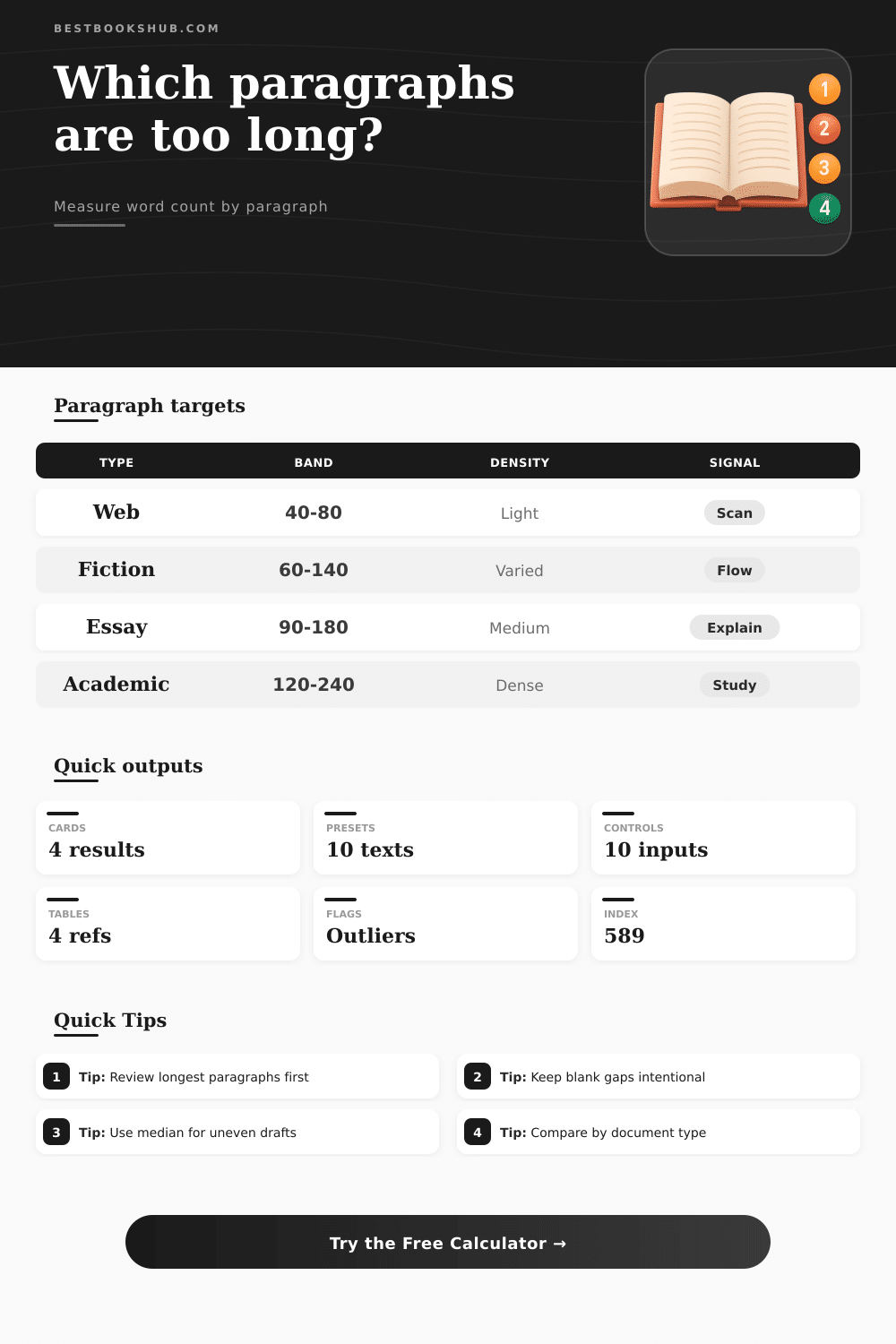
| Web article | 40-80 words | Fast scanning and mobile reading | Dense blocks that hide the main point. |
| Fiction scene | 60-140 words | Action, description, interiority, and dialogue mix | Too many identical block sizes in a row. |
| Essay or guide | 90-180 words | Explanation with examples and transitions | Paragraphs that carry multiple claims. |
| Academic prose | 120-240 words | Context, evidence, method, and interpretation | Long evidence stacks without a topic turn. |
| Setting | What it changes | Best use | Possible effect |
|---|---|---|---|
| Ignore blanks | Blank separators are not counted | Normal pasted articles | Cleanest paragraph statistics. |
| Mark gaps | Extra blank blocks become alerts | Manuscript cleanup | Shows layout problems without changing fit. |
| Count zero blocks | Empty paragraphs appear as zero | Formatting QA | Min count can become zero. |
| Count target misses | Empty blocks affect fit percentage | Strict production checks | Target fit drops when blank gaps exist. |
A paragraph calculator compares their size (median), range (max/min) and number (count). It also look at more things like how they fit in your target band, empty space (gaps), outliers, and density. This let you see what it all adds up to.
Many writers will tell you that overall word count is only half the story. Five thousand words might be a breezy-feeling draft, or it could be brutally dense, with those same words sitting different within every paragraph. Chunky blocks force us to grasp too much at one time; short choppy ones leave us hungry for something substantial. Usually, the difference between exhausting vs. Readability is hiding at the paragraph level. Paying attention to individual block makes all the differance when revising.
Why Paragraph Size Matters for Your Writing
What’s the trick? You recognize rhythm beforehand to anticipate where the eye will rest before the reader even do. In nonfiction, an article on the Web lets most paragraphs range from forty or eighty words, providing a naturaly place for the eye to stop every couple of seconds. In fiction, momentum of narrative carries the reader farther, but a paragraph of two hundred unbroken words risk losing them at just the moment the tension mounts. In academic work, the audience is prepared for extended stretches since they’re expecting dense thinking; it works only if every paragraph earn its length by making a clear turn of thought.
The calculator do the math, freeing you up to ask: Does the shape really serve the material? There is quiet drama when there are empty lines between paragraphs because it create a break in the story. Sometimes there was no reason at all, it’s just an artifact of having copied something onto another platform or even within different editor. Treating each blank as an error skews your stats. Treating them all as sacred bloats out the draft. Part of the craft is learning to distinguish one from the other, and how you choose to do this change every other metric the tool spits back.
The same happens with outliers. If a paragraph suddenly swell nearly twice as large than those around it, there’s likely a collision between two idea that never quite got connected. It is not usually a case of brutal cutting. More often, it is gentle surgery. You can do this by moving one claim up to a new block and inserting a bridging sentence. Then break the text at the change in focus.
Paragraphs that are short can also tell you something. They might be clear bridge passage worth protecting. Or they might be underdeveloped thoughts trying to pass for concise. Context tells.
In most drafts, median size works better than average. Arithmetic mean can get skewed by one or two paragraphs of monsters which pull the average upward while the typical block stay modest. Median doesn’t fall for that distortion; it provides a steadier center line from which to measure the long and short of things. When you have a middle number, its easier to judge what’s on either side without emotional interference.
Words matter but so does density. If I write a paragraph full of technical terms and citations and proper nouns, it’s going to feel longer than another paragraph with fewer words. Or one created out of short dialogue beats may feel lighter despite having similar numbers. You should of be able to switch between various methods of measuring how it “feels” so that the numbers reflect what the reader experiences.
Writers will often revise their paragraphs out of context. Even if blocks of text look perfect on their own, they can still mess up the rhythm once you plug them back in the rest of the writing. Best to go through the entire count, get your results sorted on a sheet of paper or in your mind, then read the three longest paragraphs first. The split will often show itself pretty fast if they’re trying to do two jobs. Then read the three shortest. Are they places where you lacked courage? Were they intentional pauses?
Which is all to say: none of this replaces taste. What works in an essay might smother a short story. And the numbers are diagnostic; not prescriptive. They tell you where there’s friction and how to choose between smoothing it out or leaning into it on purpose. You don’t care how you get them there; you just want the reader to zip along your thoughts and barely notice that you’ve built a scaffold underneath them.
The scaffold then vanishes… Leaving only the thinking. And this, I think, is when the draft begins to take on its own air of completness.