📖 Manuscript structure lab
Word Count per Act Calculator
Split a manuscript into Act I, Act IIa, midpoint pressure, Act IIb, and Act III targets with pages, chapters, scenes, tolerance ranges, and revision buffer.
Load a manuscript profile, then adjust length, pages, chapters, scenes, act shares, and draft progress.
DISCLOSURE: This post may contain affiliate links, meaning when you click the links and make a purchase, I receive a commission. As an Amazon Associate I earn from qualifying purchases.
The live table converts percentages into word, page, chapter, scene, and tolerance targets.
| Act segment | Share | Word target | Target range | Page range | Chapter target | Scene target | Story job |
|---|---|---|---|---|---|---|---|
| Run the calculator to generate the act plan. | |||||||
| Act model | Act I | Act IIa | Act IIb | Act III | Best fit |
|---|---|---|---|---|---|
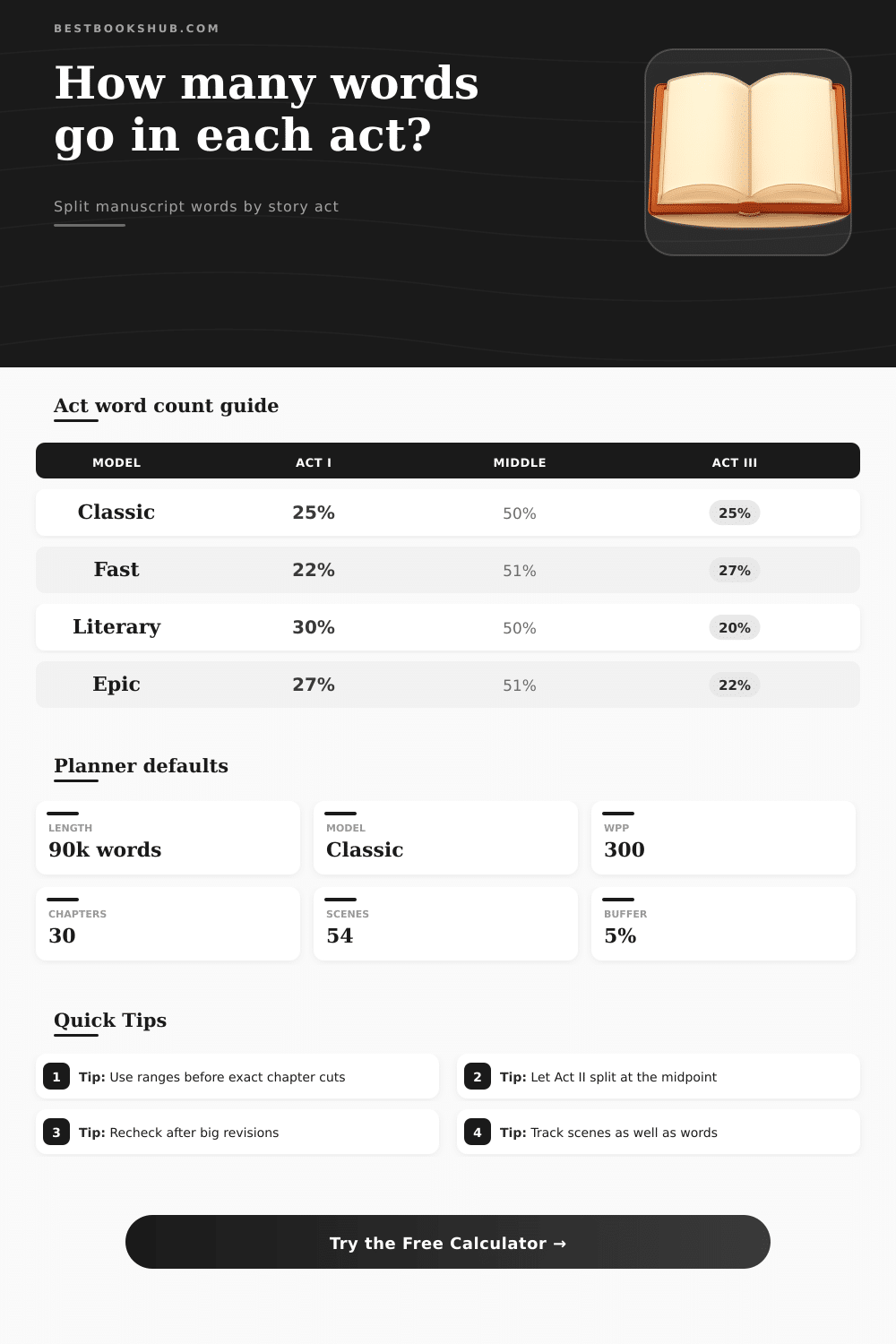
| Classic novel | 25% | 25% | 25% | 25% | Balanced commercial fiction, memoir, and mainstream story structure. |
| Fast commercial | 22% | 26% | 25% | 27% | Thrillers, action, page-turning suspense, and high-stakes genre work. |
| Romance arc | 23% | 27% | 26% | 24% | Relationship-forward novels with a strong midpoint emotional reversal. |
| Mystery pressure | 24% | 28% | 26% | 22% | Clue progression where investigation weight grows through the middle. |
| Literary slow open | 30% | 25% | 25% | 20% | Character-led, reflective, or voice-driven manuscripts. |
| Epic expansion | 27% | 26% | 25% | 22% | Large casts, worldbuilding, quests, and series openers. |
| Draft length | Act I at 25% | Midpoint at 50% | Act III at 75% | Planning note |
|---|---|---|---|---|
| 40,000 words | 10,000 | 20,000 | 30,000 | Novella turns need visible consequence quickly. |
| 70,000 words | 17,500 | 35,000 | 52,500 | Lean genre drafts often use shorter chapters. |
| 90,000 words | 22,500 | 45,000 | 67,500 | A flexible benchmark for many adult novels. |
| 110,000 words | 27,500 | 55,000 | 82,500 | Longer drafts need strong middle sequence turns. |
| 140,000 words | 35,000 | 70,000 | 105,000 | Epic structures benefit from act-level sub-arcs. |
| Act segment | Primary job | Common draft signal | If short | If long |
|---|---|---|---|---|
| Act I | Hook, normal world, catalyst, commitment | The protagonist crosses a line and cannot reset. | Add context or consequence. | Move commitment earlier. |
| Act IIa | Tests, promise, new-world pressure | The old plan meets fresh complications. | Expand discovery scenes. | Combine repeated tests. |
| Act IIb | Reversal fallout and rising squeeze | Midpoint truth changes the strategy. | Deepen consequences. | Cut circling or delay. |
| Act III | Final plan, climax, aftermath | The story question gets answered. | Allow resolution space. | Trim explanation after climax. |
The middle section of your manuscript isn’t coming together for you. You loved writing the beginning. It’s really strong. But somewhere around page 100, the story tend to lag, slowing down the read. The problem isn’t a lack of creativity. The problem is structure. Most likely, you’re spreading out your strongest stuff over entire novel. When you want to focus the narrative energy, you spread it out.
Dividing your draft into acts will allow you to direct energy toward points in the narrative where it’s needed. Before tackling tricky sections, youll want a roadmap of sorts. Use the Act Break Calculator. It spits out numbers so that abstract theories becomes actionable word counts. Making pacing choices becomes less about guessing and more about checking, does this fit within desired word count for Act IIa? If not, move it up or down. That kind of certainty goes a long way towards making things less stressful.
Fix Your Story Structure With Word Counts
What’s the starting point for all your math? It is the total length you’re writing from. An average commercial novel would come out to roughly ninety thousand words. A tighter thriller may fall into range of eighty thousand; a literary fiction book can go as high as a hundred twenty thousand. More than your ego determines where that upper bound is; it depends on what genre you’re working in. With fantasy, you can afford to include some worldbuilding. Romance novels need some room to breathe for the emotional arc, but they don’t require an encyclopedia entry about it.
Establishing that figure up-front makes everything else achievable. It keeps things grounded in actualy pages instead of hopeful estimates. After setting length, select a model. It is classic four-part design, with 25 percent for each segment. This make sense for even-handed stories. These stories has equally weighted parts: Setup, Middle, and Resolution.
But not all tales will fit that box. Mysteries tend to require larger center chunk, as clue after clue piles up. Thrillers can be faster paced and may want to drop the hook quickly on page one, with less time spent at the beginning. Presets are available for such changes to keep you from having to guess what percentages matches your genre rules.
How many scenes or chapters do you envision? This will allow you to break down your word count in terms that makes sense to you. Want thirty chapters? The calculator tells you what average length of each chapter must be. Want fifty-four scenes? It displays the best number of words per scene. This avoids the most frequent error: extremely brief beginnings and extremely lengthy middles.
It establishes a rhythm where readers is forced to turn pages. A consistent unit-size earns your reader’s trust. Keep in mind, though, that these figures aren’t set in stone. They’re pace guidelines rather than creative handcuffs. That five percent margin of error covers variances on the page, some scenes may require tightening, while others might stretch. Your midpoint may arrive a bit too soon (or late), but again, so what?
As long as you maintain the momentum, it’s rarely a disaster. You want to prevent the midsection from sagging or the final act from feeling rushed, but other than that, don’t sweat it too much. Revise by recalculating. If you take out ten thousand words in the first act, and don’t recalibrate the remaining percentages of the book, then it will result in an unbalanced structure (the end will appear much more short relative to what preceded it).
Maintaining agreement between the numbers you’re using and the text itself guarantees that each element is playing its part. The story dictates the structure; the structure doesn’t dictate the story. There’s no such thing as controlled chaos when you write. You create characters and worlds that won’t stay in their lanes. A framework doesn’t cage them; it provides them with a stage.
By defining where each act begins and ends, you ensure that every scene earns its place. The payoffs land. The pressure builds properly. You don’t drift towards the end of your book like it’s going to float there somewhere, but your story moves forward with purpose because each piece is earning its spot on the page. That’s what separates a meandering draft from an inevitible draft.