📖 Word rhythm lab
Word Length Standard Deviation Calculator
Paste text to calculate mean word length, median word length, standard deviation, coefficient of variation, short and long word spread, and word length distribution bins.
Load a realistic writing sample, then adjust stopword exclusion, word parsing, short and long thresholds, and bin size.
| Length bin | Words | Share | Weighted distance | Examples | Bar |
|---|---|---|---|---|---|
| Run the calculator to see bins. | |||||
| Letters | Count | Share | Cumulative | Unique forms | Most common examples |
|---|---|---|---|---|---|
| Length frequencies appear after calculation. | |||||
| Group | Rule | Count | Share | Mean length | Common examples |
|---|---|---|---|---|---|
| Short and long word groups appear after calculation. | |||||
| Writing sample | Mean length | Typical stdev | Coefficient variation | What it often means |
|---|---|---|---|---|
| Early reader text | 3.2-4.2 | 0.9-1.7 | 22-40% | Short words and tight vocabulary range. |
| General fiction | 4.1-5.1 | 1.7-2.7 | 34-55% | Mix of short function words and descriptive content words. |
| Book review or essay | 4.5-5.8 | 2.0-3.1 | 38-60% | More abstract terms with ordinary connective words. |
| Academic or technical prose | 5.4-7.2 | 2.6-4.0 | 42-68% | Longer terminology and wider word length range. |
DISCLOSURE: This post may contain affiliate links, meaning when you click the links and make a purchase, I receive a commission. As an Amazon Associate I earn from qualifying purchases.
Compare your distributions. How has the draft improved or changed? Compare draft lengths. How long are your words? Did you use more stopwords in this draft? Are there more long words than short ones?
When we look at how long each word lasts, that’s when the rhythm of what you write hides. Short words tumbling into each other create brisk sentences; longer ones stacking up and demanding attention slow down deliberate. The difference isn’t random. It’s a pattern, and by seeing it clearly enough, you’ll be able to judge whether it helps you create the voice you want… Or goes against it.
How Word Length Helps Your Writing
Most writers find this distinction easy to understand. Adding a sentence full of seven-letter abstractions jars us out of children’s tale. Inserting a paragraph packed with three-letter connectors into a legal agreement leaves it feeling strangely lifeless. It’s just putting numbers on what your ear hears anyway.
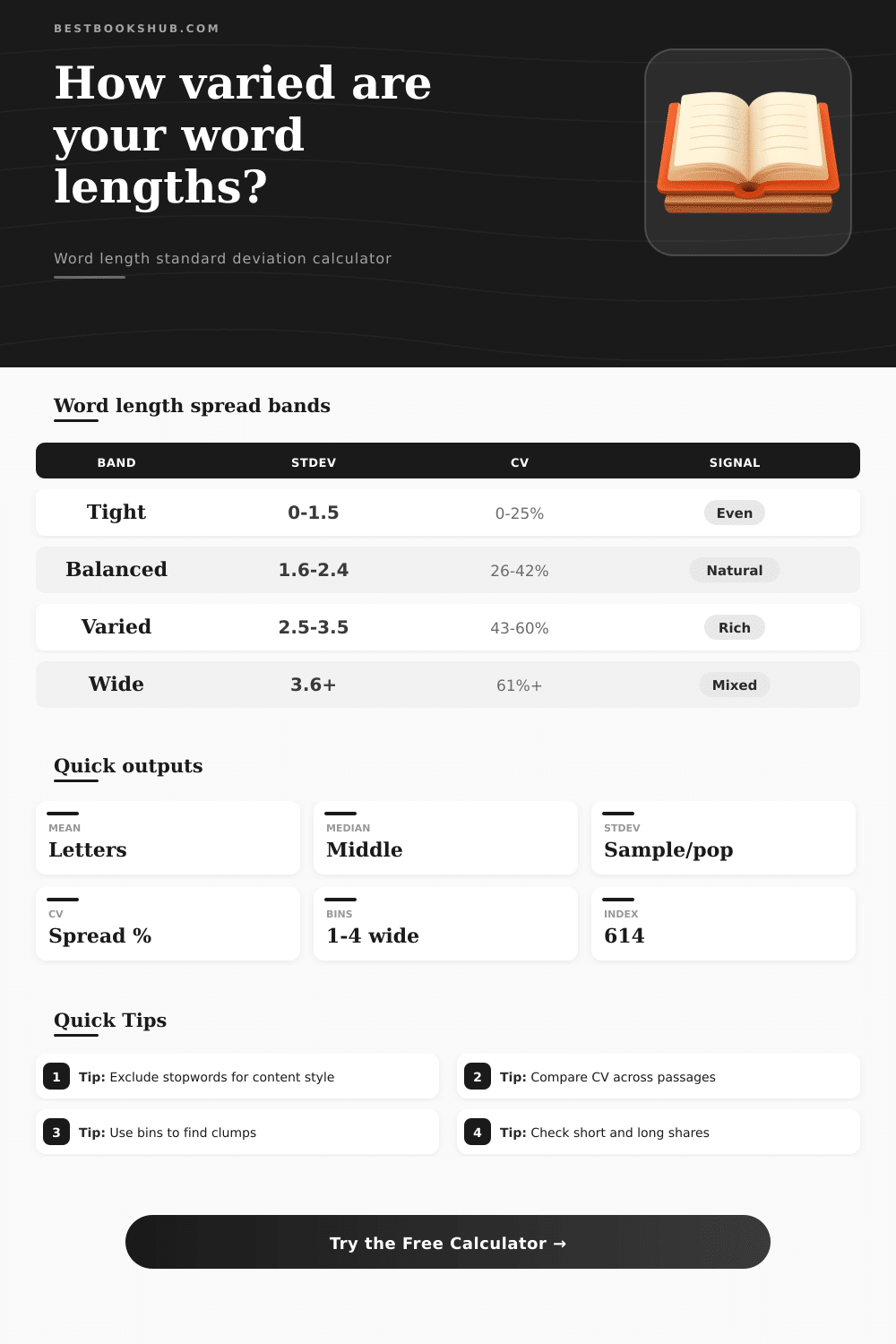
The mean word length indicates its center of gravity. The median indicates position of the average (typical) word. The standard deviation indicate how much others deviate from the average. The spread relative to the average allow for comparing two different passages, even if they have different averages.
That’s where it gets interesting: begin to toggle on or off the filters. Add all the words. You get sentence’s natural pulse, which is engine running on function words. Remove stopwords like common ones, and the image shift. Now you’re seeing just content words, the meaning-carrying words. That’s often a surprise. A passage that seemed well-balanced suddenly seems top-heavy after removing prepositions and articles.
Once you’ve made your choice, the calculator do the math for you. But the choice is yours to make.
Certain genres follow specific layouts. Kids’ books are early readers, packed closely so their young minds has something solid underfoot. Fiction follows a natural ebb and flow: some quick dialogue, some slow description. Academic papers expand, dragging along their long technical terms and the everyday glue used to bind an argument. No spread is necessarily superior; each merely follow its kind. Where we run into problems is when one veers off the path it’s genre prescribes.
Keep an eye out for the number of word shares. Short words add clarity and speed. They are ideal for dialogue or instructions. Long-ones can become dense, they are pretensious. Look how each bin shows you exactly where they start to clump. Maybe you find most of your vocabulary hovers around four- to six-letters with a stubborn train of dozen-monsters dragging the standard deviation above what you hoped.
One quick look at the distribution will tell you why a paragraph may read as heavy even though the average word is ordinary enough. If writers revisit this measure over time, they start to train their ear for proportion. They’ll start to pick out where one word change… Like substituting use for utilize, might shrink whole page. A narrative you want to read as dreamlike can stretch and flex more broadly then a series of safety instructions.
The numbers do not dictate taste; they simply remove the guesswork from the conversation you have with your own sentences. It takes the guessing out of the dialogue between you and your prose. Context also matters. What feel is right depends on tone and subject and audience. Judgment doesn’t get replaced by a coefficient. But if you do have those numbers in your face, then the judgment gets sharper. You’re not just revising blindly. You’re revising with a plan to affect something you can actualy name.
The takeaway: The tool doesn’t write for you. It just reflects back what you’ve written so far, showing you if length of words is working together or fighting against each other. If you look hard enough into that mirror, you’ll usually find your next revision staring back.