📚 Text distribution tool
Word rank-frequency calculator
Paste a passage, rank every repeated word, compare Zipf-style slope, and see whether the vocabulary is broad, balanced, or concentrated.
| Rank | Word | Count | Share | Cumulative | Zipf expected | Delta |
|---|---|---|---|---|---|---|
| Load a preset or paste text to calculate ranks. | ||||||
| Rank pattern | Top word share | Type-token ratio | Read as |
|---|---|---|---|
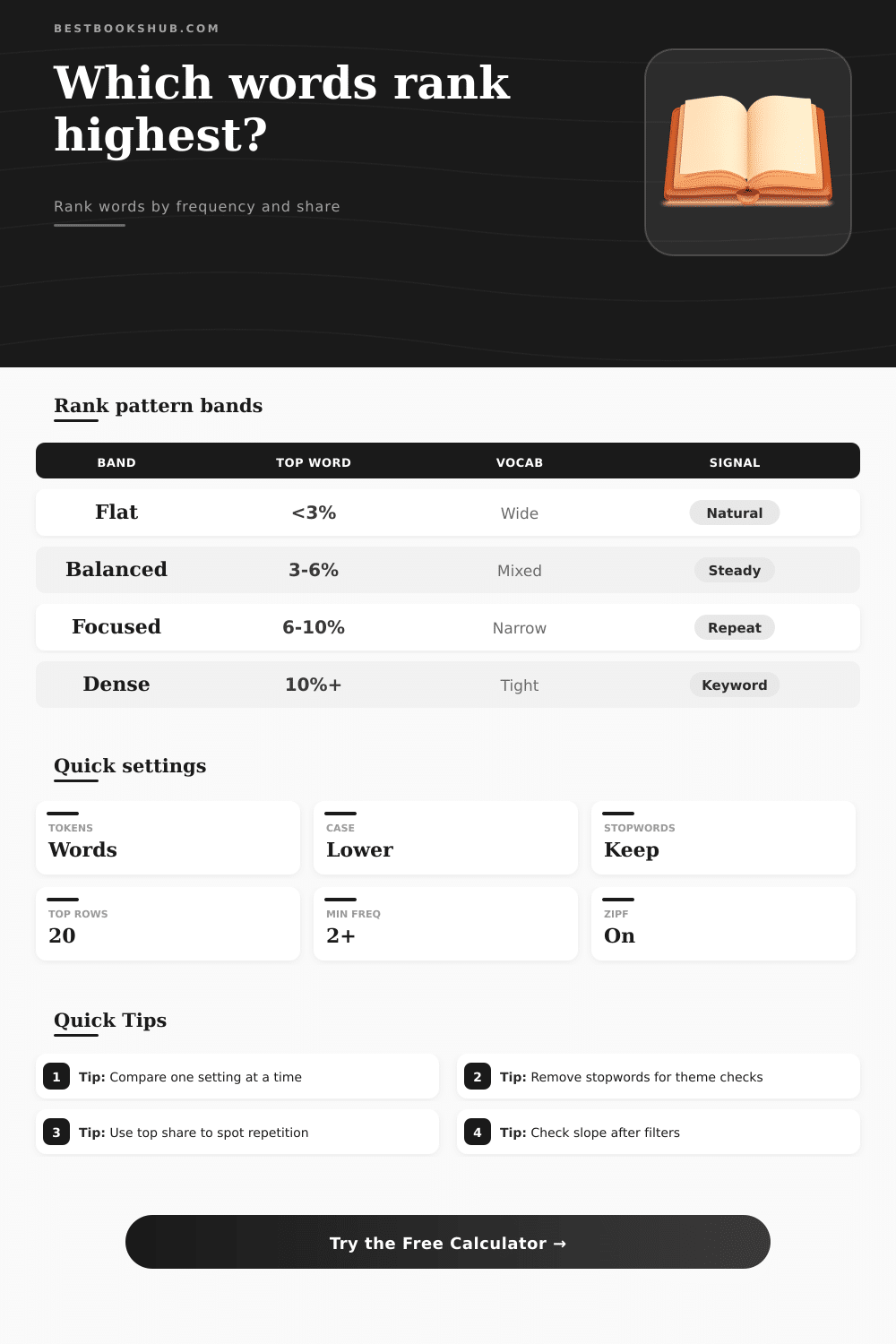
| Flat vocabulary | <3% | High | Broad wording, little repetition |
| Balanced prose | 3-6% | Mixed | Natural passage rhythm |
| Focused passage | 6-10% | Lower | Repeated theme or phrase set |
| Dense keyword set | 10%+ | Low | List, refrain, metadata, or repeated term |
| Token mode | Keeps together | Splits apart | Best use |
|---|---|---|---|
| Words with apostrophes | dont, readers | Hyphen parts | General prose |
| Keep hyphen compounds | well-known | Numbers unless attached | Style checks |
| Letters and numbers | ISBN13, page4 | Punctuation marks | OCR and IDs |
| Catalog code split | Letters, digits | All separators | Index terms and records |
| Zipf slope | Shape | Common cause | Check next |
|---|---|---|---|
| Above -0.75 | Flat | Short text or many singletons | Sample size |
| -0.75 to -1.20 | Classic falloff | Natural mixed prose | Stopword choice |
| -1.20 to -1.60 | Steep | Focused language or refrain | Top phrases |
| Below -1.60 | Very steep | Keyword list or repeated prompt | Duplicate text |
| Comparison profile | Expected top word | Expected TTR | Expected slope | Signal to watch |
|---|---|---|---|---|
| General prose | 3-7% | 35-65% | -0.85 to -1.20 | Balanced function words |
| Dialogue-heavy passage | 4-9% | 30-58% | -0.95 to -1.35 | Pronoun and reply loops |
| Academic note | 3-8% | 40-70% | -0.80 to -1.15 | Repeated technical terms |
| Poetry or refrain | 6-15% | 25-55% | -1.10 to -1.65 | Deliberate recurrence |
| Catalog or index terms | 8-25% | 15-50% | -1.25 to -2.00 | IDs and controlled vocabulary |
DISCLOSURE: This post may contain affiliate links, meaning when you click the links and make a purchase, I receive a commission. As an Amazon Associate I earn from qualifying purchases.
Before you’re aware of what’s amiss, you read a manuscript and know there’s an issue. It’s not the plot, and it isn’t necessarily bad grammar; you just feel like the rhythm is off, like language is being used mechanicaly. If you take out all punctuation and look at raw frequency of words, you will see a pattern to writer’s repetitions.
There’s a shape to our language, and knowing that change how we edit. Zipf’s Law notes that we have a handful of commonly used words, and the rest crop up infrequently. The calculator up there runs math for you. You’ll get a clear view of which words you use often and where frequency rapidly fall off as you descend in list.
How to Check Your Word Patterns
This is the slope, or the rate at which frequency decreases. A high slope indicate that all of your focus is on a small number of words; a low one suggest that your vocabulary has been spread out among many unique word. Neither is necessarily good or bad, but both tell you something about your draft. A high slope could of indicate that you’re relying too heavily on crutch words. Alternatively, maybe you’re working on a technical document where repetition help explain the material.
Function words… Such as “and” and “the”, is largely ignored by most writers in checking their writing style. They add structure without obscuring signal. That’s where the tool comes into play: You can strip them out. And then the fun starts.
What words remain? Your themes will start to show through once extra wording has been removed. Maybe there is an unusual density of a certain kind of verb in your action sequences. Perhaps the use of a particular character’s name are unnaturally high. Again, it isn’t about the count, but the noticing of concentration. If one word make up 10% of all your tokens, that’s a dependency, not a stylistic trait.
To that end the page list a bunch of patterns on a reference table, dividing them into dense, focused, balanced and flat bands. That gives you labels to check your writing against what it should look like. A poem will tend to have many repeating words. Marketing copy is same. Dialogue will tend toward being flatter (people do repeat themselves). Most general prose falls in the middle range and has a more even distribution of type per word.
Knowing this prevents you from fixing things that were meant to be that way. If you’re writing a refrain, you don’t want a wide spread of key terms; if you’re writing an expository essay, you don’t want too much concentration of terms either, as it would bore readers. Normalization decisions confuse people. Do you treat “cats” and “cat” as equivalent words? What about hyphenated compound word?
Making these decisions will greatly change your results. Fortunately, this calculator include toggles for you to adjust those parameters and observe their impact on the strength of your patterns. If switching between singular/plural reduces your top-ranked word from five percent down to two percent, then you have more varied vocabulary than initialy thought.
That variability transforms the report from a snapshot into a diagnosis. Instead of merely observing what’s present, you’re assessing the data’s strength in face of various linguistic rules. This all gets back to a matter of control. No more guessing what’s wrong with your work when revising; now there’s evidence, not just feelings in your gut.
See what words have been given too much or too little weight, then determine whether that was intentional. The numbers aren’t telling you the story: they’re pointing out where the scaffolding might be sag. After you’ve looked at the distribution, you won’t read through looking for mistakes; you’ll read looking for balance. And you will see again how the language shapes up, allowing you to tweak the rhythm until it sounds right.