📖 Word pace tracker
Words behind pace calculator
Compare planned words against finished words, then translate the gap into catch-up words, adjusted reading minutes, deadline pressure, and a seven-day recovery path.
Choose how you know the plan: by start and due dates, by a word count that should already be finished, or by a fixed daily word quota.
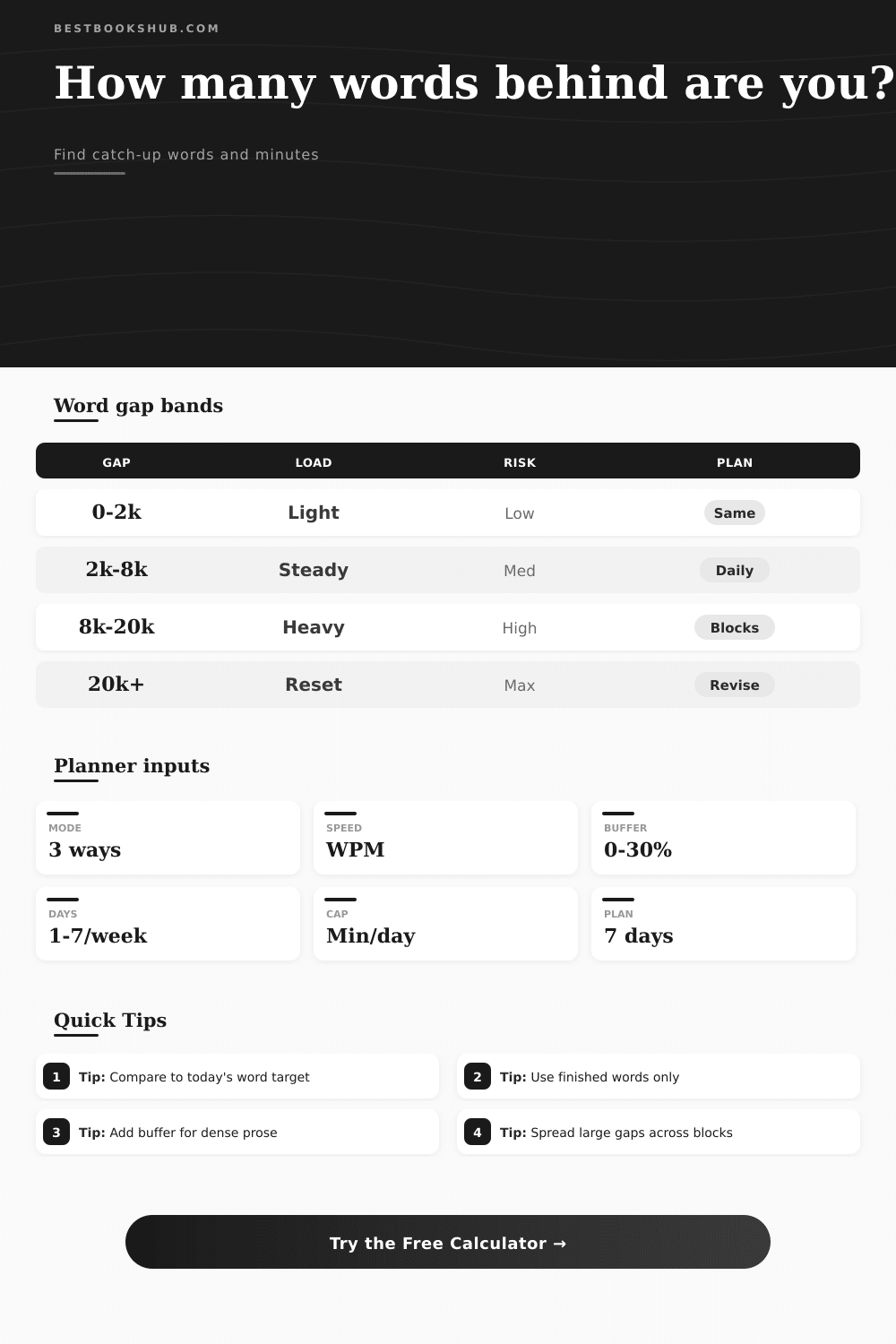
| Gap size | Typical signal | Best recovery move | Watch point |
|---|---|---|---|
| Under 2,000 words | Small slip | Add one short session or fold it into tomorrow. | Do not overcorrect if the next chapter is easy. |
| 2,000 to 8,000 words | Visible lag | Add daily words across the next week. | Extra minutes matter more than planned pages. |
| 8,000 to 20,000 words | Heavy catch-up | Use reading blocks and reduce nonessential notes. | Dense chapters can double the real time. |
| Over 20,000 words | Plan reset | Revise the deadline, target scope, or session length. | A single weekend rarely absorbs the whole gap. |
| Material type | Effective WPM range | Workload factor | Use this when |
|---|---|---|---|
| Narrative fiction | 240 to 320 | 0.90x | The prose is flowing and notes are minimal. |
| General trade nonfiction | 200 to 280 | 1.00x | You need normal retention without citation checks. |
| Dense nonfiction | 160 to 220 | 1.22x | Concepts, figures, or unfamiliar vocabulary slow you down. |
| Textbook or course packet | 130 to 190 | 1.38x | You pause for exercises, summaries, or class notes. |
| Academic or APA sample | 90 to 160 | 1.65x to 2.00x | References, headings, methods, and citation style are part of the pass. |
| Daily extra minutes | At 150 WPM | At 220 WPM | At 300 WPM |
|---|---|---|---|
| 15 minutes | 2,250 words | 3,300 words | 4,500 words |
| 30 minutes | 4,500 words | 6,600 words | 9,000 words |
| 45 minutes | 6,750 words | 9,900 words | 13,500 words |
| 60 minutes | 9,000 words | 13,200 words | 18,000 words |
DISCLOSURE: This post may contain affiliate links, meaning when you click the links and make a purchase, I receive a commission. As an Amazon Associate I earn from qualifying purchases.
You might start out thinking: “I’m only three chapters behind schedule.” That’s discouraging! It might happen in college; you’re supposed to keep up with your reading list. Or it might happen when you join a book club and realize you are behind schedual.
But time isn’t usually the issue. The issue is that you believe that pages = progress. Pages don’t = progress. A 10-page-long chapter of a lightweight novel will take half the time than an equally-long chapter from an academic book full of footnotes. They’re both 10 pages. You need something that cuts through this illusion… ; and tracking words instead of pages do exactly that.
Why Word Counts Are Better Than Page Numbers
A word provides you with standard unit of work. And that converts vague anxiety into a concrete number. Once you enter your word count and desired trajectory, this page’s calculator will do the math for you. It’ll convert that unclear deficit into specific numbers: how many minutes? How much reading each day? You get to avoid guessing whether to push harder to make it up, or to haggle with your timeline.
People tend to think they’re being slow because they’re reading slowly. They simply don’t realize that speed is only part of the equation. Often times, it has more to do with density of what they’re trying to absorb. For example, maybe you can absorbs 200 words per minute when the content is narrative. Nice. But then you pick up an academic paper littered with citations, or a technical manual, and your actual pace plummets to 150 words per minute.
You aren’t putting in any less effort. That’s why things go wrong. By allowing you to choose what kind of reading material it’s tracking, this tool takes that into account. If you choose “General Trade Fiction” then the system knows you’re going to be breezing through stuff, taking brief notes as you go along. If instead you choose “Dense Nonfiction/Academic Stacks,” then it knows to slow down and think more deeply while remembering more information.
I think most under-used tool in this interface is the buffer setting. Admitting there should of been a 10-15% buffer around your estimate acknowledges that human attention is variable. Sometimes the words will come pouring out, and sometimes your brain will slam into a wall. To ignore this variation is to create weak plans which break at the tiniest bit of resistance. A bufferless plan are a wish list.
However, once the gap reaches over eight thousand words, it becomes too big to adjust daily. After all, how long can you maintain this? Twenty minutes per day for an entire month? That burns you out! Instead, your brain tells you that it want focused blocks. Catching up by front-loading additional time on one single day or committing a weekend to playing catch-up feels much better. It’s less taxing mentally, and it allows you to get back on track as quickly as possible.
This method acknowledges your energy levels and avoids grinding away at slow, low-grade stress. Also note: Skimming doesn’t count if you need to retain the information. When you read for an exam or discussion, knowing how many words you really processed will help you better gauge where you stand. Including skimmed passages in your total count inflates your sense of accomplishment. It’s like pumping air into a flat tire; once you actualy need the pressure, it won’t hold. Be honest about what you’ve actualy learned.
After all, this tool models reality, not aspiration, so it’ll work best if you feed it accurate information. It’s all laid out in the reference tables on that page. They detail what sort of gap translates into what level of risk, so that you know when it makes sense to smooth things over and let nature take its course (because a small deviation… Fewer than two thousand words!. Is just noise)., is just noise) vs. It also shows when it makes more sense to rewrite your schedule from scratch.
It saves you from panicking about little slips and still lets you know when something really needs fixing. Because if serious deficits aren’t addressed, they can become unmanageable. Reading is a series of sprints within a marathon. There will be days when you’re running fast and consuming books like mad. And there will be days when you feel like stopping.
Perfection isn’t the goal; just awareness. Awareness helps you turn from vague worry into clear data. You will know exactly how far off pace you are. You can stop guessing. You will know exactly what it’ll take to get back on pace. It’s that kind of clarity that lets you manage your reading list … or dread it.