📖 Clause density lab
Words per clause calculator
Estimate words per finite clause, clause density per 100 words, subordination load, and sentence-to-clause rhythm for drafts, essays, narration, and study passages.
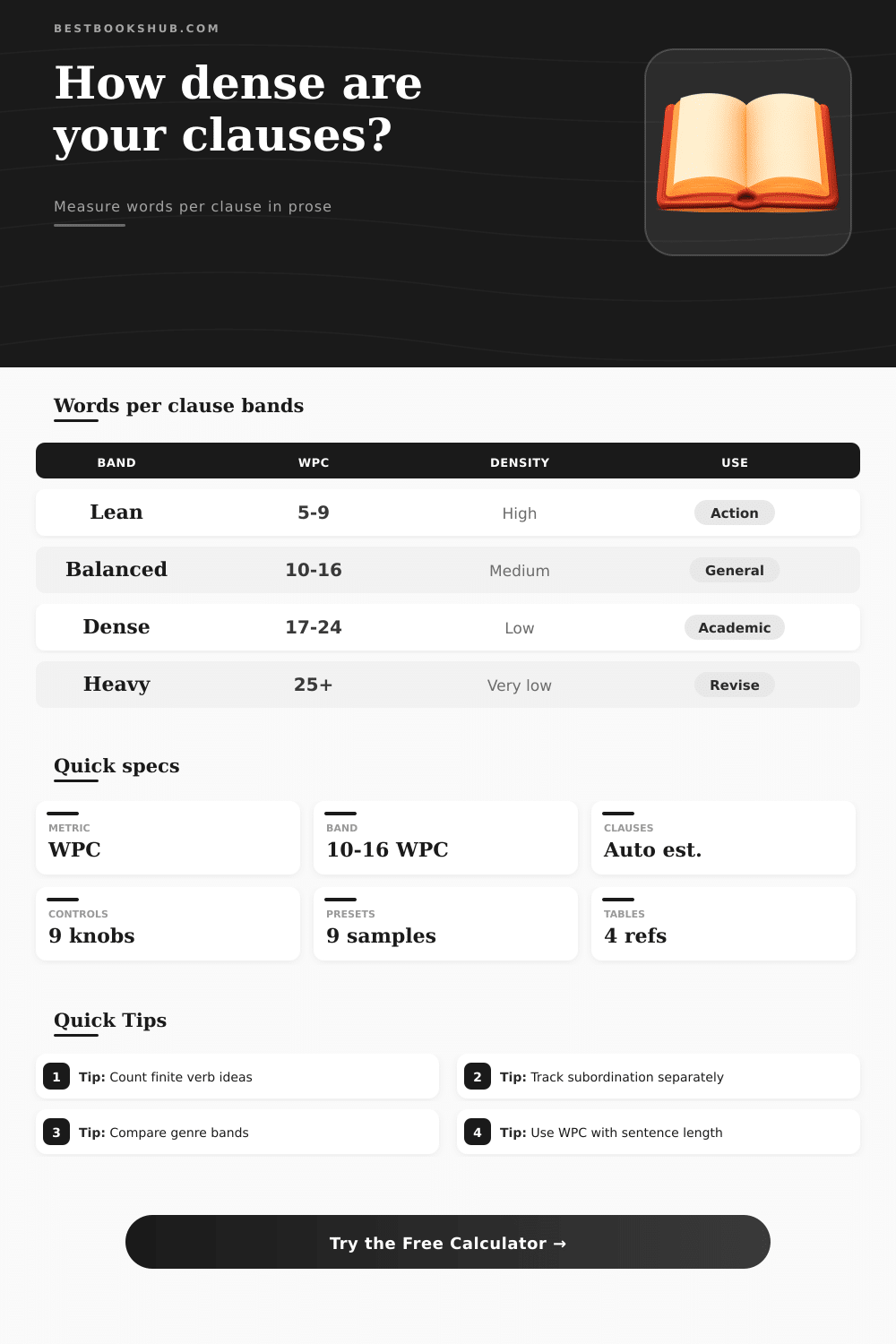
| Band | Words per clause | Clause density | Common reading effect |
|---|---|---|---|
| Lean and quick | 5-9 WPC | High clause turnover | Action, dialogue, notes, early drafts with many short finite ideas. |
| Balanced | 10-16 WPC | Moderate density | Clear paragraphs, general nonfiction, most classroom explanations. |
| Dense and developed | 17-24 WPC | Lower clause turnover | Academic discussion, literary commentary, policy summaries. |
| Heavy or packed | 25+ WPC | Very low turnover | Long noun phrases, compressed argument, or clauses that may need splitting. |
| Cue type | Examples | How the calculator treats it | Manual caution |
|---|---|---|---|
| Adverbial subordinator | because, although, when, if | Adds an embedded clause when the selected cue mode includes adverbials. | A phrase such as "because of" is not a finite clause. |
| Relative marker | who, which, that, where | Adds a relative clause under finite or relative cue modes. | Some uses of "that" are determiners, not clause openers. |
| Nominal clause marker | what, whether, why, how | Adds a content clause under finite or all cue modes. | Question words can also appear in fragments or titles. |
| Coordination | and, but, so, yet | Splits only when your coordination setting asks for repeated or all links. | Shared subjects usually form one clause chain in conservative counting. |
| Writing sample | Typical WPC range | Useful setting | What to inspect |
|---|---|---|---|
| Dialogue-heavy fiction | 5-12 WPC | Fiction and dialogue | Quoted speech, fragments, and quick exchanges. |
| Middle grade exposition | 8-14 WPC | General prose | Long embedded clauses that may slow a young reader. |
| Literary analysis paragraph | 14-22 WPC | Academic analysis | Relative clauses and that-clauses inside interpretive claims. |
| Legal or policy passage | 18-30+ WPC | Legal or policy drafting | Stacked conditions, exceptions, and semicolon-linked clauses. |
| Control | Conservative behavior | Balanced behavior | Generous behavior |
|---|---|---|---|
| Boundary sensitivity | Leans on sentence starts and strong finite signals. | Blends finite verbs, cues, and semicolons. | Accepts more embedded markers as separate clauses. |
| Coordination | Keeps shared-subject predicate chains together. | Splits repeated-subject coordination. | Splits most and/but/so/yet links as clause turns. |
| Fragments | Ignores verbless units. | Counts only when elliptical mode is chosen. | Counts long fragments using the minimum-word threshold. |
| Punctuation fallback | Uses only semicolons and colons. | Can test comma-splice evidence. | Can raise counts in highly punctuated prose. |
DISCLOSURE: This post may contain affiliate links, meaning when you click the links and make a purchase, I receive a commission. As an Amazon Associate I earn from qualifying purchases.
For example, if you want an idea about clause density and differences between drafting styles, try using this words per clause calculator. See how many clauses is packed into a passage? How much do you think is coordinated? How many are nested? It’s likely that you can’t say, but you know the difference. Sentences seem long they’re heavy. Ideas pile up within one another. Some flow quickly using short sentence.
How many finite clause does a passage contain? That figure decide clarity and also decides its rhythm. Clarity and rhythm are factor in how fatigued we’ll be by the end. Once writers is on the lookout for it, they find that patterns emerges. Typically, the dialogue is terse: People talk in quick bursts, with a lot of light conversation, but the emotion hits quickly. For example, a character said they waited because gate was stuck. That keeps the number of clauses down and the emotional impact immediate.
Why Clause Density Matters
In academic writing, it’s the reverse. For instance, a scholar might say that readers makes connections between previous scenes and new claim, which alters their memories. But the evidence vary. Now you have one sentence containing multiple concept, all qualifying the preceding ones. The writing becomes more authoritative, but it also becomes slower. That is why the measure matter because of the trade-off involved.
So what counts? How do we know what should of been counted? There’s a finite clause: it require a subject and a verb with tense. You can coordinate (join/separate) those verbs, depending on how you think about it. If there are shared subject, you have the feeling of one thought. When the subject repeat, the rhythm shifts. Other signals like “that” or “because” adds extra clauses and make the mix complicated.
At some point, you choose how strict you want to get and this is where the calculator steps in. On some days, you want a count that treats each coordinated predicate as one; on others, you just want to see layers so you can double-check whether the sentence is too dense for your audience. The figures are also hidden by genre expectations. Younger readers require white space between their ideas: middle-grade fiction won’t linger at more than fourteen words per clause very often. A legal document hovers around the low twenties or higher as each condition must be crystal clear. Most readers will skim or re-read if you push beyond twenty-five words. This isn’t a flaw in how people read; it is a sign that the sentence are doing too much.
Writers try to watch their clause load as they chase length but make common errors. They say another although, thinking that sounds smart, but it’s just adding drag. The sentence gets longer. There are fewer turns per hundred word. The reader may not be able to put her finger on it, but she feel the slowdown.
The other mistake is chopping things down to tiny independent clause. On screen it looks energetic, but after a while it begin to feel childish. For most nonfiction, balance is found in middle band. A clause of twelve to sixteen words typicaly provides enough room for detail while also delivering steady motion.
No number alone count; context is everything. Twenty words to a clause may be grand if the text is worthy of such reading. Is it in a piece of furnitures assembly directions? Expect your customers to bail out pretty quick. Experienced editors don’t have a set rule but a sense for what they’re encountering: they read a sentence or two and experience its density. Then they tweak according. This is where the tool becomes visible; you’ll see how it works as you compare versions without guessing.
In the end, however, it’s not so much that you get a perfect score as that you notice you’ve done something different than you thought you were going to with your sentence. And then you decide. Do you want to keep it clear? Or do you want to make it longer for richness? Do you want it shorter for pace? When you become conscious of this pattern, it improve everything else you write. Your page loses its mystery and starts to feel like an instrument you’re learning to play.