✍ Finish pace planner
Words per day to finish calculator
Estimate the daily word target, active-day quota, sessions, sprint load, and finish pressure for a draft, book, essay, thesis chapter, or reading assignment.
Start with either a total word goal, a remaining word count, or a chapter plan. The calculator keeps calendar days and active work days separate so rest days do not disappear from the math.
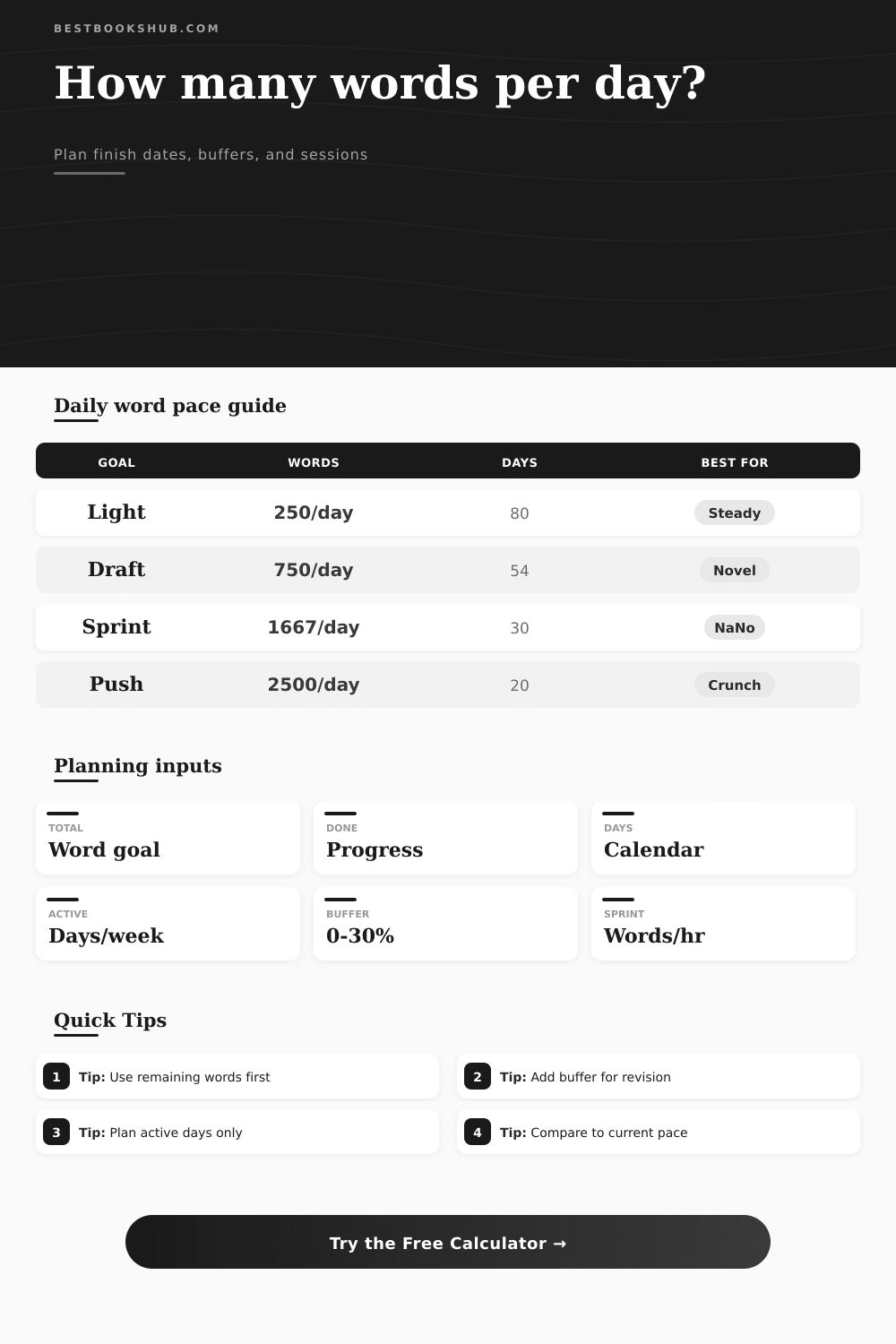
| Daily target | Weekly output | 30-day output | Best fit |
|---|---|---|---|
| 250 words/day | 1,750 words | 7,500 words | Gentle habit building, reading logs, short responses |
| 500 words/day | 3,500 words | 15,000 words | Essay drafting, book notes, steady nonfiction work |
| 750 words/day | 5,250 words | 22,500 words | Reliable manuscript progress without a heavy sprint load |
| 1,667 words/day | 11,669 words | 50,010 words | Classic 30-day novel challenge pace |
| 2,500 words/day | 17,500 words | 75,000 words | Deadline push, retreat week, or highly focused drafting |
| Project | Typical words | At 500/day | At 1,000/day |
|---|---|---|---|
| Short story draft | 5,000 words | 10 active days | 5 active days |
| Long essay or chapter | 8,000 words | 16 active days | 8 active days |
| Thesis chapter | 12,000 words | 24 active days | 12 active days |
| NaNoWriMo novel | 50,000 words | 100 active days | 50 active days |
| Full-length novel draft | 80,000 words | 160 active days | 80 active days |
| Work mode | Words/hour | 45-minute session | When to use |
|---|---|---|---|
| Line revision | 300 | 225 words | Dense prose, citations, careful editing |
| Study notes | 500 | 375 words | Reading summaries and academic response work |
| Drafting flow | 750 | 563 words | Most book, essay, and chapter drafting plans |
| Fast drafting | 1,000 | 750 words | Clean scenes, outlines, blog drafts, rough chapters |
| Sprint drafting | 1,500 | 1,125 words | Timed sprints when polish can wait |
DISCLOSURE: This post may contain affiliate links, meaning when you click the links and make a purchase, I receive a commission. As an Amazon Associate I earn from qualifying purchases.
A calendar average is useful, but the active-day target is the number that has to fit real writing or note-taking sessions.
Research, citations, revision, and hard chapters often need extra time even when the remaining word count looks small.
The project looms before you: big, and it’s due soon. Maybe it’s a report for your boss, due on Friday. Perhaps it’s a thesis chapter or even a whole novel. The word count isn’t unknown to you either. But how many words per day? That’s where things get tricky.
If you divides the word count over number of calendar days, it doesn’t cut it; real life gets in the way. There is sick days, there are rest days. Sometimes it’s one of those days where you can’t focus. Plans beat hope. This is where it gets interesting: The calculator does all the math for you. It accounts for factors that trip up many writers when trying to go on a sprint. Once you know what’s going in, it alters the way you do the work.
How to Calculate Your Daily Word Count
Most writers see calendar days and think “I’ll get it done; I’m just gonna write each day.” Burnout results. Don’t mix up actual working time with available time. If you have 30 days and only work six of them, the workload per day go up. You can enter number of active work days into the tool. This forces you to face your real schedule different than an ideal one.
Words aren’t created equally. Writing the first draft feels different from revising where you need to check lots of citation. That’s why there’s a difficulty adjustment slider. If writing is easy, then maybe you can writes two thousand words an hour. But if it’s a technical chapter, your rate slow. Having a buffer percentage isn’t being pessimistic, but realistic.
Life gets in the way. The internet might fail. You might fixate on a problem and spend several hours staring at wall. A ten or fifteen percent buffer catches those shock without breaking the timeline. That’s your daily word count, and it gets broken down into however many sittings you want to have per day.
That helps the mind. For example, sitting at a desk for four hours straight often yields diminishing returns after the first ninety minutes. Two hard sittings with a breather in between can still get job done while keeping you fresh and focused. This is how different speeds feel in reality: A pace of two hundred fifty words per day feels gentle, letting you build up a habit but not feeling pressured. Over one thousand words per day (a “sprint” pace) will demand serious concentration. It’s not something that’ll last very long before needing a rest period.
The other crucial number is how much you’re writing now. Can you go from 400 words daily now to 800? Maybe not. The app calculates what pace you should of reach compared with what youve been achieving. It shows where the mismatch is, right away, and gives you an opportunity to make adjustments: perhaps you’ll need to add a few more active days each week? Perhaps push back the finish line a bit (if you can)? Or maybe realize that some of the days must be easier.
Writing is as much a physical exercise as a creative one. Tackling it like a marathon instead of a sprint will help you conserve your energy for final stretch. Establishing clear constraints and anticipating setbacks turns anxiety into a manageable timetable. The blinking cursor is no longer your enemy. Instead, it’s more like a metronome, ticking down the steady progress towards the finish line. Actualy, it helps.